Photo by Igor Omilaev on Unsplash
The short version
- The three funds share a marketing category but not a portfolio: AIQ's 5-year CAGR of 17.2% comes mostly from mega-cap semiconductors and hyperscalers, not from "AI exposure" in any pure thematic sense.
- BOTZ and ROBO are closer to genuine industrial-automation baskets, but both have lagged broad equity benchmarks over five years and carry meaningful drawdown risk (BOTZ −55.5%, ROBO −43.7%).
- For a long-horizon investor, the honest question isn't which AI ETF wins — it's whether any of them adds something a broad tech allocation doesn't already provide.
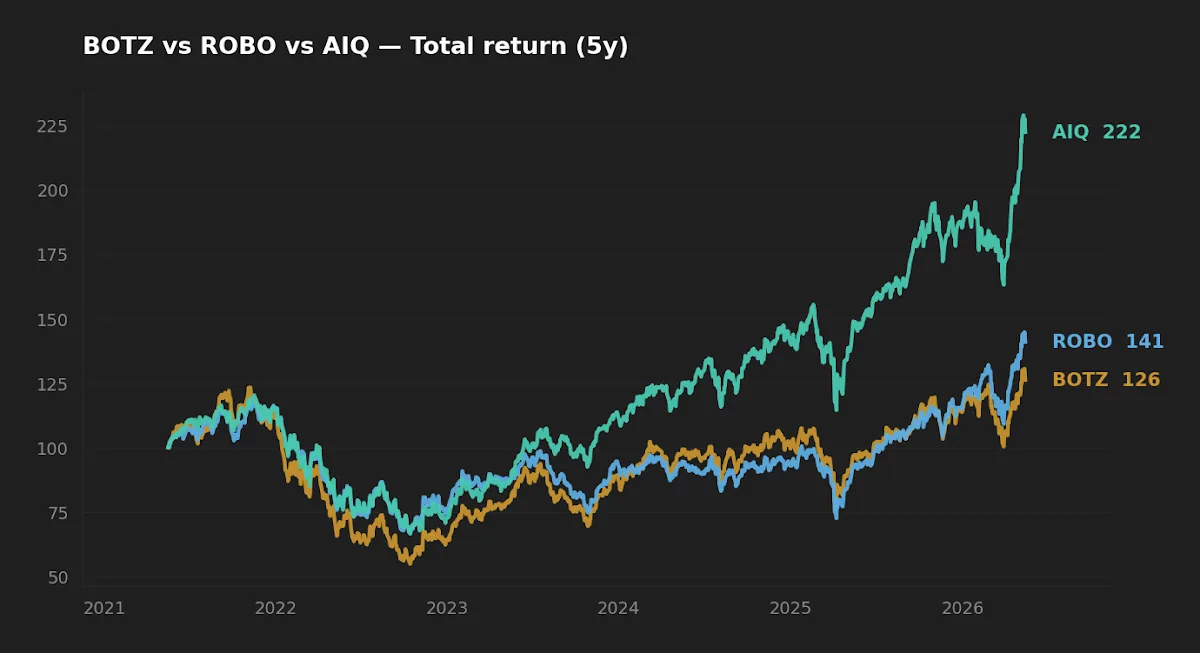
Three ETFs sit under the "AI and robotics" banner that most retail screeners use: BOTZ, ROBO, and AIQ. Over the past five years they have returned 4.3%, 6.7%, and 17.2% annualized respectively. That spread is larger than the gap between most broad U.S. equity indices and concentrated single-factor strategies. If the funds were really exposed to the same theme, that gap would be inexplicable. They aren't.
This piece works through what each one actually holds, how it has behaved across the most recent regime, and whether a long-horizon investor should hold any of them as a thematic satellite — or skip the category and own broad tech instead. The macro backdrop matters here: with the 10-year Treasury at 4.5% and the fed funds rate at 3.6% (FRED, asof 2026-05-14 and 2026-04-01), the discount rate on long-duration "growth-from-here" stories is meaningfully higher than it was during the 2020–2021 thematic bubble.
What each fund is built to be
BOTZ — Global X Robotics & Artificial Intelligence ETF. Launched September 2016. Tracks an index of companies whose primary business is industrial robotics, automation hardware, autonomous systems, and unmanned vehicles. Historically concentrated in Japanese factory-automation names (Fanuc, Keyence, SMC) and U.S. surgical robotics. The thematic interpretation here is narrow and hardware-leaning.
ROBO — Robo Global Robotics and Automation Index ETF. Launched October 2013, the longest live track record of the three. The underlying index, maintained by Robo Global, deliberately diversifies across the robotics value chain — sensors, actuators, software, healthcare automation, logistics — and applies an equal-weight tilt at the security level. The result is a broader, less mega-cap-driven exposure than the other two.
AIQ — Global X Artificial Intelligence & Technology ETF. Launched May 2018. Holds companies developing or deploying AI technologies. In practice the top holdings have been NVIDIA, Microsoft, Meta, Alphabet, Amazon, and similar hyperscalers and semiconductor names. The fund's framing is "AI" but its factor exposure is, at most points in time, almost indistinguishable from a large-cap technology basket.
The data
| Metric | BOTZ | ROBO | AIQ |
|---|---|---|---|
| Expense ratio | 0.68% | 0.95% | 0.68% |
| AUM | $3.4B | $1.8B | $8.6B |
| Inception | Sept 2016 | Oct 2013 | May 2018 |
| Distribution yield | 0.6% | 0.4% | 0.2% |
| 5Y CAGR | 4.3% | 6.7% | 17.2% |
| 10Y CAGR | n/a (post-inception) | 13.5% | n/a (post-inception) |
| 5Y annualized volatility | 26.8% | 23.6% | 25.2% |
| 5Y max drawdown | −55.5% | −43.7% | −44.7% |
Source: yfinance pulls dated 2026-05-16; expense ratios and AUM cross-checked against issuer fact sheets — Global X BOTZ, ROBO Global ROBO, Global X AIQ.
Cost: a 27 bp gap that matters more than it looks
BOTZ and AIQ both charge 0.68%. ROBO charges 0.95% — a 27 basis-point premium. On a $50,000 allocation held 20 years at a 6% gross return, that gap compounds into roughly $5,400 of foregone wealth, or about 11% of the starting capital. It is not the largest fee gap in ETF-land, but it is real, and the case for paying it has to come from somewhere — ROBO's equal-weight construction is the only thing that could justify it, and only if equal-weight is the diversification you actually want.
The honest comparison here isn't between these three funds. It's against a broad tech index like XLK or QQQM, where expense ratios are 0.08% to 0.15%. Anyone holding one of these thematic funds as a long-term core position is paying 5× to 12× the fee of an index alternative that — in AIQ's case especially — owns most of the same names.
What you're actually buying: theme purity vs. closet tech
This is where the three funds diverge most. AIQ's top holdings list and sector weights closely resemble a large-cap tech basket with a slight tilt toward semis. Its 5-year return of 17.2% mirrors what a Nasdaq-100-like exposure delivered over the same window. ROBO and BOTZ, by contrast, have meaningful exposure to mid-cap industrial automation, Japanese equities, and healthcare robotics — categories that did not participate in the AI rally of 2023–2025 to anywhere near the same degree.
AIQ's 5-year outperformance comes not from superior AI exposure but from being a thinly disguised mega-cap tech fund with a thematic label — and the investor who buys it for "AI exposure" is often buying duplicates of what they already own.
That isn't a criticism of AIQ as a product — it does what its prospectus says — but it is a warning to a portfolio constructor. If you already hold VOO, QQQM, or any large-cap technology fund, AIQ is largely a magnification of existing exposure, not a new theme. ROBO and BOTZ are more genuinely differentiated, but the price of that differentiation has been five years of underperformance against the broader tech complex. A reader weighing this against a broader factor approach may also find the COWZ vs. FCTR comparison useful as a contrast between thematic and quantitative tilts.
Realized risk: the drawdown profile is the part that should sober you
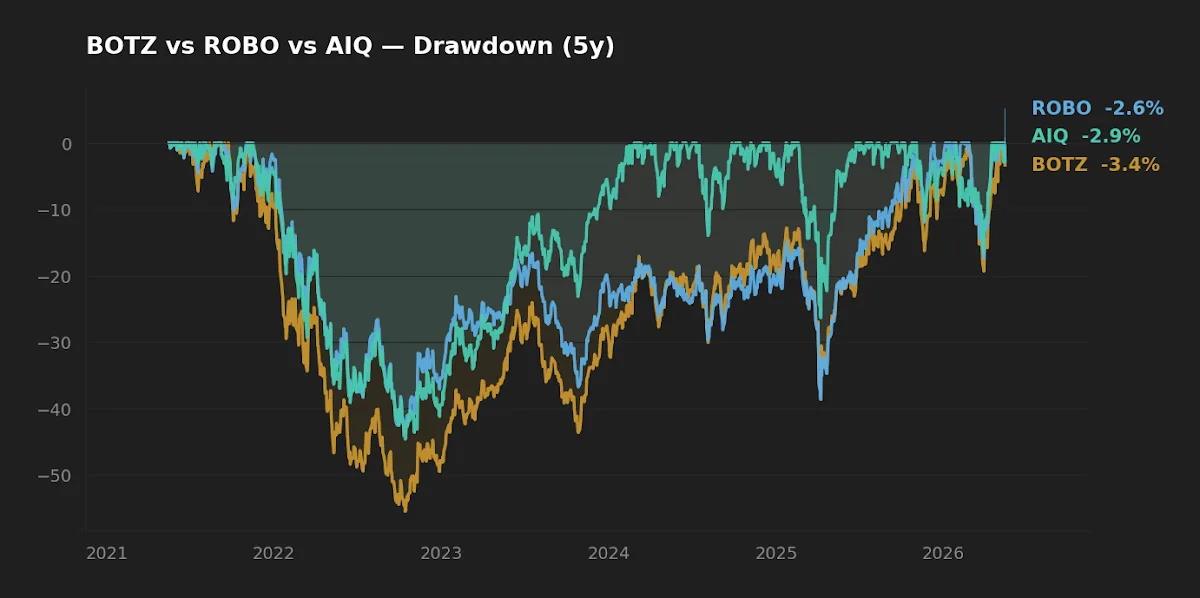
All three funds drew down sharply during the 2022 rate-driven correction. BOTZ fell 55.5% peak-to-trough — deeper than either the S&P 500 or the Nasdaq-100 in the same window. ROBO fell 43.7%; AIQ fell 44.7%. Annualized volatility ran between 23.6% and 26.8% for the three, well above the broad-market range of roughly 16–18%.
BOTZ's deeper drawdown is the part most investors underestimate. The fund's narrower industrial-automation concentration — and its meaningful Japanese factory-automation exposure — meant it absorbed both the global rate shock and a separate yen-driven repricing of Japanese equities. The fund recovered, but the recovery duration matters: drawdown duration, not just depth, is what tests an investor's ability to hold through stress. Initially I expected ROBO to show the worst drawdown given its small-and-mid-cap tilt; in fact its broader value-chain diversification absorbed the shock better than BOTZ's tighter robotics concentration. The data sometimes pushes back on the priors.
The capacity and scale question
AIQ at $8.6 billion in AUM is meaningfully larger than BOTZ at $3.4 billion or ROBO at $1.8 billion. For a buy-and-hold investor, the practical effect is mostly bid-ask spread: AIQ trades tightly, BOTZ adequately, ROBO occasionally with wider spreads during volatile sessions. None of the three is at imminent risk of closure, but ROBO's smaller AUM combined with its higher fee creates structural pressure that is worth monitoring — the worst outcome for a long-term holder of a niche thematic ETF isn't underperformance, it's forced liquidation and the tax event that follows. For a deeper take on the cost-effectiveness side of robotics ETFs specifically, the BOTZ vs IRBO comparison covers an alternative low-cost robotics option.
What the AI infrastructure picture adds
One reason AIQ's exposure is hard to disentangle from a broad tech bet is that the picks-and-shovels layer of AI — semis, data-center REITs, utilities, hyperscaler capex — has driven the bulk of recent thematic returns. Investors who want AI exposure without the closet-tech problem sometimes look further upstream; see Top ETFs for AI Infrastructure in 2026 for that angle. Investors more interested in AI-as-portfolio-manager rather than AI-as-holdings can compare against actively AI-managed funds in Best AI-Managed ETFs for 2026.
At-a-glance scoreboard
| Category | Winner | Margin |
|---|---|---|
| Cost | BOTZ / AIQ (tie) | 27 bp vs ROBO |
| Realized risk (5Y) | ROBO | Modest — shallower drawdown, lower vol |
| Realized return (5Y) | AIQ | Large — but largely a tech-beta story |
| Realized return (10Y) | ROBO | Only fund with a 10Y record |
| Theme purity | BOTZ / ROBO | AIQ is closer to large-cap tech |
| Trading liquidity | AIQ | Tightest spreads, largest AUM |
FAQ
Is AIQ actually an AI fund, or is it just large-cap tech with a label?
Functionally, AIQ has behaved like a large-cap tech basket with a tilt toward names with explicit AI revenue streams. Its top holdings overlap heavily with XLK and QQQM. That makes it a reasonable expression of "I want concentrated exposure to companies benefiting from the AI capex cycle" but a poor expression of "I want diversifying exposure I don't already own."
ROBO has the longest track record. Does that matter?
Yes, but read carefully. ROBO's 10-year CAGR of 13.5% beats its 5-year CAGR of 6.7% — meaning most of the compounding happened pre-2020, when robotics was a smaller, less crowded theme. The recent five years tell a different story. A long live track record is more honest than a backtest, but it is not a forward forecast.
Why is BOTZ's drawdown so much deeper than the other two?
Two compounding factors: narrower thematic concentration in industrial automation, and significant exposure to Japanese equities, which had their own rate and currency repricing on top of the global tech correction. Concentration without offsetting diversifiers cuts both ways — it helps in thematic up-cycles and hurts disproportionately in regime shifts.
Are any of these suitable as core long-term holdings?
Mulden's editorial frame is that thematic ETFs are satellite positions, not core ones. The fee, concentration, and regime-dependence all argue against using a 0.7–1.0% expense-ratio thematic fund as the foundation of a multi-decade portfolio. As a small (5–10%) satellite tilt for an investor who already holds broad market exposure, any of the three can be defended on different grounds.
Which is most tax-friendly for a taxable U.S. account?
All three are passively managed index ETFs with similar low distribution yields (0.2–0.6%), and U.S. ETFs benefit from the in-kind redemption mechanism that minimizes capital-gains distributions. None of the three is meaningfully tax-disadvantaged versus the others, but all three are less tax-efficient than a broad index fund simply because their narrower turnover bases generate more rebalancing trades. A 401(k) or IRA neutralizes most of this consideration.
What this comparison can and can't tell you
Five years is one regime. The window 2021–2026 covered the post-COVID recovery, the 2022 rate shock, and the 2023–2025 AI rally — but no major credit-driven recession, no extended deflationary stretch, and no period of sustained tech sector underperformance like 2000–2002. Thematic ETFs are particularly regime-sensitive, and the 5-year CAGR figures should be read as one observation, not a verdict. ROBO's 10-year CAGR captures more regimes but is still subject to survivorship selection in the underlying index. The performance gap between AIQ and the others is partly a story about AI and largely a story about mega-cap tech leadership in this specific window — a fact that may or may not persist.
Scenarios where each fund could fit
- Reader who already owns broad U.S. tech (XLK, QQQM) and wants higher concentration in the AI capex story: AIQ adds magnification, not diversification. Honest framing helps — a 5% overlay on top of an existing 25% tech allocation is a meaningful tilt; a 25% AIQ allocation on top of QQQM is mostly the same fund twice.
- Reader who wants genuine robotics/automation exposure as a small satellite: ROBO's broader value-chain construction and longer track record argue for it, despite the higher fee. Allocation sizing matters — 3–7% of total portfolio, not 20%.
- Reader specifically interested in Japanese industrial automation: BOTZ provides that exposure in a way ROBO and AIQ do not, but the drawdown profile means it should be sized conservatively.
- Reader building a long-term core portfolio: none of the three is the right answer. Broad U.S. equity exposure at 0.03–0.08% expense ratios is the better foundation; thematic funds sit at the edges, not the center. The beginner's guide to long-term ETF investing works through the case for that ordering.
Editor's read
If forced to hold one of these three as a thematic satellite, the editor leans toward ROBO — its construction is the most honestly thematic, its 10-year track record gives the longest regime sample, and its equal-weight tilt provides genuine diversification away from the mega-cap tech that already dominates most portfolios. AIQ is well-built and cheap for what it is, but as "AI exposure" it largely duplicates what a broad tech fund already provides. BOTZ is the narrowest expression and should be sized accordingly. The broader point, though, is that for a long-horizon buy-and-hold investor, no thematic fund is a substitute for low-cost broad exposure — these are tilts, not foundations.
The editor does not hold BOTZ, ROBO, or AIQ at the time of writing.
Key takeaways
- The three funds share a label but not a portfolio — their 5-year return spread of nearly 13 percentage points reflects very different underlying factor exposures.
- AIQ's outperformance is largely a mega-cap tech story; ROBO and BOTZ are more genuinely thematic but have lagged.
- All three drew down 44–56% in 2022. Thematic concentration cuts both ways.
- For long-horizon investors, any of these works only as a small satellite (3–7%) on top of broad market exposure — not as core.
- If the goal is genuine theme diversification, ROBO is the most honest expression despite the 0.95% fee.
Methodology. Price, return, volatility, and drawdown data pulled from yfinance on 2026-05-16 covering the trailing 5-year window (2021-05 through 2026-05) and, where available, the 10-year window. Expense ratios, AUM, and inception dates cross-checked against issuer fact sheets linked above. Macro context (10-year Treasury yield, fed funds rate, VIX, CPI) from FRED, asof dates noted inline. Returns are total return assuming reinvested distributions. Drawdown is measured on daily closing prices.
This article is for educational purposes and does not constitute personalized financial advice. See Disclaimer.