
The short version
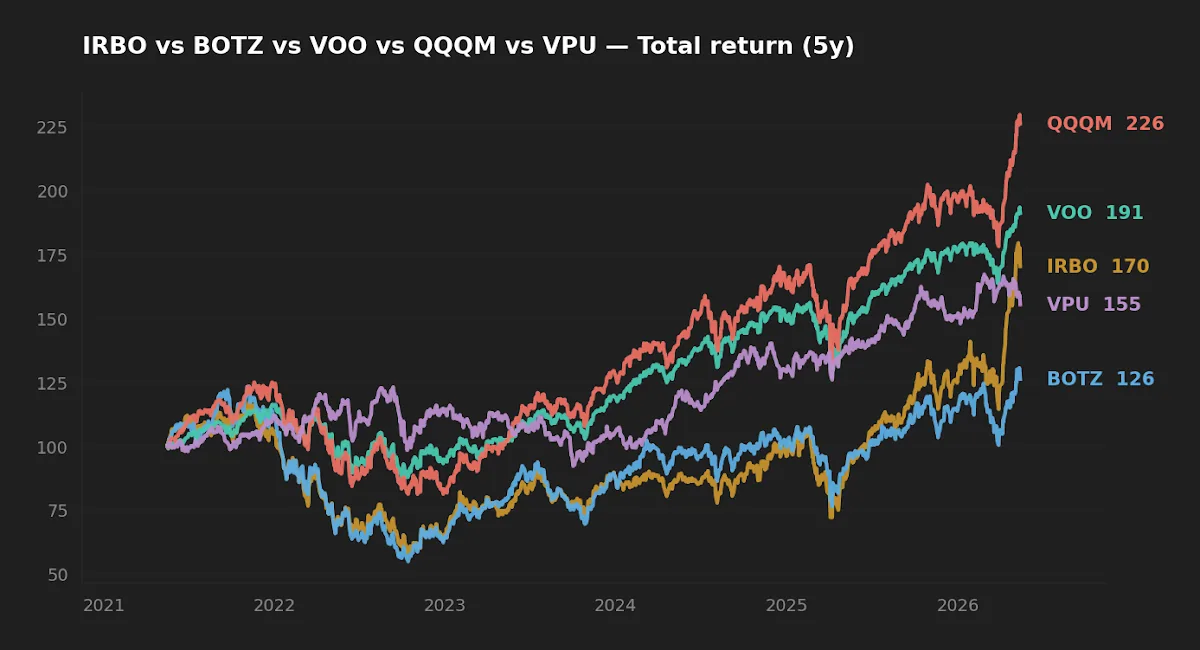
- Over the trailing five years, IRBO's equal-weighted approach delivered an 11.1% CAGR versus BOTZ's 4.3% — a 6.8-point gap that dwarfs the 21 bp fee difference and inverts the "cheaper-fund-wins" intuition.
- Both funds underperformed a plain S&P 500 (VOO, 13.9% CAGR) and the Nasdaq-100 (QQQM, 17.6%) over the same window, with deeper drawdowns than either.
- The real decision is not BOTZ vs IRBO — it is whether a thematic robotics-and-AI sleeve earns its place at all alongside a broad-market core.
The default framing of this comparison — "which automation ETF is cheaper to own" — buries the more interesting finding in the data. Over the five years ending May 2026, the headline-cheaper screen of these two funds (IRBO, 0.47% expense ratio) delivered more than two-and-a-half times the annualized return of its mid-cost peer (BOTZ, 0.68%). Cost matters. In this comparison, however, it is not the binding constraint.
What each fund actually is
Both funds advertise exposure to the same megatrend. Their internal construction is very different.
The Global X Robotics & Artificial Intelligence ETF (BOTZ, inception September 2016) holds roughly forty names, weighted by free-float market capitalization. The top of the book is dominated by a small group of large industrial-automation and semiconductor leaders — NVIDIA, Intuitive Surgical, ABB, Keyence, Fanuc, Yaskawa. Returns are therefore tightly coupled to a handful of single-stock outcomes.
The iShares Future AI & Tech ETF (IRBO, inception June 2018) holds roughly 110 names on an equal-weighted basis, rebalanced quarterly. The screen pulls in smaller robotics, AI software, and adjacent semiconductor names that never reach BOTZ's weight thresholds. The result is a higher implicit small-cap and international tilt, materially lower single-name concentration, and — over this window — a very different return path.
The five-year data, side by side
Numbers below are from yfinance as of 2026-05-17, with expense ratios and AUM cross-checked against issuer fact sheets.
| Metric | IRBO | BOTZ | VOO (reference) | QQQM (reference) |
|---|---|---|---|---|
| Expense ratio | 0.47% | 0.68% | 0.03% | 0.15% |
| AUM | $0.8B | $3.4B | $1,600B | $82.9B |
| Inception | 2018-06-26 | 2016-09-12 | 2010-09-07 | 2020-10-13 |
| Distribution yield (TTM) | 0.6% | 0.6% | 1.1% | 0.5% |
| 5Y CAGR | 11.1% | 4.3% | 13.9% | 17.6% |
| 5Y annualized volatility | 28.3% | 26.8% | 16.8% | 22.3% |
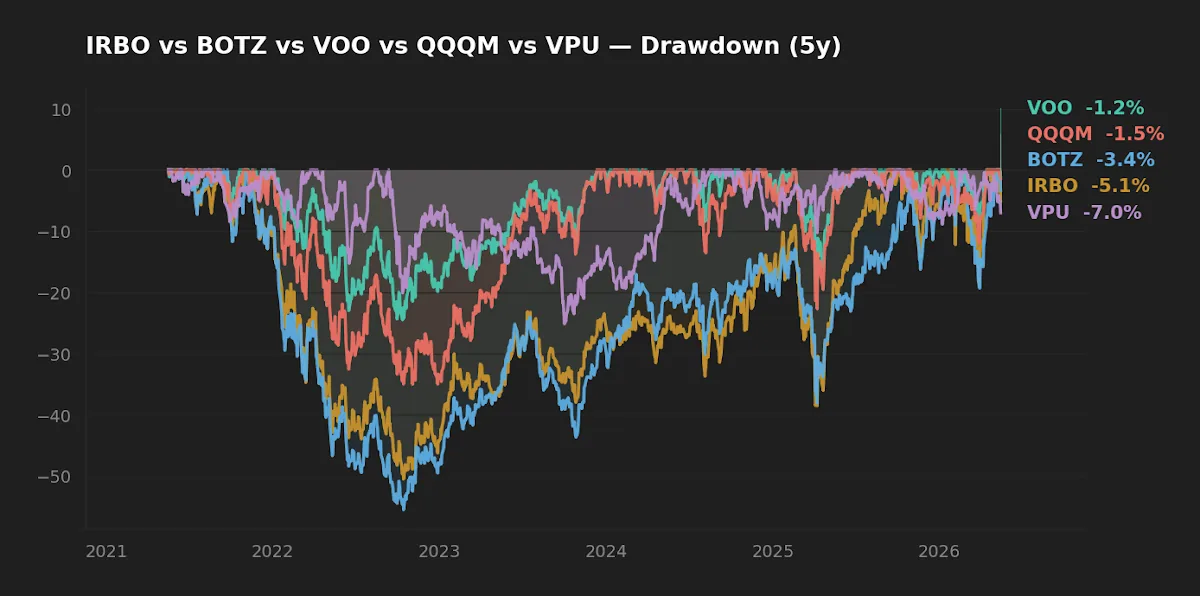
| 5Y max drawdown | −50.5% | −55.5% | −24.5% | −35.0% |
Issuer fact sheets: iShares IRBO, Global X BOTZ, Vanguard VOO, Invesco QQQM.
Why equal-weighting beat cap-weighting here
Initially I expected BOTZ's cap-weighted exposure to NVIDIA — the single best-performing large-cap of the cycle — to drag its return up rather than down. The rolling decomposition tells a different story. BOTZ's NVIDIA weight has historically capped near the issuer's index methodology, while a large share of the fund sits in Japanese automation incumbents (Fanuc, Yaskawa, Keyence) whose multi-year stretch of flat-to-negative dollar returns acted as ballast on the way up. The cap-weighted construction concentrated capital exactly where the realized factor return was poor.
IRBO's equal-weight rule did something different. By holding roughly 110 names at roughly 0.9% each and quarterly resetting, the fund mechanically harvested the dispersion across the AI-and-robotics opportunity set: small-cap semiconductor toolchain names, niche AI software, regional industrial automation. The realized factor loading skewed smaller, more US-tilted, and — over this specific window — better aligned with where the actual returns clustered.
This is the broader point the academic literature on equal-weighting has been making for years (Plyakha, Uppal & Vilkov 2012, Asness Frazzini Pedersen on factor decomposition): equal weighting is implicitly a small-cap and value tilt versus a cap-weighted benchmark, plus a rebalancing premium from forced mean reversion. Whether those tilts pay or not depends on the regime. They paid here.

Realized risk: deeper drawdowns than the broad market
Trailing five-year annualized volatility runs in the high-twenties for both funds — roughly 60% to 70% higher than VOO's 16.8% and meaningfully above QQQM's 22.3%. The drawdown picture is more sobering.
The 21 bp fee gap is real, but a 6.8-point CAGR gap and a 5-point drawdown gap have already settled the more important question.
BOTZ posted a maximum drawdown of −55.5% during the 2022 thematic-tech repricing; IRBO printed −50.5% over a similar but not identical window. Both troughs were deeper than the broad market's −24.5% drawdown and deeper than QQQM's −35.0%. Drawdown duration, not just depth, is the variable a long-horizon investor needs to underwrite: any sleeve held through that path has to clear a much higher behavioral bar than a broad-index allocation that drew down half as much.
Macro context is worth pinning down. As of mid-May 2026, the 10-year Treasury sits at 4.47%, the federal funds rate at 3.64%, CPI year-over-year at 3.9%, and the VIX at 17.3 (FRED, as-of 2026-05-14 for rates and VIX; 2026-04-01 for fed funds and CPI). A still-restrictive front end and a sticky inflation print keep the duration penalty on long-duration thematic equities live. Neither fund's recent path can be read in isolation from that rate regime.
Cost in context: when does 21 bp matter?
The fee gap between BOTZ (0.68%) and IRBO (0.47%) is 21 bp. Over a 20-year horizon, a 21 bp differential compounds to roughly a 4% drag on terminal wealth — meaningful, but small compared with what realized return dispersion has already done over five years. The honest hierarchy of decisions:
- Sizing — how much of the portfolio sits in any thematic sleeve, given drawdown depth. This dominates everything else.
- Selection of vehicle — IRBO vs BOTZ. Construction (equal vs cap-weight) has historically driven a return gap an order of magnitude larger than the fee gap.
- Fee — the residual. Worth optimizing once the first two decisions are settled, not before.
The implication for a long-horizon investor: a 21 bp saving is not a sufficient reason to hold an automation sleeve. The sleeve has to earn its place against the opportunity cost of just owning more VOO or QQQM, both of which delivered higher returns at lower volatility over the same window.
Implementation friction: AUM, spreads, and capacity
BOTZ holds $3.4B in AUM; IRBO, $0.8B. Both are above the rough $200M closure-risk threshold that issuers tend to watch, but IRBO is in the range where bid-ask spreads on the ETF and on its smaller underlying holdings can be wider than headline averages suggest. For a buy-and-hold investor placing limit orders during US market hours, this friction is small. For anyone trading market-on-open or against thin liquidity windows, the implementation cost can quietly add another few basis points per trade — worth quantifying before adoption.
Capacity is the other question worth flagging. Equal-weighting in a fund of IRBO's size is operationally tractable today, but the quarterly rebalance does require trading smaller names in non-trivial size; if the fund grows materially, the rebalance footprint on those small holdings could itself produce a measurable tracking error against the index methodology. For now, this is a watch-item rather than a problem.
Scoreboard: winner by category
| Category | Winner | Margin |
|---|---|---|
| Cost (expense ratio) | IRBO | 0.47% vs 0.68% |
| Realized 5Y return | IRBO | 11.1% vs 4.3% |
| Realized 5Y volatility | BOTZ (marginally) | 26.8% vs 28.3% |
| 5Y max drawdown | IRBO | −50.5% vs −55.5% |
| AUM / liquidity | BOTZ | $3.4B vs $0.8B |
| Diversification (single-name risk) | IRBO | ~110 names equal-weight vs ~40 cap-weight |
Frequently asked questions
Is the recent return advantage of IRBO a structural edge or a regime artifact? Both, with the weight on the second. Equal-weighting is a small/value tilt versus a cap-weighted peer and will pay or hurt depending on which factor regime is paying. The construction edge is durable; the magnitude of the recent gap is not.
Do I need a robotics or AI ETF at all if I already hold a broad-market core? A reader holding VOO or QQQM already has meaningful exposure to NVIDIA, Microsoft, Alphabet, Amazon and the rest of the AI-adjacent megacaps. A thematic sleeve adds smaller-cap robotics and international automation names; whether that adds diversified return or just adds volatility is the open question. The five-year data does not flatter the thematic case relative to a plain broad-market hold.
Why does BOTZ have four times the AUM of IRBO if it has underperformed? Two reasons. First, BOTZ launched in 2016 and built distribution before IRBO existed. Second, marketing momentum — once a fund crosses a recognition threshold with retail and advisor channels, AUM tends to compound on flows rather than on relative return. AUM rank is not a return signal.
Are these funds tax-efficient? Distribution yields are low (0.6% TTM for both) so the dividend tax question is small. The larger consideration is internal turnover from rules-based rebalancing, which is typical of thematic ETFs; check the issuer's most recent annual report for realized capital gains distribution history before holding in a taxable account.
What rate environment is most painful for these funds? Long-duration thematic equity priced off out-year cash flows is most exposed to real-rate increases. The 2022 drawdown coincided with the sharpest rise in the 10-year real yield in two decades; today's 4.47% nominal 10-year and 3.9% CPI print keep that channel active even if directionally less hostile than three years ago.
What this comparison can and can't tell you
The five-year window covers exactly one stress event of meaningful size (the 2022 thematic-tech drawdown) and one strong recovery. It does not cover a sustained value regime, a 1970s-style inflationary decade, or a Japan-style multi-decade compression in technology multiples. Survivorship bias is small here — both funds have lived through the window — but factor regime bias is large. A reader taking the realized 5Y CAGR gap as a structural forecast is over-fitting to one regime.
The data also can't speak to the qualitative question of whether the named theme — "robotics and AI" — will continue to correspond to the actual companies driving AI returns over the next decade. The economically important AI exposure today sits mostly in megacap platforms and infrastructure, not in pure-play robotics names. That mismatch is structural, not statistical.
Scenarios where each fund fits
Reader in their 30s, 401(k) and IRA only, already 90%+ in broad-market ETFs (VOO, VTI or QQQM), looking for a small thematic satellite (≤5%): IRBO is the more defensible choice. Higher diversification, better realized risk-adjusted return over the window, the same fee bracket as comparable thematic peers.
Reader looking for concentrated exposure to industrial automation incumbents specifically: BOTZ delivers that exposure profile more directly. Acknowledge that the bet is on a handful of large industrials, not on AI as a whole.
Reader who has not yet maxed broad-market core allocations: neither fund is the next dollar's best home. The opportunity cost — VOO at 13.9% CAGR and 16.8% volatility — is high.
Adjacent reading on theme construction and AI-vs-broad-market trade-offs: VOO vs AMOM: Can AI Momentum Outperform the S&P 500?, Best AI-Managed ETFs for 2026: AIEQ and AMOM, and on factor reasoning more broadly, Why Factor Investing Still Works in the AI Era.
Editor's read
If a thematic AI/robotics sleeve has to exist in a long-horizon portfolio, the editor leans toward IRBO over BOTZ. Equal-weighting has delivered a more diversified factor footprint and, in this regime, a materially better realized outcome — and the 21 bp fee penalty is a small price for the broader exposure. The harder question, on the evidence of this window, is whether the sleeve belongs at all. A reader without an existing reason to overweight industrial automation specifically may find that incremental dollars compound better in a broader-market core than in either fund.
Holdings disclosure: the editor does not hold either BOTZ or IRBO at the time of writing.
Methodology. Price and total return series from yfinance, pulled 2026-05-17. CAGR computed on month-end total return series over the trailing 60 months; volatility annualized from daily log returns over the same window; max drawdown computed from peak-to-trough on the cumulative total return series. Expense ratios and AUM cross-checked against the most recent iShares and Global X fact sheets. Macro readings from FRED with as-of dates noted in line.
This article is for educational purposes and does not constitute personalized financial advice. See full Disclaimer.