
Photo by Nejc Soklič on Unsplash
The short version
- BNDX (international bonds) and BND (US bonds) have delivered nearly identical 10-year CAGRs — 1.5% and 1.4% respectively — which is not a coincidence, because BNDX is currency-hedged back to the US dollar.
- The diversification case for BNDX rests on lower realized volatility (4.9% vs 6.0% over five years) and a shallower drawdown, not on higher return.
- Bottom line: BND fits investors who want the cheapest, largest single US bond holding; BNDX earns its place only as a second sleeve for someone deliberately diversifying rate regimes.
The question in the title is the one most three-fund investors quietly skip. US total-market equity, international equity, and a US bond fund — that is the canonical portfolio. International bonds almost never make the list. So does adding BNDX to a portfolio that already holds BND do anything measurable, or is it a line item that looks like diversification without behaving like it? This matters because the answer determines whether you are buying a distinct risk exposure or paying an extra basis point for a near-duplicate.
Context: what these two funds actually hold
BND, the Vanguard Total Bond Market Index Fund, tracks the broad US investment-grade universe — Treasuries, agency mortgage-backed securities, and investment-grade corporates. It is one of the two largest bond funds in existence, with roughly $397.9B in assets (Vanguard fact sheet, 2026-07-16). BNDX, the Vanguard Total International Bond Index Fund, holds investment-grade bonds issued outside the US — predominantly developed-market government debt from Europe and Japan — and, critically, hedges the currency exposure back to the US dollar. That single design choice is the whole story, and we will return to it.
A reader coming from a US-centric portfolio usually assumes "international bonds" means taking on foreign-currency risk. BNDX is built to do the opposite. The fund's return is the foreign bond yield plus the return of the currency hedge, not the raw foreign yield translated at a floating exchange rate. If that distinction is unfamiliar, it explains most of the confusion around this fund.
The data
| Metric | BNDX | BND |
|---|---|---|
| Name | Vanguard Total International Bond | Vanguard Total Bond Market |
| Expense ratio | 0.07% | 0.03% |
| AUM | $123.3B | $397.9B |
| Inception | 2013-05-31 | 2001-11-12 |
| SEC-style yield (TTM) | 4.5% | 4.0% |
| 5Y CAGR | 0.2% | −0.2% |
| 10Y CAGR | 1.5% | 1.4% |
| 5Y volatility (annualized) | 4.9% | 6.0% |
| 5Y max drawdown | −15.9% | −17.9% |
| NAV | $47.91 | $72.66 |
Price and return figures are from yfinance, pulled 2026-07-16; expense ratio, AUM, and mandate are from the Vanguard issuer fact sheets (BNDX, BND). The 5Y CAGR numbers for both funds sit within a rounding error of zero — a direct consequence of the 2022 rate shock, which sits inside the five-year window and dominates it.
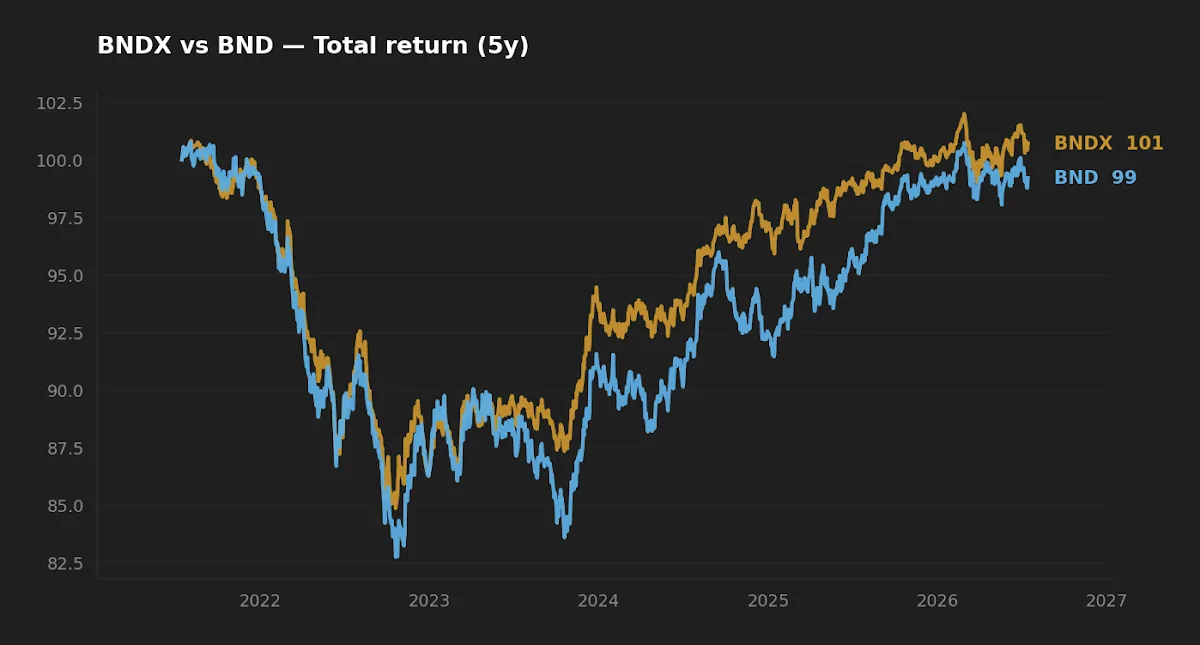
The 10-year CAGRs are nearly identical — and that is the point
Over ten years, BNDX returned 1.5% annualized and BND 1.4%. For two funds holding bonds from entirely different sovereign issuers, that convergence looks suspicious. It is not luck. Once BNDX hedges its foreign holdings back to USD, the currency return is stripped out, and what remains is duration risk plus the hedge's carry. The hedge return is approximately the short-term interest-rate differential between the US dollar and the foreign currency. When US short rates sit above their developed-market peers — as they broadly have — hedging foreign bonds into dollars earns positive carry that offsets the lower coupons on European and Japanese government debt.
Initially I expected BNDX's return to track foreign yields, which have been structurally lower than US yields for most of the past decade. Then I decomposed it: the hedge carry does much of the work of closing the gap. That is why a fund full of sub-1% Japanese and European government bonds still produced a 10-year CAGR indistinguishable from a US-only fund. The exposure you are actually buying is not "foreign yield" — it is "foreign duration, priced in dollars."
BNDX is not a bet on foreign interest rates translated through a floating currency. It is a bet on foreign duration, hedged into dollars — and that hedge quietly earns the US–foreign rate differential.
Realized risk: the hedge shows up as lower volatility
Here the two funds finally separate. BNDX's five-year annualized volatility was 4.9% against BND's 6.0%, and its worst drawdown was −15.9% versus BND's −17.9% (yfinance, 2026-07-16). The counterintuitive result — an international fund being less volatile than the domestic one — is again the hedge. Removing currency fluctuation eliminates a large, noisy component of return. What is left is a diversified basket of developed-market government durations, which do not move in perfect lockstep with the US Treasury curve. Different central banks ease and tighten on different schedules; that dispersion is the actual diversification BNDX offers.
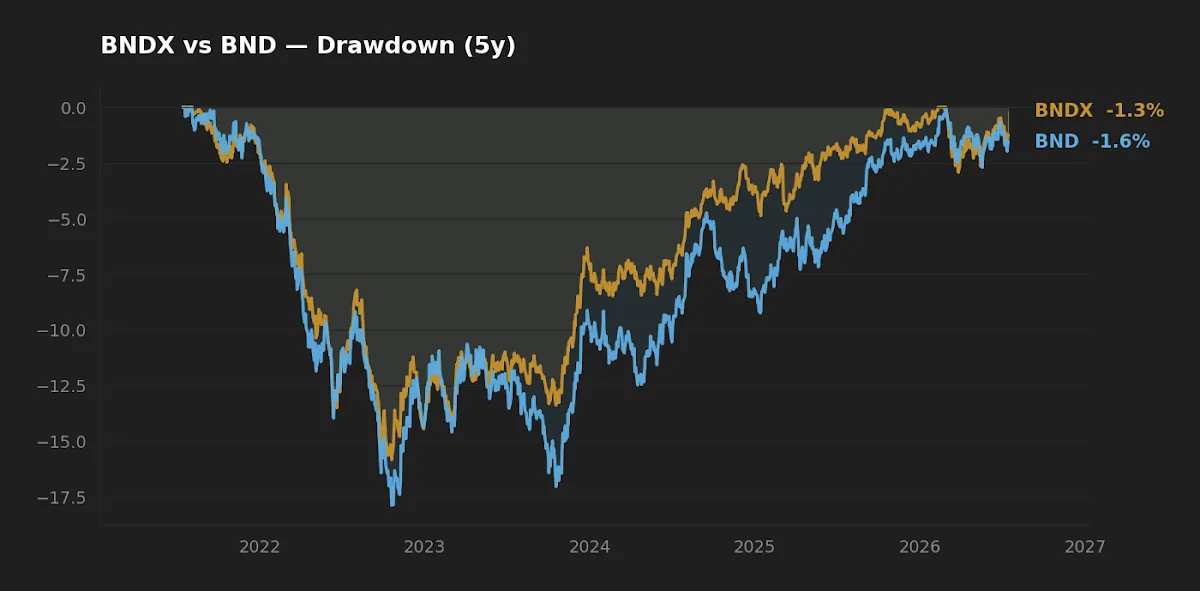
The honest caveat: the diversification benefit is modest and regime-dependent. In 2022, when nearly every developed central bank hiked in the same direction, the two funds fell together — both drawdowns are within two percentage points of each other. Cross-country rate diversification helps most when policy cycles desynchronize, and it helps least in exactly the synchronized-shock scenario a bond investor most wants protection from. That is an asymmetry worth naming: the benefit is largest when you need it least.
Cost, scale, and implementation friction
BND's 0.03% expense ratio undercuts BNDX's 0.07% by four basis points. On a bond sleeve, where expected returns are low and mostly known in advance, cost is a larger fraction of total return than it is in equities — every basis point of fee comes directly out of a low-single-digit yield. BND is also more than three times the size ($397.9B vs $123.3B), which supports tight bid-ask spreads and deep secondary liquidity. Neither fund carries meaningful closure risk; both are core Vanguard products. BNDX does run the operational overhead of maintaining currency forwards, which is part of what the extra four basis points pays for. That is not a hidden cost — it is the price of the hedge that produces the lower volatility discussed above.
For context on the yield environment both funds sit in: the 10-year Treasury yielded 4.58% and the fed funds rate was 3.63% (FRED, asof 2026-07-14 and 2026-06-01). With CPI running at 3.7% year over year (FRED, asof 2026-06-01), the real yield on either fund is thin. This is the backdrop against which any bond allocation should be judged, and it is the same environment discussed in the bonds-versus-cash rate-cut analysis.
Where BNDX fits — and where it does not
If you already hold BND as the fixed-income sleeve of a three-fund portfolio, adding BNDX does something real but small: it lowers the volatility of the bond sleeve and diversifies the rate-regime exposure away from a single central bank. Vanguard itself includes international bonds in its target-date funds for exactly this reason. Whether that marginal smoothing justifies a second holding, a second line to rebalance, and four extra basis points is a judgment call that depends on how large your bond allocation is in the first place. On a 10% bond sleeve, the diversification is a rounding error on total-portfolio risk. On a 40% sleeve near retirement, it is more defensible.
Scoreboard
| Category | Winner | Why |
|---|---|---|
| Cost | BND | 0.03% vs 0.07%; four basis points matter on a low-yield sleeve. |
| Realized risk | BNDX | Lower 5Y volatility (4.9% vs 6.0%) and shallower drawdown (−15.9% vs −17.9%). |
| Realized return | Tie | 10Y CAGRs of 1.5% and 1.4% are statistically indistinguishable. |
| Suitability (single core holding) | BND | Cheaper, larger, simpler; the default US fixed-income anchor. |
FAQ
Is BNDX currency-hedged? Yes. Vanguard hedges BNDX's foreign-currency exposure back to the US dollar, which is why its returns track duration and hedge carry rather than raw exchange-rate moves (Vanguard fact sheet, 2026-07-16).
Why is an international bond fund less volatile than a US one? Because the currency hedge removes exchange-rate fluctuation, leaving a diversified basket of developed-market government durations. That basket happened to be less volatile than the US aggregate over the past five years (yfinance, 2026-07-16).
Do I need both BND and BNDX? Not necessarily. BND alone is a complete US investment-grade holding. BNDX adds rate-regime diversification and slightly lower volatility, which is most meaningful when your bond allocation is large.
Why were both five-year returns near zero? The 2022 rate shock falls inside the five-year window and dominates it. Longer-horizon figures (the 10-year CAGRs near 1.5%) are more representative of normal conditions.
How does BND compare to AGG? They are near-twins tracking similar US aggregate indexes; the differences are duration and tracking, covered in the BND vs AGG analysis. For international equity diversification, which follows a different logic than bonds, see the VEA vs VWO breakdown.
What this comparison can and cannot tell you
The return and risk figures cover at most a 10-year window (BNDX's live history begins in 2013), and the five-year statistics are heavily shaped by a single rate-hiking regime. This sample cannot tell you how the two funds behave through a sustained period of desynchronized global monetary policy, which is precisely the scenario where BNDX's diversification would matter most. There is no stress test here for a US-specific credit event, nor for a disorderly move in currency-hedging costs. Treat the volatility and drawdown gaps as suggestive of a structural feature — the hedge — rather than as a precise forecast.
Scenarios where each fund fits
A reader in their 30s, 401(k)-only, holding a 10% bond allocation as ballast, gains little measurable benefit from splitting it across two funds — BND alone is the cleaner choice. A reader in their 50s with a 40% fixed-income sleeve who wants to avoid concentrating all duration risk in a single central bank's policy path has a more defensible case for adding BNDX. A reader who values one-line simplicity and minimum cost over marginal risk-smoothing should hold BND and stop there.
Editor's read
If forced to hold only one, the editor leans BND: it is cheaper, larger, and complete as a standalone US fixed-income anchor, and four basis points compound against you over decades on a low-yield asset. BNDX is genuinely interesting — the currency hedge does produce lower realized volatility and real cross-country rate diversification — but that benefit is modest and shrinks in exactly the synchronized-shock scenarios a bond holder most fears. It earns a place as a second sleeve for investors deliberately diversifying rate regimes on a sizable bond allocation, not as a default addition to every portfolio.
The editor holds a US total-bond position; does not hold BNDX at the time of writing.
Key takeaways
- BNDX's 10-year CAGR (1.5%) matches BND's (1.4%) because the currency hedge converts foreign yield plus hedge carry into a dollar-duration return.
- BNDX's realized volatility (4.9%) and drawdown (−15.9%) are lower than BND's (6.0%, −17.9%) — the diversification shows up in risk, not return.
- The diversification benefit is regime-dependent and weakest during synchronized global rate shocks.
- BND wins on cost (0.03% vs 0.07%) and scale ($397.9B vs $123.3B); BNDX pays for its hedge with four extra basis points.
- BNDX is a satellite for large, deliberately diversified bond sleeves — not a default addition.
Methodology: price and total-return figures from yfinance, pulled 2026-07-16, over trailing 5- and 10-year windows; expense ratio, AUM, and mandate from Vanguard issuer fact sheets (2026-07-16); macro figures from FRED (10Y Treasury and VIX asof 2026-07-14, fed funds and CPI asof 2026-06-01).
This article is for educational purposes and does not constitute personalized financial advice. See the full Disclaimer.