
Photo by Paris Bilal on Unsplash
The short version
- On stated yield, BND (3.95%) pays more than MUB (3.16%) — but MUB's income is exempt from federal tax, so the honest comparison is the tax-equivalent yield, not the headline number.
- The break-even federal marginal rate is roughly 20%: below it, BND's taxable yield wins after tax; above it, MUB's tax-equivalent yield pulls ahead — before you even account for state tax.
- Bottom line: MUB fits an investor in a high federal bracket holding bonds in a taxable account; BND fits tax-advantaged accounts and lower brackets, where the exemption buys nothing.
Municipal bonds are one of the few places in a portfolio where the number printed on the fact sheet is misleading by design. A muni fund advertises a lower yield than a comparable taxable fund and still leaves some investors with more spendable income. The whole question turns on one variable — your marginal tax rate — and on a piece of arithmetic that retail comparisons routinely skip. This article walks the tax-equivalent yield math between MUB (iShares National Muni Bond ETF) and BND (Vanguard Total Bond Market ETF), then checks the theory against five years of realized returns.
Context: two different tax wrappers around the same idea
Both funds hold high-grade, intermediate-duration bonds, but they collect income from different corners of the market. MUB tracks a broad index of investment-grade U.S. municipal bonds — debt issued by states, cities, and public authorities — and its interest is exempt from federal income tax. BND tracks the total U.S. investment-grade taxable market: Treasuries, agency mortgage-backed securities, and corporate bonds, all of which throw off fully taxable interest at your ordinary income rate.
That single distinction is the entire trade. Municipal issuers can borrow at lower nominal rates precisely because investors accept a smaller coupon in exchange for the exemption. So the muni yield always looks worse on paper. Whether it is worse depends on the tax you would otherwise pay — which is why the same two funds can be the right and wrong answer for two investors sitting in different brackets.
The data, before the interpretation
Figures below are from yfinance (price, distribution yield, realized CAGR, volatility, and drawdown), pulled 2026-07-16, with expense ratio and AUM cross-checked against issuer fact sheets: iShares MUB and Vanguard BND.
| Metric | MUB | BND |
|---|---|---|
| Name | iShares National Muni Bond | Vanguard Total Bond Market |
| Expense ratio | 0.05% | 0.03% |
| AUM | $45.8B | $397.9B |
| Inception | 2007-09-07 | 2001-11-12 |
| Distribution yield | 3.2% | 4.0% |
| Tax treatment of income | Federally exempt | Fully taxable |
| 5Y CAGR | 0.7% | -0.2% |
| 10Y CAGR | 1.8% | 1.4% |
| 5Y volatility | 4.1% | 6.0% |
| Max drawdown (5Y) | -11.9% | -17.9% |
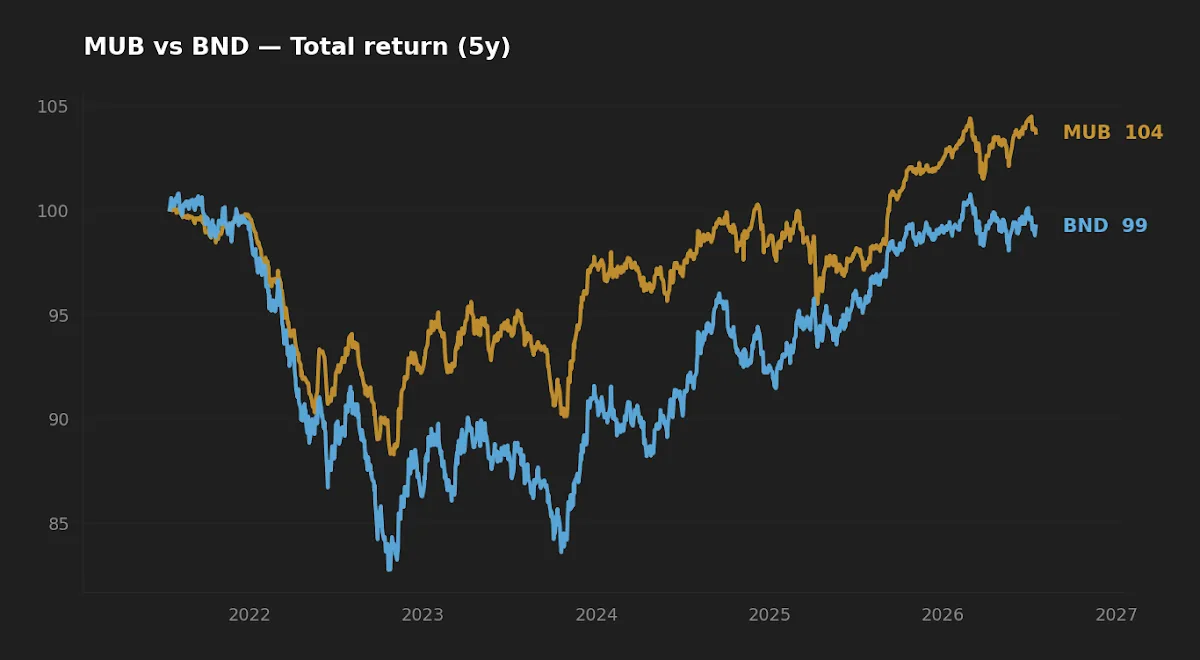
Two things stand out before any tax math. First, the fee gap is small — 0.05% versus 0.03%, two basis points — so cost is not the deciding variable here, which is unusual for a Mulden comparison. Second, over the trailing five years MUB not only yielded less but returned more (0.7% versus -0.2% CAGR) while taking less risk (4.1% versus 6.0% annualized volatility, and an -11.9% versus -17.9% worst drawdown). That is not what most investors expect from the "lower-yielding, safer-looking" fund, and it deserves an explanation rather than a headline.
The tax-equivalent yield formula
To compare a tax-free yield with a taxable one, you gross the muni yield up to what a taxable bond would have to pay to leave you with the same after-tax income:
Tax-equivalent yield = tax-free yield ÷ (1 − marginal tax rate)
Applying MUB's 3.16% distribution yield across federal brackets:
| Federal marginal rate | MUB tax-equivalent yield | vs. BND 3.95% |
|---|---|---|
| 12% | 3.6% | BND wins |
| 22% | 4.1% | MUB edges ahead |
| 24% | 4.2% | MUB ahead |
| 32% | 4.6% | MUB clearly ahead |
| 35% | 4.9% | MUB clearly ahead |
| 37% | 5.0% | MUB clearly ahead |
Solving for the crossover directly: 3.16% ÷ (1 − t) = 3.95% gives t ≈ 0.20. So the break-even federal marginal rate is about 20%. An investor in the 12% bracket keeps more income from BND; an investor in the 24% bracket or higher keeps more from MUB. The gap widens with income — at the top 37% rate, MUB's exemption is worth a full percentage point of extra equivalent yield.
The muni fund's lower headline yield is not a disadvantage to overcome — it is the price of an exemption, and above roughly a 20% federal rate that exemption is already paid back.
The non-obvious part: BND is not fully taxable either
Here is where most comparisons quietly overstate MUB's edge. BND is not a uniformly taxable fund. A large share of its portfolio is U.S. Treasury and agency debt, and Treasury interest is exempt from state and local income tax. So for an investor in a high-tax state, part of BND's 3.95% yield is already shielded at the state level, while MUB's federal exemption may or may not extend to the state — a national muni fund like MUB holds bonds from many states, so most of its income is taxable in your home state unless you hold an in-state fund.
The clean way to think about it: MUB wins the federal layer decisively for high earners, but BND quietly claws back some of the state layer through its Treasury sleeve. Initially I treated this as a rounding error. Then I worked the two-layer calculation for a top-bracket investor in a high-income-tax state and the break-even shifted by enough to matter — the state-tax treatment of BND's Treasury component narrows MUB's apparent advantage more than the single-variable formula suggests. The tax-equivalent yield table above is the right first cut, not the final word.
Two more frictions the formula hides. A slice of MUB's holdings can be subject to the federal Alternative Minimum Tax, so the "exempt" income is not always exempt for AMT payers. And muni credit is not Treasury credit — MUB carries issuer default and downgrade risk that BND's government-heavy book largely does not. The yield spread is partly compensation for that, not a free lunch.
Realized risk: why the "safer" fund also drew down less
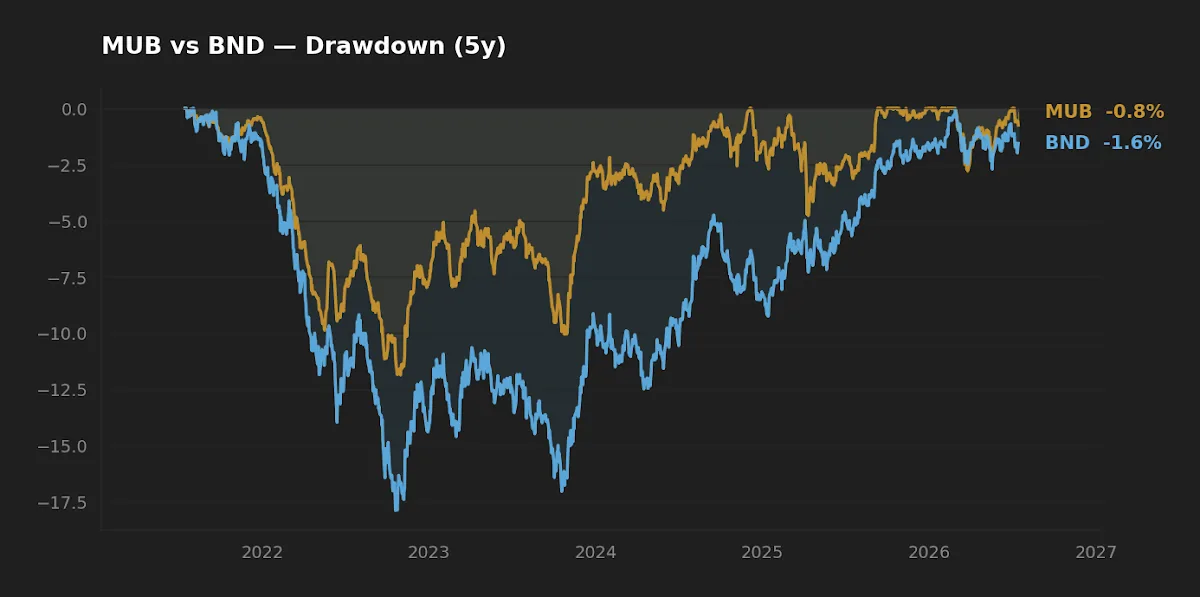
The 2022–2023 rate shock is the stress test embedded in this five-year window, and the two funds handled it differently. BND's -17.9% max drawdown reflects its longer effective duration and the fact that a rising-rate regime hits every taxable-market sector at once. MUB's -11.9% drawdown was shallower, helped by a shorter effective duration and by the muni market's stickier, tax-sensitive buyer base, which tends to dampen forced selling. Municipal demand is structurally tied to investors who want the exemption and are slower to rotate out, which softens the volatility of the asset relative to a total taxable index.
That behavior explains the counterintuitive return gap. MUB did not outperform because munis are a better asset in the abstract; it outperformed over this specific window because its shorter duration and calmer investor base were the right traits for a rate-hiking regime. In a falling-rate environment — the path some expect if the Fed continues easing from the current 3.63% funds rate (FRED, asof 2026-06-01) — BND's longer duration would likely reverse the ranking and let it capture more price appreciation. This is single-regime risk in plain view: five years is one interest-rate story, not a distribution of them. Readers weighing bonds against cash as rates fall may find the rate-cut path analysis on SGOV vs BND a useful companion, and those comparing BND against its taxable twin can see the BND vs AGG duration and tracking read.
Scoreboard: winner by category
| Category | Winner | Why |
|---|---|---|
| Cost | BND | 0.03% vs 0.05% — small, but BND is cheaper |
| Stated yield | BND | 3.95% vs 3.16% before tax |
| After-tax yield (high bracket, taxable account) | MUB | 4.6%+ tax-equivalent yield above a ~20% federal rate |
| Realized risk (5Y) | MUB | Lower volatility and shallower drawdown |
| Suitability in tax-advantaged accounts | BND | Exemption is worthless in an IRA/401(k); take the higher gross yield |
Scenarios where each fund fits
Reader in the 32%+ bracket, bond sleeve held in a taxable brokerage account → MUB is the natural fit. The tax-equivalent yield clears BND comfortably, and the exemption compounds every year without a tax drag. Worth checking whether an in-state muni fund would add a state-level exemption on top.
Reader whose bonds live entirely in a 401(k) or IRA → BND. Inside a tax-advantaged account the muni exemption buys nothing, so you would be accepting a lower yield for no benefit. Take the higher gross yield and the two-basis-point cost edge.
Reader in the 12–22% bracket, taxable account → the math is close to a wash near the break-even, so duration preference and state-tax situation should decide it rather than the exemption alone.
What this comparison can and can't tell you
The tax-equivalent formula is exact for the federal layer and approximate everywhere else. It assumes a single flat marginal rate, ignores the interaction with the net investment income tax, treats MUB's income as fully federally exempt (AMT and any taxable-muni holdings aside), and does not model your state. The realized-return figures cover one five-year window dominated by a single rate-hiking regime; they are not a forecast, and the relative ranking would likely flip in a sustained falling-rate environment. Treat the numbers as a decision framework, not a projection. For the broader principle that after-tax outcomes often matter more than headline returns, the note on tax-loss harvesting and the after-tax compounding gap extends the same logic.
FAQ
Is MUB's income really tax-free? Its interest is generally exempt from federal income tax. It is not automatically exempt from state tax — a national fund holds out-of-state bonds whose income your home state can tax — and a portion may be subject to the federal AMT. Capital gains from selling shares are still taxable.
At what tax bracket does MUB beat BND? On yield alone, the break-even federal marginal rate is about 20%. Below it, BND's taxable yield leaves you with more after tax; at 24% and above, MUB's tax-equivalent yield pulls ahead, with the advantage widening as your rate rises.
Should I hold a muni fund in my IRA or 401(k)? Generally no. Tax-advantaged accounts already shelter income, so the muni exemption adds nothing while you accept a lower yield. Taxable bond funds like BND are usually the better fit inside those accounts.
Why did MUB return more than BND over five years if it yields less? The trailing window was dominated by rising rates. MUB's shorter effective duration and stickier investor base produced a shallower drawdown (-11.9% vs -17.9%) and higher realized CAGR. That reflects this regime, not a permanent edge; longer-duration BND would likely lead in a falling-rate period.
Does the small expense-ratio difference matter? Barely. At 0.05% versus 0.03%, the two-basis-point gap is minor relative to the tax and duration effects. Cost discipline still matters in general, but here it is not the deciding variable.
Key takeaways
- Compare munis to taxable bonds on tax-equivalent yield, not stated yield — MUB's 3.16% grosses up to 4.6%+ at a 32% federal rate.
- The break-even federal marginal rate is roughly 20%; the muni advantage grows with your bracket.
- Hold munis in taxable accounts and taxable bonds in tax-advantaged accounts — location, not just selection, drives the after-tax result.
- BND's Treasury sleeve is already state-tax-exempt, which narrows MUB's edge for high-state-tax investors more than the single-variable formula shows.
- The five-year return and risk figures reflect one rate regime; expect the ranking to shift if rates fall.
Editor's read
For a bond position that genuinely sits in a taxable account and a federal bracket above the mid-20s, the editor leans MUB: the exemption is real, compounding, and — unusually — came with lower realized risk over the recent rate shock. But the case is bracket- and account-specific, not universal. Inside a tax-advantaged account, or below the break-even rate, BND's higher gross yield and marginally lower fee are the honest choice. This is one of the few comparisons where the right answer depends less on the funds and more on where the reader sits.
The editor holds a total-market taxable bond position for the fixed-income sleeve and does not hold MUB at the time of writing.
Methodology: Price, distribution yield, realized CAGR, volatility, and drawdown from yfinance, pulled 2026-07-16, covering the trailing five- and ten-year windows through that date. Expense ratio and AUM cross-checked against issuer fact sheets (iShares, Vanguard). Macro reference rates from FRED (10-year Treasury 4.58% asof 2026-07-14; fed funds 3.63% asof 2026-06-01; CPI YoY 3.7% asof 2026-06-01). Tax-equivalent yields computed as stated yield ÷ (1 − marginal rate) and are illustrative, not tax advice.
This article is for educational purposes and does not constitute personalized financial advice. See our full Disclaimer.