
Photo by Yaw Afari on Unsplash
The short version
- TLT, IEF, and SHY charge the same 0.15% expense ratio, so this decision is not about cost — it is entirely about how much interest-rate duration you want to hold.
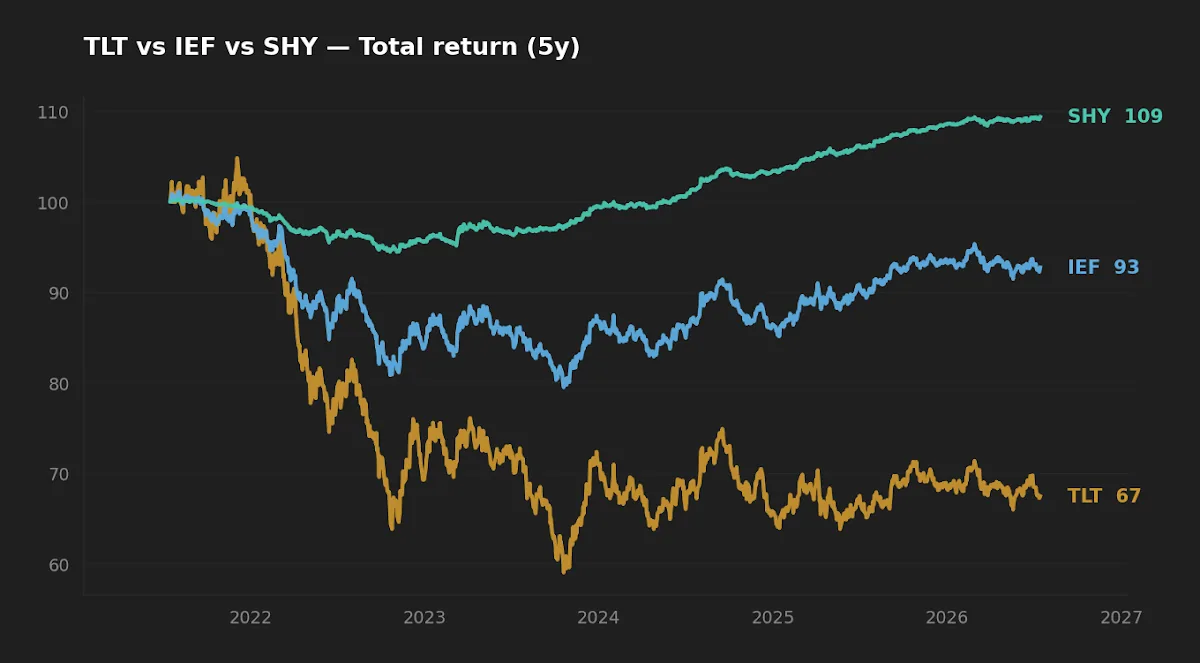
- Over the trailing five years the ranking inverts as you shorten duration: SHY returned roughly +1.8% annualized while TLT lost about 7.6% per year — a direct artifact of the 2022–2023 rate shock, not a verdict on which fund is "better."
- Bottom line: SHY is a cash-adjacent parking sleeve, IEF is the balanced middle of the ladder, and TLT is a high-convexity bet on falling long-end yields — three different jobs, not three grades of the same job.
Three iShares Treasury funds, launched on the same day in July 2002, charging the same fee, holding the same issuer's paper — and yet over the last five years one of them fell more than 40% while another barely moved. The question worth asking is not which Treasury ETF wins, but what job each one is actually built to do inside a long-horizon portfolio.
This matters because "bonds are safe" is a claim about credit risk, not price risk. U.S. Treasuries carry essentially no default risk, but their price sensitivity to interest rates spans an enormous range depending on maturity. Choosing among TLT, IEF, and SHY is really choosing a point on the duration spectrum — and that single choice drives almost everything about how the position behaves in a portfolio.
Context: what a duration ladder actually is
Duration measures how much a bond's price moves for a 1% change in yields. As a rough working estimate, iShares 20+ Year Treasury Bond ETF (TLT) carries an effective duration near 16 years, iShares 7-10 Year Treasury Bond ETF (IEF) near 7 years, and iShares 1-3 Year Treasury Bond ETF (SHY) near 1.9 years. Translate that directly: a 1% rise in the relevant part of the curve costs TLT roughly 16% of price, IEF about 7%, and SHY under 2%. A ladder simply means holding different maturity buckets so that the portfolio's overall rate sensitivity is deliberate rather than accidental.
The current backdrop frames the trade-off. The 10-year Treasury yields 4.58% and the effective federal funds rate sits at 3.63% (FRED, asof 2026-07-14 and 2026-06-01 respectively), with CPI running near 3.7% year over year (FRED, asof 2026-06-01). That is a modestly upward-sloping curve with real yields positive across most maturities — a very different starting point from the near-zero-rate world in which these funds spent much of the last decade. Starting yield matters more than any backtest, because it sets the coupon income that carries a bond position through time. Readers weighing bonds against cash may find the companion piece on a 2026 rate-cut path (SGOV vs BND) a useful complement to the maturity question here.
The data
| Metric | TLT (20+ yr) | IEF (7-10 yr) | SHY (1-3 yr) |
|---|---|---|---|
| Expense ratio | 0.15% | 0.15% | 0.15% |
| AUM | $41.1B | $47.1B | $25.4B |
| Inception | 2002-07-22 | 2002-07-22 | 2002-07-22 |
| Distribution yield | 4.5% | 3.9% | 3.7% |
| 5Y CAGR | -7.6% | -1.5% | +1.8% |
| 10Y CAGR | -2.4% | +0.4% | +1.6% |
| Annualized vol (5Y) | 15.8% | 7.7% | 2.0% |
| Max drawdown (5Y) | -43.7% | -21.4% | -5.7% |
Data: price, return, volatility, and drawdown from yfinance (pulled 2026-07-16); expense ratio, AUM, and mandate from issuer fact sheets — TLT, IEF, SHY.
Cost is a non-factor — which is itself the point
All three funds charge 0.15%. In most head-to-head ETF comparisons the fee gap does real work over decades, and it is usually the first thing I look at. Here it does nothing to separate them. That absence is clarifying: with cost held constant, the entire decision collapses onto one axis — how much duration risk you are willing to underwrite. There is no "cheaper twin" to reward patience; there is only a risk budget to allocate.
The non-obvious consequence is that comparing five-year CAGRs to pick a "winner" is close to meaningless. SHY's +1.8% and TLT's -7.6% do not tell you SHY is the better fund. They tell you the last five years contained a violent repricing of long-end rates, and duration is exactly the exposure that gets punished in that regime. Rank the same three funds over a period of falling long yields and the order flips completely — TLT would lead by a wide margin precisely because its duration works as leverage in both directions.
With cost held constant across all three funds, the entire decision collapses onto a single axis: how much interest-rate duration you are willing to underwrite.
Realized risk: the drawdown tells the real story
The return numbers are regime-dependent; the risk numbers are structural. TLT's -43.7% five-year drawdown is not a fluke — it is what ~16 years of duration does when long yields rise several hundred basis points from a low base. That is an equity-like loss from an instrument many investors hold specifically to avoid equity-like losses. IEF's -21.4% and SHY's -5.7% scale almost exactly with their respective durations, which is the reassuring part: the funds behaved as their mandates predict.
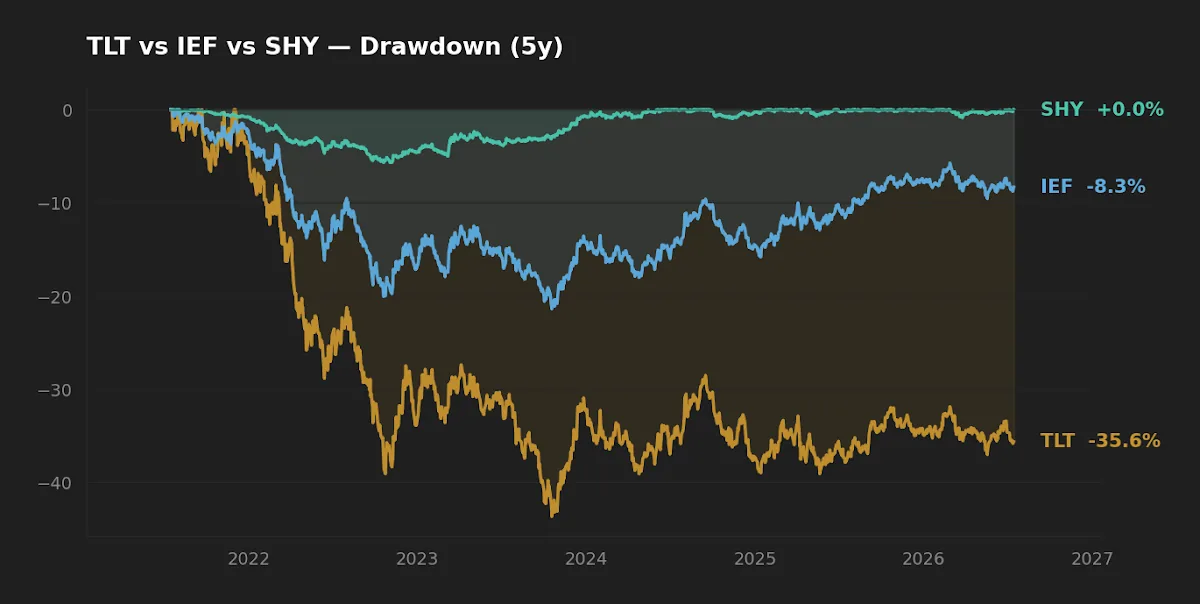
Annualized volatility (15.8% for TLT, 7.7% for IEF, 2.0% for SHY) reinforces the same ranking. What the volatility figure hides is convexity — the asymmetry the data does not surface in a single number. Because bond price-yield relationships are curved, TLT gains slightly more from a yield fall than it loses from an equal-sized yield rise. That convexity is the honest case for long duration: it is the payoff profile you are actually buying. It does not rescue the position in a sustained rising-rate regime, and it should never be confused with a promise. But it explains why a long-Treasury sleeve can act as a genuine offset when a growth shock drives yields sharply lower — the scenario in which stocks and short bonds both struggle to help.
How each fund fits a real portfolio
Think in terms of jobs, not grades. SHY functions as a near-cash sleeve — a place to hold dry powder that earns a coupon with minimal price risk, comparable in spirit to the defensive parking discussed in SGOV vs gold as two different defenses. IEF is the balanced middle: enough duration to offer meaningful diversification against equities in a flight-to-quality, without TLT's tail behavior. TLT is a deliberate, high-convexity position on the long end — powerful when it works and brutal when it does not.
A ladder holds more than one because the future rate path is unknowable. Holding all three in chosen weights lets the portfolio's aggregate duration sit where you intend rather than where a single fund dictates. If you already own a total-bond fund, note that you may hold slices of all three maturity buckets already; the mechanics of that overlap are worth understanding through the lens of BND vs AGG before layering a standalone Treasury sleeve on top.
Scoreboard: winner by category
| Category | Winner | Why |
|---|---|---|
| Cost | Tie | All three at 0.15% — no separation. |
| Realized risk (5Y) | SHY | -5.7% max drawdown, 2.0% vol — smallest by far. |
| Realized return (5Y) | SHY | +1.8% CAGR, but this reflects a rising-rate regime, not durable superiority. |
| Diversification vs equities | IEF / TLT | Duration is what offsets a growth shock; SHY has too little to help much. |
| Suitability as core ballast | IEF | Meaningful duration without TLT's tail behavior. |
What this comparison can and can't tell you
The five-year window used here is dominated by one macro event: the 2022–2023 rate-rise cycle. That is a single regime, and single-regime samples flatter short duration and punish long duration by construction. The numbers are accurate but not representative of a full cycle. This analysis also does not stress-test the funds against a deflationary shock or a rapid cutting cycle, both of which would favor TLT sharply. Distribution yields shown are trailing figures, not forward yield-to-maturity, so they lag the current coupon environment. Treat the drawdown and volatility figures as the durable, structural signal; treat the CAGR ranking as regime commentary that will not persist.
Scenarios where each fund fits
Reader in their 30s, long accumulation horizon, wants stock-hedge ballast: IEF's ~7-year duration offers real diversification against an equity drawdown without TLT's tail, and starting yields near current 10-year levels make the carry more supportive than in prior years.
Reader parking a cash reserve for 6–18 months: SHY behaves close to cash with a coupon and a -5.7% worst-case over five years — the right tool when capital preservation, not duration, is the goal.
Reader deliberately positioning for falling long-end yields: TLT delivers the convexity, but the -43.7% drawdown is the honest price of admission and sizing should reflect that this is a directional view, not ballast.
Editor's read
If the goal is durable ballast inside a long-horizon core rather than a rate call, the editor leans toward IEF: it carries enough duration to actually help when equities fall, without TLT's equity-sized drawdowns that can tempt a holder into selling at the worst moment. SHY is the natural home for a genuine cash reserve, and TLT earns a place only as a sized, intentional position for someone who understands they are underwriting long-end convexity in both directions. The identical 0.15% fee means none of this is a cost decision — it is a risk-budget decision, and it should be made on purpose.
Holdings disclosure: the editor holds a short-duration Treasury sleeve; does not hold TLT at the time of writing.
FAQ
Why did TLT lose money when Treasuries are supposed to be safe? Treasuries carry almost no default risk, but their prices fall when interest rates rise. TLT holds bonds with ~16-year duration, so the sharp rate increases of 2022–2023 produced a -43.7% drawdown (yfinance, 2026-07-16). Safe from default is not the same as safe from price movement.
Is SHY basically the same as holding cash? It is close but not identical. SHY holds 1–3 year Treasuries, carries a small amount of price risk (a -5.7% five-year drawdown), and yields about 3.7%. It behaves like a cash-adjacent sleeve, but it can still lose value briefly if short rates jump.
Should I hold all three or just pick one? That depends on the duration you want overall. Holding more than one lets you set the portfolio's aggregate rate sensitivity deliberately. Holding one concentrates you at a single point on the curve. Neither is universally correct; it is a function of your horizon and risk budget.
Do the different expense ratios matter here? No — all three charge 0.15% (issuer fact sheets). Cost does not separate them, which is why the decision rests entirely on duration and risk rather than fees.
Which fund helps most if the stock market crashes? Historically, longer-duration Treasuries (IEF and especially TLT) tend to rise most in a flight-to-quality when yields fall, so they offer more diversification against an equity shock. SHY, with minimal duration, provides stability but little offsetting gain.
Key takeaways
- All three funds cost 0.15%, so this is a duration decision, not a cost decision.
- The five-year return ranking (SHY > IEF > TLT) is a rising-rate-regime artifact and would invert if long yields fall.
- Drawdown and volatility scale with duration exactly as expected — that structural ranking is the durable signal, not the CAGR.
- SHY = cash-adjacent parking; IEF = balanced core ballast; TLT = sized, high-convexity long-end position.
- Starting yields near 4.58% on the 10-year make bond carry more supportive today than in the near-zero-rate decade prior (FRED, asof 2026-07-14).
Methodology: Price, total return, volatility, and drawdown computed from yfinance daily data pulled 2026-07-16, over trailing 5-year and 10-year windows. Expense ratio, AUM, inception, and mandate from iShares issuer fact sheets. Macro figures from FRED (10-year Treasury and VIX asof 2026-07-14; fed funds and CPI asof 2026-06-01). Duration estimates are approximate working figures for illustration.
This article is for educational purposes and does not constitute personalized financial advice. See our full Disclaimer.