
Photo by K. Mitch Hodge on Unsplash
The short version
- SGOV and gold ETFs both get labelled "defensive," but they hedge different risks. SGOV defends against equity drawdowns by holding T-bill principal stable and paying a real yield; gold defends against currency debasement and monetary-regime stress.
- At a 3.9% distribution yield against a 0.09% expense ratio and a five-year realized drawdown of essentially zero, SGOV is paid to wait. Gold ETFs charge 0.10%-0.40%, pay no income, and have realized 5Y annualized volatility around 17.9% with a drawdown of about 20.9%.
- For most long-horizon investors the two are complements, not substitutes. The useful question is not "which one" but "what mix, against which scenario, sized to what tolerance."
An ultra-short Treasury ETF and a physical-gold ETF sit under the same retail label of "defensive assets," and that label hides more than it reveals. One pays a real, taxable yield each month while its principal barely moves; the other charges a holding fee, pays nothing, and trades with the realized volatility of a major-currency cross. Treating the two as substitutes is the source of most bad allocation decisions in this corner of the portfolio.
This piece works through what each fund actually does, what the live data shows over a five-year window that includes a hiking cycle and a cutting cycle, and where the two roles overlap — or, more usefully, where they don't.
What each fund actually is
SGOV — iShares 0-3 Month Treasury Bond ETF — holds a rolling ladder of US Treasury bills with maturities under three months. There is no credit risk in any meaningful sense and almost no duration risk. The yield resets toward the front end of the Treasury curve within weeks of any Fed action, which makes SGOV functionally equivalent to a high-grade money-market fund inside a wrapper that trades intraday and clears in any brokerage account.
The gold side is a small family with similar mechanics and different price points. IAU (iShares Gold Trust) and GLD (SPDR Gold Shares) hold physical bullion in vaulted storage and track spot gold less the expense ratio. GLDM (SPDR Gold MiniShares) is SSGA's lower-cost share of the same exposure, designed for buy-and-hold investors who don't need GLD's institutional-grade liquidity. There is no income from any of them; the only return source is gold's price appreciation.
The conceptual gap matters. SGOV is dry powder for equity drawdowns and a real-yield buffer in the meantime. Gold is a hedge against the monetary regime itself — real-rate compression, dollar weakness, or sustained inflation surprises that outrun the front end of the curve. A portfolio that relies on SGOV alone has no insurance against the regime that erodes its purchasing power. A portfolio that relies on gold alone has no liquid, low-volatility reserve to deploy when equities fall 30%.
Headline data
| Metric | SGOV | IAU | GLD | GLDM |
|---|---|---|---|---|
| Issuer | iShares (BlackRock) | iShares (BlackRock) | SSGA / WGC | SSGA |
| Inception | 2020-05-26 | 2005-01-21 | 2004-11-18 | 2018-06-25 |
| Expense ratio | 0.09% | 0.25% | 0.40% | 0.10% |
| AUM | $85.2B | $71.5B | $153.5B | $31.0B |
| Distribution yield | 3.9% | 0.0% | 0.0% | 0.0% |
| 5Y CAGR | 3.5% | 19.5% | 19.4% | 19.7% |
| 5Y annualized volatility | 0.2% | 17.9% | 17.9% | 17.9% |
| 5Y max drawdown | −0.03% | −20.9% | −21.0% | −20.9% |
Sources: yfinance for price, return, volatility and drawdown, pulled 2026-05-16; window 2021-05 through 2026-05, daily. Expense ratios and AUM from issuer fact sheets — SGOV, IAU, GLD, GLDM. Macro figures from FRED: 10Y Treasury 4.47% (2026-05-14), Fed Funds 3.64% (2026-04-01), CPI YoY 3.9% (2026-04-01), VIX 17.3 (2026-05-14).
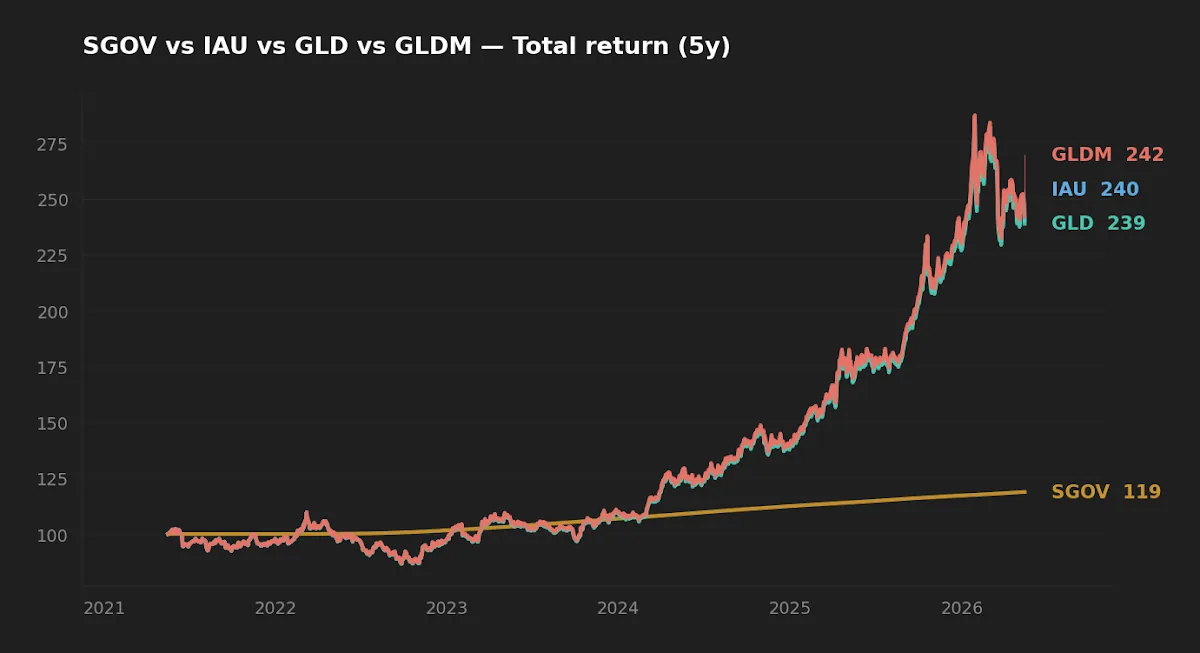
What SGOV's profile actually says
Five years is a short live track record, but the structural simplicity of SGOV makes it more informative than the timestamp suggests. The fund's max drawdown of three basis points over five years isn't a fluke — it is a mechanical consequence of holding ultra-short T-bills marked daily. The volatility floor for this strategy is essentially the bid-ask spread, not market risk.
That stability comes at the cost of optionality. SGOV's yield is whatever the front end of the Treasury curve is paying at the time. With Fed Funds at 3.64% and the 10-year at 4.47%, SGOV currently delivers a positive but thin real return against CPI running at 3.9%. If the Fed cuts aggressively, SGOV's yield drops inside a quarter — there is no duration to lock in today's coupons. That makes SGOV excellent at its narrow job (preserve principal, generate cash flow at the prevailing front-end rate) and structurally bad at any other job an investor might quietly want it to do. The fund is honest about what it is; allocators often aren't.
Gold's realized risk: not a money-market substitute
The 5Y numbers for the three gold ETFs cluster tightly because they hold the same underlying exposure with small expense-ratio differences. CAGRs of 19.4-19.7%, annualized volatility of 17.9%, and a drawdown of roughly 21%. Two observations follow.
First, the 5Y CAGR is regime-flattering. The 2020-2026 window captures a near-zero-rate environment, two episodes of inflation alarm, and a sustained bid for gold from official-sector buyers. Reading 19.5% per year as a forward expectation is precisely the mistake the data is most likely to trick a reader into making. The 10Y CAGRs in the same data (13.2-13.4% for GLD and IAU) are closer to a sensible upper-bound base case, and even that window starts from a 2015 low.
Second, the realized drawdown is the number to internalize. A 21% peak-to-trough decline inside a five-year stretch when gold delivered roughly 19.5% per year tells you something important: even in a strong regime, the path is not smooth. Multi-year drawdowns of 20-30% are common across gold's longer history — most recently the 2011-2015 decline that took the metal from above $1,900/oz to below $1,100 before the 2019-2020 leg up. Anyone allocating to gold as "defense" should plan to hold through those stretches without re-rating it as a failed position.
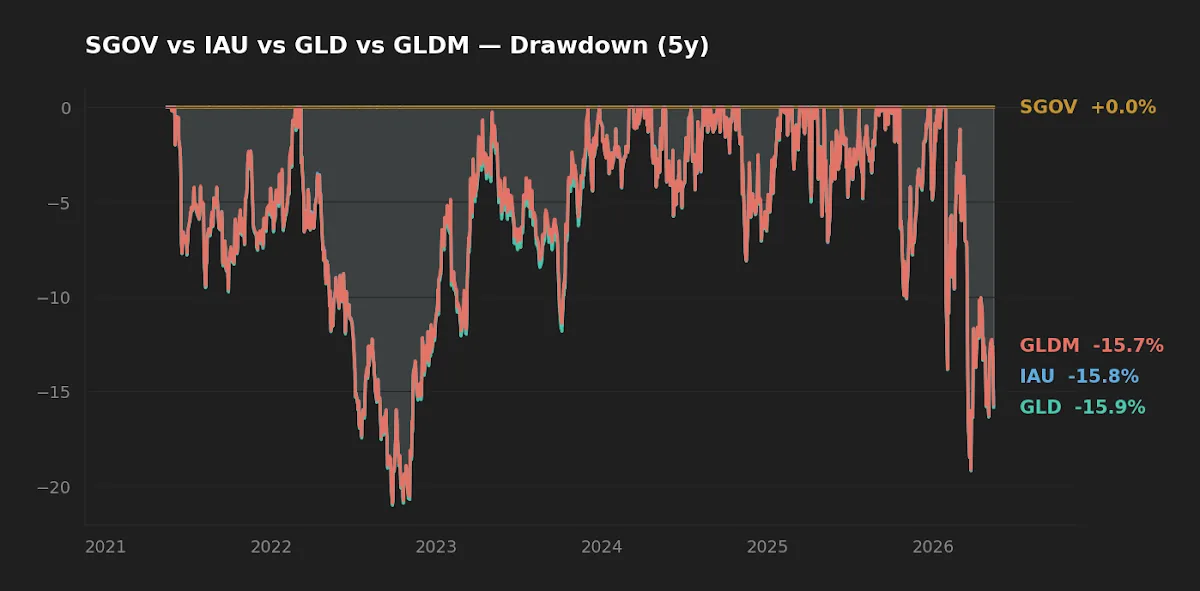
SGOV is paid to wait. Gold asks you to wait through a 20% drawdown, with no income to cushion the experience.
The carry math most retail content elides
Here is the comparison most defensive-asset writeups leave on the cutting-room floor. SGOV currently delivers about 3.9% in cash yield while charging 0.09%. Gold ETFs deliver 0% in cash yield while charging 0.10% (GLDM), 0.25% (IAU), or 0.40% (GLD). The annual carry differential between SGOV and IAU at today's rates is roughly 4.1 percentage points in SGOV's favor, before any movement in the gold price.
Compounded over a decade at flat rates, that carry differential alone gives SGOV a roughly 50% nominal head start over a static gold position. For gold to match SGOV's nominal total return over ten years from this starting point, gold would need to appreciate at roughly 4% per year. With CPI running at 3.9% and the long-run real return on gold historically near zero, that is essentially the inflation rate plus a small premium — achievable, but not free, and the path is volatile.
The implication is uncomfortable for the reflexive "5% gold sleeve" prescription. Whether gold earns its place depends almost entirely on the macro regime an investor is underwriting. If the base case is "front-end rates stay positive in real terms and the dollar holds reserve status," SGOV does the defensive job at less than zero cost. If the base case is "real rates compress, the dollar weakens, and inflation surprises persist," gold's expected payoff dominates. The honest answer is that neither base case is certain — and that is exactly why holding both, in a deliberate ratio, is the dominant strategy for most long-horizon investors. The framing is consistent with the broader sleeve approach in Building a 2-Layer ETF Portfolio.
When each one fails its own job
SGOV fails when nominal stability is the wrong objective. In a regime of sustained 6%+ inflation with the Fed unwilling or unable to keep front-end rates ahead of CPI, SGOV's "stable principal" silently erodes in real terms. The 2021-2022 episode, when SGOV-equivalent yields were near zero while CPI ran above 7%, is the cleanest recent example. SGOV did its narrow job — principal stable, yield positive — and that job was the wrong one.
Gold fails differently: it fails psychologically. Multi-year drawdowns of 20-30% are common, and they often coincide with periods when equities are doing well. An investor who funded a gold sleeve to hedge a fear that did not materialize will find themselves underperforming the index for years and questioning the position. Most don't survive that test. The behavioral cost of holding gold through a wrong-regime stretch is the largest hidden tax on the asset.
Both failure modes argue for sizing discipline. Treat SGOV as a working reserve sized to an actual cash-need or rebalance-trigger horizon — typically 3-12 months of contributions or a fraction of equity allocation appropriate to the investor's drawdown tolerance. Treat gold as a long-horizon insurance position sized to a level you can hold through a multi-year underperformance without reaching for the sell button. For the rate-cycle angle on the other side of the curve, Best ETFs for Falling Interest Rates sits adjacent to this question.
At-a-glance scoreboard
| Category | Winner | Margin |
|---|---|---|
| Cost | SGOV / GLDM | SGOV 0.09%, GLDM 0.10% — both materially below GLD's 0.40% |
| Income | SGOV | 3.9% distribution yield vs 0% |
| Realized 5Y drawdown | SGOV | Decisive — −0.03% vs −20.9% |
| Inflation / regime hedge | Gold | Structural — gold has no rate-reset risk |
| Liquidity for rebalancing | SGOV | Stable principal, deployable on any equity dip |
| Multi-decade real preservation | Toss-up | Depends entirely on the regime |
Frequently asked questions
Is SGOV the same as a money-market fund?
Functionally similar in risk and yield, but mechanically different. SGOV is an ETF — it trades intraday at a market price near NAV, settles T+1, and lives inside any brokerage account. A money-market fund is a mutual fund priced once daily. For most retail investors the distinction is small; SGOV's edge is that it doesn't require a separate cash-management account or sweep program.
Why hold gold at all if SGOV pays a real yield?
Because the regime that justifies SGOV (positive real front-end rates, dollar stable) is not guaranteed to persist. Gold's contribution to a portfolio is conditional: it pays off in regimes where SGOV silently bleeds purchasing power. Sizing it small enough to be tolerable through wrong-regime stretches is the discipline.
Should I prefer GLDM, IAU, or GLD?
For buy-and-hold investors, expense ratio dominates. GLDM at 0.10% and IAU at 0.25% are both materially cheaper than GLD at 0.40%. GLD's edge is institutional-grade liquidity for large-block trading — irrelevant to most retail accounts. Between GLDM and IAU the decision is mostly continuity (existing position, broker fee structure) rather than performance.
What happens to SGOV if the Fed cuts to zero?
SGOV's yield collapses toward zero within roughly a quarter as the underlying T-bills mature and reset at the new front-end rate. Principal stability is preserved; income disappears. In a zero-rate regime SGOV becomes a pure cash placeholder rather than an income source — still useful as dry powder, no longer useful as carry.
Does holding both create unnecessary cost or complexity?
Not meaningfully. At a 5% gold sleeve held in GLDM (0.10%) and a working SGOV reserve at 0.09%, the blended fee drag at the portfolio level is on the order of 1 basis point. The cost of holding both is trivial; the cost of holding only one and being wrong about the regime is not.
What this comparison can and can't tell you
SGOV has only five years of live data. That window covers a near-zero-rate environment, a hiking cycle, and the start of a cutting cycle — but no 2008-style credit event and no 1970s-style sustained inflation. The fund's strategy is structurally simple enough that the short track record is less of a concern than for an active or factor-based strategy, but the 5Y CAGR of 3.5% reflects one specific rate path and should not be extrapolated.
The gold-ETF numbers are equally regime-bound. A 19.5% CAGR over the past five years is not the unconditional expected return of gold; it is what the metal happened to deliver across a window dominated by inflation alarm and official-sector buying. The 13.2-13.4% ten-year CAGRs are a more defensible upper-bound input, and the long-run real return on physical gold has historically been close to zero. This comparison does not run a fresh quantitative analysis of GLD/IAU/GLDM tracking error or premium-discount dynamics, both of which matter for short-horizon traders but are immaterial for buy-and-hold investors. For wider context on the metals complex, see the Precious Metals ETF Guide 2026.
Scenarios where each one fits
- Investor in their 30s, 401(k)-only, no near-term cash needs: SGOV adds little inside a tax-deferred account given the long horizon and the absence of a rebalancing-cash use case. A small gold sleeve (3-5%) in GLDM for regime insurance is more defensible than a SGOV sleeve.
- Investor in their 50s with a defined rebalance discipline: A working SGOV reserve sized to one to two years of equity-buy ammunition makes a Daryanani-style band rule executable without forced equity sales. Gold remains optional, sized to comfort.
- Investor managing a taxable account with a multi-year goal (down payment, tuition): SGOV is the natural home — predictable principal, monthly income, ordinary-income tax treatment. Gold is a poor fit for goal-dated capital because the drawdown path can collide with the timeline.
- Investor who specifically fears a dollar-debasement scenario: A 5-10% gold allocation in GLDM or IAU is the cleanest expression. SGOV alone does not hedge this risk.
Editor's read
If forced to size only one of the two for a long-horizon core, the editor leans toward a working SGOV reserve over a gold sleeve — the carry math is unforgiving and the rebalancing utility of stable principal is concrete. But the choice is not binary. A small gold position sized to 3-5%, held in GLDM or IAU rather than GLD on cost grounds, is the regime hedge most portfolios are quietly missing. The mistake to avoid is treating either as a substitute for the other; they answer different questions.
The editor holds a working short-duration Treasury reserve and a small gold position via a low-cost gold ETF as part of an in-house allocation framework; specific sizing is not disclosed.
Methodology. SGOV, IAU, GLD, and GLDM price, yield, AUM, and risk metrics pulled from yfinance on 2026-05-16; the 5Y window is 2021-05 through 2026-05, calculated daily. Expense ratios sourced from issuer fact sheets (linked above). Macro context from FRED — 10Y Treasury and VIX asof 2026-05-14, Fed Funds asof 2026-04-01, CPI YoY asof 2026-04-01. Long-run gold drawdown and real-return characteristics are stated qualitatively from multi-decade public price history; no fresh backtest of a specific gold ETF was run for this piece.
This article is for educational purposes and does not constitute personalized financial advice. See full Disclaimer.