
Photo by Markus Winkler on Unsplash
The short version
- TIP and SCHP hold the full-maturity TIPS ladder and behave almost identically; the only durable difference between them is a 0.15% fee gap that favors SCHP.
- VTIP holds only short-maturity TIPS, and over the last five years that shorter duration delivered both a higher realized return (3.3% vs under 1.0% CAGR) and less than half the drawdown — because the real-rate rise punished long duration more than inflation protection rewarded it.
- Bottom line: the real choice here is not between issuers but between two very different risk profiles — full-curve inflation exposure with rate sensitivity, or a near-cash inflation hedge.
Investors reach for Treasury Inflation-Protected Securities (TIPS) expecting one thing: a bond that keeps pace with the consumer price index. What surprises most people is that two funds both labeled "TIPS ETF" can post five-year returns that differ by more than 2.5 percentage points a year while holding the same asset class. The gap has almost nothing to do with which issuer runs the fund and almost everything to do with duration.
This comparison looks at three of the most widely held inflation-protected bond ETFs — TIP (iShares), SCHP (Schwab), and VTIP (Vanguard) — through the lens a long-horizon investor actually cares about: what you own, what it costs, and how it behaved when real rates moved against it.
Context: what a TIPS ETF actually protects
A TIPS bond has two moving parts. Its principal is indexed to CPI, so the inflation component is neutralized by design. But the bond still trades on a real yield — the return above inflation — and that real yield behaves like any other bond yield: when it rises, the price of the bond falls, and the longer the maturity, the harder it falls. This is the point most retail coverage skips. Inflation protection removes the inflation term from your return; it does nothing to remove real-rate duration risk.
That distinction is the entire story of 2021–2023. Headline CPI ran hot — it is still 3.7% year over year (FRED, asof 2026-06-01) — yet long-dated TIPS funds lost value, because the Federal Reserve pushed real yields sharply higher off a deeply negative base. The inflation accrual was real, but it was swamped by the mark-to-market hit on duration. A fund's maturity profile, not its inflation linkage, decided who bled and who didn't.
TIP and SCHP both track broad, all-maturity TIPS indices, giving them an effective duration in the six-to-seven-year range. VTIP tracks a short-maturity index (roughly 0–5 years), which cuts its duration to around 2.5 years. Same asset class, very different interest-rate beta. For a broader treatment of how duration separates otherwise-similar bond funds, see BND vs AGG: The Two Total-Bond Giants.
The data
| Metric | TIP | SCHP | VTIP |
|---|---|---|---|
| Name | iShares TIPS Bond | Schwab U.S. TIPS | Vanguard Short-Term TIPS |
| Expense ratio | 0.18% | 0.03% | 0.03% |
| AUM | $14.7B | $16.5B | $71.1B |
| SEC-style yield (TTM) | 3.8% | 4.0% | 3.6% |
| Inception | 2003-12-04 | 2010-08-05 | 2012-10-16 |
| 5Y CAGR | 0.7% | 0.8% | 3.3% |
| 10Y CAGR | 2.2% | 2.4% | 3.0% |
| 5Y volatility (annualized) | 6.2% | 6.1% | 2.8% |
| 5Y max drawdown | -14.5% | -14.3% | -5.5% |
Expense ratio, AUM, yield, and inception are from the issuer fact sheets: iShares TIP, Schwab SCHP, and Vanguard VTIP. Return, volatility, and drawdown figures are computed from yfinance total-return price history, pulled 2026-07-16.
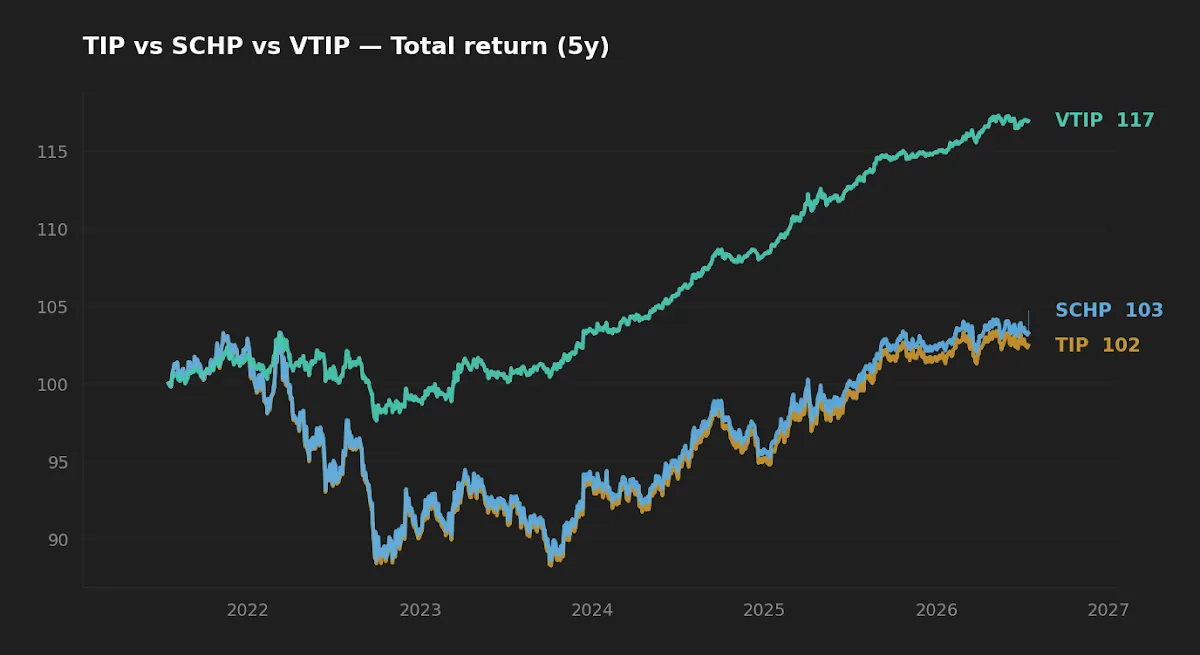
TIP vs SCHP: the same fund, one of them cheaper
Start with the pair that are genuinely close substitutes. TIP and SCHP hold the same broad TIPS universe, and it shows: 5Y CAGR of 0.7% vs 0.8%, 10Y CAGR of 2.2% vs 2.4%, volatility of 6.2% vs 6.1%, and drawdowns within 0.3 percentage points of each other. Statistically, the return difference between them is noise plus the fee.
And the fee is the one thing that is not noise. TIP charges 0.18%; SCHP charges 0.03% — a 0.15% gap that compounds silently every year the position is held. On a broad TIPS fund whose 10-year CAGR is only 2.4%, giving up 15 basis points is surrendering roughly 6% of your gross real-bond return to the expense line, every year, in perpetuity. TIP's incumbency (a 2003 inception and two decades of institutional familiarity) explains why it still holds $14.7B, but incumbency is not a reason to overpay for an index product.
TIP's one structural edge is liquidity: as the older, more heavily traded name it tends to show tighter bid-ask spreads, which matters to a large or tactical trader turning over size. For a buy-and-hold investor adding on a monthly cadence, that spread advantage is dwarfed by the annual fee drag. Between two funds tracking the same index, the cheaper one wins the long game by default.
Inflation protection removes the inflation term from your return. It does nothing to remove real-rate duration risk — and in the last five years, that is the risk that mattered.
Realized risk: where duration shows its teeth
Now the interesting part. VTIP holds the same inflation-protected asset class as TIP and SCHP, yet its five-year record looks like it came from a different universe: 3.3% CAGR against under 1.0% for the full-maturity funds, 2.8% volatility against 6.1–6.2%, and a maximum drawdown of just -5.5% against roughly -14.5%.
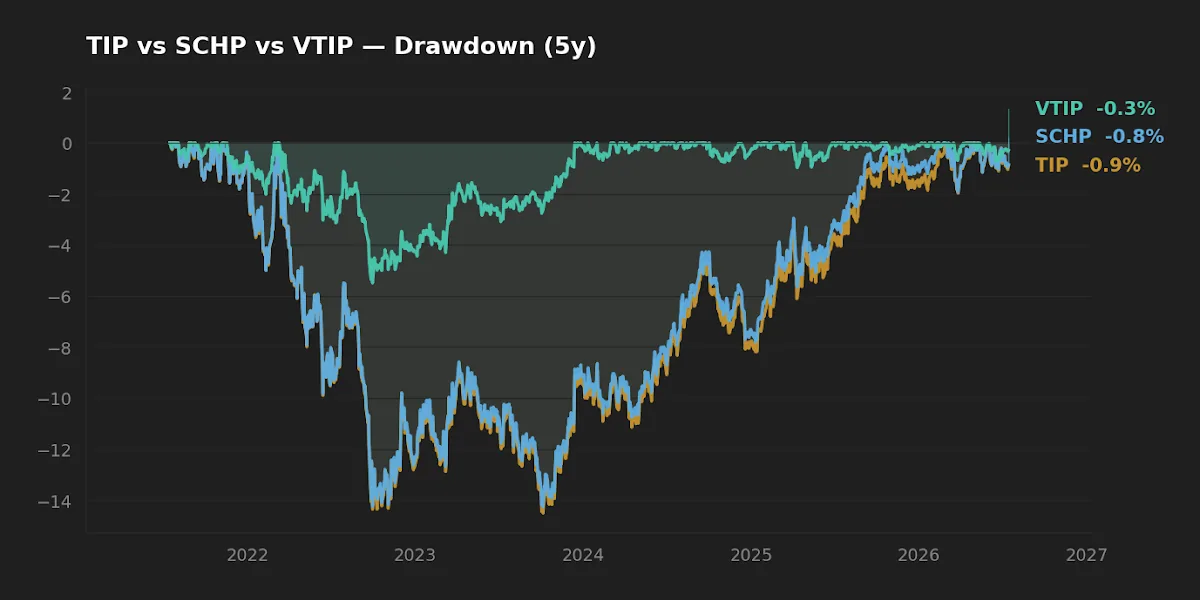
Initially I assumed the shorter fund would simply return less — less duration, less term premium, less yield. The realized numbers say the opposite for this window, and the reason is instructive. During 2021–2023 the real yield on TIPS moved from deeply negative to solidly positive. That repricing inflicted a large capital loss on anything with six or seven years of duration, and the CPI accrual — even at elevated inflation — could not offset it. VTIP's ~2.5-year duration meant its bonds rolled to maturity quickly and repriced at the new, higher real yields with a fraction of the mark-to-market pain. The short fund captured most of the inflation compensation while sidestepping most of the rate damage.
The uncomfortable corollary: VTIP's five-year edge is regime-specific, not a permanent superiority. In a scenario where real yields fall sharply — a hard recession, an aggressive easing cycle — the longer duration of TIP and SCHP would work in their favor, and they would likely outrun VTIP. The 2021–2023 window rewarded short duration; a mirror-image window would reward the opposite. What VTIP reliably offers is not higher return but lower variance of outcome: a cleaner isolation of the inflation-beta with the real-rate duration mostly stripped out.
Scale and the behavioral tell
One number in the table is easy to skate past: VTIP holds $71.1B, more than TIP and SCHP combined. That is a striking outcome for the "boring," lowest-duration option in the category. The most plausible read is behavioral. Investors who buy TIPS want an inflation hedge, and they discovered — painfully, in 2022 — that they did not also want the equity-like drawdown that long-duration TIPS delivered. Capital migrated toward the fund that does the one job (inflation protection) without the side effect (rate risk). VTIP's AUM is, in effect, a record of investors learning the difference between inflation protection and duration the hard way. Scale itself then reinforces the choice: the deepest book tends to mean the tightest spreads and the lowest closure risk in the group.
Scoreboard: winner by category
| Category | Winner | Why |
|---|---|---|
| Cost | SCHP / VTIP (tie) | 0.03% each vs 0.18% for TIP |
| Realized risk | VTIP | 2.8% vol, -5.5% drawdown vs ~6.1% / ~-14.5% |
| Realized return (5Y) | VTIP | 3.3% CAGR vs 0.7–0.8%, this regime |
| Full-curve inflation exposure | SCHP | Broad-maturity index at the lowest fee |
| Liquidity for size | TIP | Longest history, tightest institutional spreads |
FAQ
Are TIP and SCHP interchangeable? For practical purposes, yes — they track the same broad TIPS index with near-identical realized risk and return. The durable difference is the 0.15% fee gap in SCHP's favor. TIP's edge is trading liquidity, which matters more to large or active traders than to a monthly buy-and-hold investor.
Why did VTIP beat the longer funds if it has less duration? Because the last five years were dominated by rising real yields. Long-duration TIPS took large mark-to-market losses on that move; VTIP's short duration avoided most of it while still collecting inflation compensation. In a falling-real-yield regime, the longer funds would likely lead instead.
Does a TIPS ETF fully protect me from inflation? It neutralizes the CPI component of return by indexing principal to inflation. It does not protect against changes in real interest rates, which drive the fund's price. That real-rate sensitivity is why a broad TIPS fund can fall in price even while inflation is high.
Which is better for a near-term cash-like sleeve? VTIP behaves closest to a low-volatility, inflation-linked cash alternative, with a -5.5% worst-case drawdown over five years. TIP and SCHP carry meaningfully more rate risk and are better understood as intermediate bond positions than as cash substitutes.
How does the current yield compare to plain Treasuries? The three funds show trailing yields of 3.6–4.0%, against a 10-year nominal Treasury of 4.58% (FRED, asof 2026-07-14). The TIPS yield is a real yield plus realized inflation accrual, so the two are not directly comparable — a nominal Treasury pays you regardless of what inflation does; a TIPS fund adjusts. Deciding where each belongs across account types is its own question, covered in Account Location: Which ETFs Belong in a Roth vs a Taxable Account.
What this comparison can and can't tell you
The five-year window here spans essentially one macro regime: the post-2021 inflation surge and the real-rate normalization that followed. It is a single, unusually severe stress test for duration, and it flatters short-maturity TIPS. It does not include a deflationary shock or a sharp easing cycle, both of which would likely reverse the ranking between VTIP and the longer funds. Ten-year CAGR figures compress that regime dependence but still rest on a limited sample. Treat the realized numbers as evidence of how these funds respond to rate moves, not as a forecast of which will lead next.
Scenarios where each fund fits
Reader in their 30s, long horizon, wants inflation insurance without a bond that swings 14%: VTIP isolates the inflation hedge with minimal rate risk — the closest thing here to an inflation-linked cash buffer.
Reader building a diversified intermediate-bond sleeve who wants full-curve real-yield exposure: SCHP delivers the broad TIPS index at the lowest fee, accepting the duration that comes with it.
Large or tactical trader turning over size and prioritizing execution: TIP's depth and spread profile can justify its higher fee for that specific use, though not for a passive hold.
Editor's read
Editor's read
If the goal is a clean inflation hedge that behaves — an allocation that does one job without importing a 14% drawdown into the defensive part of a portfolio — the editor leans toward VTIP: it strips out most of the real-rate duration and, over this window, was rewarded for it. If instead the goal is full-curve TIPS exposure inside a broader bond sleeve, SCHP is the more coherent pick than TIP, since the two are functionally the same index and 0.15% a year is an unforgiving handicap over decades. TIP is hard to justify for a buy-and-hold investor when an identical, cheaper twin exists.
The editor does not hold TIP, SCHP, or VTIP at the time of writing.
Methodology. Expense ratio, AUM, trailing yield, and inception date are from issuer fact sheets (iShares, Schwab, Vanguard), linked above. Total-return CAGR, annualized volatility, and maximum drawdown are computed from yfinance adjusted-close history over trailing 5- and 10-year windows, pulled 2026-07-16. Macro reference figures (10-year Treasury, CPI year over year) are from FRED, as-of dates noted inline.
This article is for educational purposes and does not constitute personalized financial advice. See our full Disclaimer.