
The short version
- For a first $10,000, the wrapper decision (Roth IRA, Traditional IRA, 401(k), HSA, or taxable brokerage) outweighs the ticker decision in nearly every realistic case — yet most retail content inverts that ordering.
- At a 9% nominal annual return, a single $10,000 deposit compounds to roughly $132,700 over 30 years untouched, and about 58% of that growth lands in the final decade.
- The 2026 macro backdrop (10Y Treasury 4.5%, VIX 17.3, headline CPI 3.9% YoY) is unhelpful for prediction and friendly to a written, durable allocation policy.
The first $10,000 deserves better than a ticker recipe. It is the deposit that turns "saving" into "investing" for most people, and the framework set around it determines how the next decade of contributions will behave. The interesting question is not which ETF gets the first dollar — it is which decisions, made in what order, give the result the best chance of compounding for thirty years instead of thirty months.
This article walks through that decision sequence. There is no fixed allocation at the end, on purpose: a recipe ages badly, but a framework survives regime changes, life changes, and the editor's own changes of mind. Live macro context is cited where it adds reader value — as of mid-May 2026, the 10Y Treasury yields 4.47%, the VIX sits at 17.26, the effective fed funds rate is 3.64%, and headline CPI runs at 3.9% year over year (FRED series DGS10, VIXCLS, DFF, CPIAUCSL; asof 2026-05-14 and 2026-04-01) — but none of the framework hinges on those readings.
Why this piece does not include a head-to-head fund table
A reader arriving here from a search for "best ETF for IRA" or "best fund for HSA" might expect a comparison table. The honest answer is that "IRA" and "HSA" are account wrappers, not tradable instruments. A fund table built around them would compare apples to filing cabinets. The upstream question is how to think about the wrapper itself, the allocation that sits inside it, and the rule that keeps the allocation intact. The voice on this site has discussed specific ticker choices elsewhere — for example, in Roles Before Tickers — but the goal here is upstream of any ticker.
What the $10,000 actually decides
Ten thousand dollars is not a portfolio. It is a commitment device. It is large enough that the choice of broker, account type, and asset allocation will shape every dollar that follows for the next decade or longer; it is small enough that the wrong fund pick costs much less than the wrong account type. Beginners almost always invert that ordering — debating one S&P 500 ETF against another for an hour, then leaving the resulting position in a taxable brokerage when a Roth IRA or 401(k) match was sitting unused.
The hierarchy that actually matters, in descending order of decision weight:
- Wrapper — taxable, Roth IRA, Traditional IRA, 401(k), HSA. A 22%-bracket investor who skips an available 401(k) match is paying a guaranteed first-year cost an order of magnitude larger than the spread between most peer index ETFs. Within tax-advantaged space, the HSA is the most under-used wrapper among investors who qualify: triple-tax-advantaged when used for qualified medical expenses, and effectively a stealth retirement account when receipts are filed away and reimbursed decades later.
- Asset allocation — the split between equity, fixed income, cash equivalents, and (optionally) gold. Brinson, Hood and Beebower (1986) and the literature that followed have repeatedly placed allocation as the dominant driver of long-horizon return variance for diversified portfolios.
- Fund selection inside each sleeve — broad, low-cost, liquid index funds. The gap between the best and second-best US total-market ETF is, in nearly every realistic case, smaller than a single mistimed rebalance.
- Contribution rhythm — automation beats willpower. A monthly auto-contribution that quietly continues through a 25% drawdown is worth more than any tactical decision the same investor will make in their first decade.
- Rebalancing rule — a written drift band (Daryanani 2008-style ±15/±25% relative bands; Vanguard's 2024 rebalancing research finds the same family of rules dominates calendar-only rebalancing on a risk-adjusted basis).
Asset allocation: the load-bearing decision
For a long-horizon investor (≥20 years) with stable income and an emergency fund held outside the investment account, the academic and practitioner consensus is straightforward: a high equity weight, broadly diversified, with a small ballast sleeve sized to the investor's actual behavior in stress — not their self-image of it.
"Behavior in stress" is the part most frameworks under-specify. The honest test is: in March 2020, did this investor add money, hold, or sell? An investor who sold needs a meaningfully larger ballast sleeve than one who added — not because the math says so, but because the math only works if the investor stays seated. A 90/10 stocks-to-cash mix that gets liquidated at a 30% drawdown produces a worse outcome than a 70/30 mix that survives intact.
For a first meaningful deposit deployed in 2026, the live yield curve actually lets the conservative sleeve do real work. With short-dated Treasury bills tracking an effective fed funds rate of 3.64% (FRED DFF, asof 2026-04-01) and the 10Y at 4.47%, an investor's cash and short-duration ballast pays real after-inflation income for the first time in over a decade. The framework does not change because of this; patience just costs less to hold.
The back-heavy math of patience
The compound-interest equation is the most-quoted formula in retail finance and the least internalized.
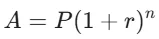
At a 9% nominal annual return — broadly in line with the long-run total return of US equities, and on the optimistic side of the global equity literature — a single $10,000 deposit, untouched, evolves as follows:
| Horizon | Future value | Multiplier | Growth in this decade |
|---|---|---|---|
| 5 years | $15,386 | 1.5× | — |
| 10 years | $23,674 | 2.4× | $13,674 |
| 20 years | $56,044 | 5.6× | $32,370 |
| 30 years | $132,677 | 13.3× | $76,633 |
The non-obvious detail is in the last column. Growth between year 20 and year 30 ($76,633) is greater than the entire growth of the prior twenty years combined. This is the back-heavy property of geometric compounding, and it has a hard implication: most of the eventual wealth in any long-horizon plan is generated in a window the investor has not yet reached. Contributions and discipline in the first decade are paid for in the third. A separate piece on the final-decade asymmetry develops this point; the short version is that anyone who quits at year 12 because the trajectory looks linear has misread the curve.
The growth between year 20 and year 30 is larger than the growth of all the prior twenty years combined. Most of the wealth in a long-horizon plan is generated in a window the investor has not yet reached.
Implementation friction beginners underestimate
Three forms of friction routinely turn a clean spreadsheet into a messy realized return. Each is small in any given year and large over thirty.
Fee drag, compounded. A 0.50% expense ratio versus 0.03% looks like nothing on a $10,000 balance — $47 a year. Over 30 years at 9% gross, that 47-basis-point gap costs roughly $20,000 of terminal value on the same starting deposit. Faithfulness in small things is basis-point arithmetic the investor will eventually inherit.
Tax-cost ratio. In a taxable account, fund turnover and the qualified-versus-ordinary character of distributions matter as much as gross return. An active mutual fund with 60% turnover and a meaningful share of short-term gains can quietly hand back 100–200 bp per year in tax cost — invisible on a brokerage statement, very visible on a Form 1099. Index ETFs with low turnover and primarily qualified dividends remain the default for taxable accounts not for ideological reasons but for after-tax arithmetic. Inside an IRA or HSA, the tax-cost ratio is effectively zero, which is why high-turnover or high-yield strategies belong there if they belong anywhere.
Behavioral cost. The DALBAR studies have well-known methodology issues, but the qualitative finding — that the average investor underperforms the average fund they own — survives most reasonable reformulations. The gap is paid in poorly-timed switches. A written rebalancing rule and an automated contribution schedule are the two cheapest defenses against that gap, and they cost nothing to implement.
What this framework cannot tell you
Three honest limits belong in the body, not the disclaimer. First, the 9% illustration above is a single-path geometric calculation, not a distribution. Realized long-horizon outcomes for a US equity sleeve over rolling 30-year windows since 1928 cluster between roughly 6% and 12% nominal CAGR; the dispersion is wide and the investor does not get to choose where they land. Sequence-of-returns risk — the order in which good and bad years arrive — matters most when contributions or withdrawals are large relative to the balance, which is precisely the situation when an investor first deploys $10,000.
Second, the framework is silent on the investor's specific tax bracket, state of residence, employer plan vesting, and household balance sheet. None of those are decorative; all of them can dominate the decision.
Third, factor and macro regimes shift on multi-decade scales. A framework calibrated to the post-1990 disinflation era has not been stress-tested against a sustained inflationary regime. With CPI still running at 3.9% YoY (FRED CPIAUCSL, asof 2026-04-01) and rates well above the 2010s baseline, the prudent response is not to reach for inflation hedges by reflex, but to recognize that the next decade's real returns are unlikely to look identical to the last. Position-level adjustments to the 2026 backdrop are a separate question from the framework that survives across regimes.
FAQ
Should I wait for a market pullback before deploying $10,000?
Empirically, lump-sum deployment beats dollar-cost averaging in roughly two-thirds of historical windows for equities, because markets are up most years. The case for spreading the deposit over six to twelve months is behavioral, not statistical: it makes it more likely the investor stays invested through the first drawdown. If splitting the deposit is what makes the framework hold, split it. If not, deploy.
Is the current environment (4.5% 10Y, VIX 17.3) a good or bad time to start?
Both adjectives over-claim. A VIX of 17.26 sits in the calm half of its historical range, and yields above 4% mean the conservative sleeve actually pays real income. Neither is predictive of the next twelve months. The framework is not built to time the entry; it is built to survive whatever the entry turns out to have been.
Roth IRA, Traditional IRA, or HSA first?
For investors eligible for an HSA through a high-deductible health plan, the HSA's triple-tax-advantaged structure is hard to beat on an arithmetic basis — contributions deductible, growth tax-free, withdrawals tax-free for qualified medical expenses. After that, the Roth-vs-Traditional choice reduces to a marginal-tax-rate comparison: current bracket versus expected retirement bracket. Younger investors in lower current brackets generally favor Roth; investors in their peak earning years often favor Traditional. An available employer match precedes both.
How much should be in international stocks?
The honest answer is "anywhere from 0% to a market-cap-weighted ~40%, defended once and held." Forward-looking diversification arguments support international exposure; backward-looking 2010s US outperformance argues against it. Picking a number between 20% and 40% and committing to it matters more than picking the exactly right number.
Robo-advisor or DIY portfolio?
For an investor who will not write and follow their own allocation policy, a robo-advisor's roughly 25 bp fee is cheap insurance against behavior drift. For an investor who will, the same 25 bp compounds into a meaningful drag. The decision is honestly about self-knowledge, not technology.
Editor's read
If forced to compress this into a single starting move for an investor deploying their first $10,000 today, the editor would prioritize the wrapper decision over everything else, write a one-page allocation policy (target weights, drift bands, contribution schedule), and accept whatever broad-market index funds are cheap and liquid inside that wrapper. The fund choice is a leaf node; the allocation policy is the root. A polished ticker list inside the wrong account is worse than a boring ticker list inside the right one. Initially the editor underweighted how much the wrapper decision dominates; running the after-tax arithmetic over 30 years on a high-turnover fund inside a taxable account is what permanently changed the ordering.
Key takeaways
- The wrapper decision (taxable vs. Roth IRA vs. Traditional IRA vs. 401(k) vs. HSA) outweighs the ticker decision for a first $10,000 in nearly every realistic case.
- Asset allocation is the load-bearing structure; fund selection is a leaf node. A written allocation policy beats a clever fund pick.
- Compounding is back-heavy: roughly 58% of the 30-year terminal value at 9% is generated in years 21–30 — a window the investor has not yet reached on day one.
- Three forms of friction (fee drag, tax cost, behavioral cost) routinely cost more than a ticker mistake. The first two are decided once; the third is the only one that takes ongoing discipline.
- The 2026 macro backdrop (4.5% 10Y, VIX 17.3, 3.9% CPI) is irrelevant to whether the framework works and informative about how much patience currently costs.
Methodology: compounding figures use A = P(1 + r)n with P = $10,000 and r = 9% nominal annual, no contributions and no taxes. Macro figures sourced from the Federal Reserve Economic Data (FRED) series DGS10, DFF, VIXCLS, and CPIAUCSL, fetched 2026-05-18; asof dates cited inline. Allocation literature references: Brinson, Hood & Beebower (1986), Daryanani (2008), Vanguard rebalancing research (2024).
The editor holds broad-market index ETFs as the core of a long-horizon, buy-and-hold allocation; specific holdings, weights, and account types are not disclosed. This article is for educational purposes and does not constitute personalized financial advice. See Disclaimer for full terms.