
The short version
- Starting an ETF portfolio is a sequence of four decisions — horizon, account type, allocation, rebalancing rule. Get that sequence right and the ticker question becomes almost trivial.
- For a long-horizon US-domiciled investor, four building blocks cover ~95% of the territory: broad US equity, ex-US equity, a short-duration cash sleeve, and an optional yield or factor tilt.
- With the 10Y Treasury at 4.47% and VIX at 17.26, the 2026 regime rewards disciplined contributions, not regime-specific bets.
Most beginner ETF guides start with a list of tickers. That is the wrong place to start. The decisions that actually shape a 30-year outcome — what you own, why you own it, what account it lives in, and how you behave when prices move — all sit upstream of the ticker. This roadmap walks through that sequence in the order it should be made, with the 2026 macro tape as the backdrop.
Why ETFs solved the easy problem
Exchange-traded funds democratized something that was institutional twenty years ago: cheap, transparent, broadly diversified exposure with intraday liquidity. The mechanical advantages — in-kind creation/redemption that limits embedded capital gains, daily holdings disclosure, and razor-thin expense ratios — are well documented. Sharpe's The Arithmetic of Active Management (1991) is the foundational paper for why low-cost passive vehicles win on average in aggregate; Bogle extended the cost argument over decades.
What changed in the last ten years is the price. Vanguard's core US-equity products run at a 0.03% expense ratio. International is at 0.05%, short-duration Treasuries at 0.09%. The implication for a new investor: cost is no longer the variable to optimize. The variables that remain — framework, behavior, implementation friction, tax location — are precisely the variables most beginner guides skip.
The canonical building blocks (with real numbers)
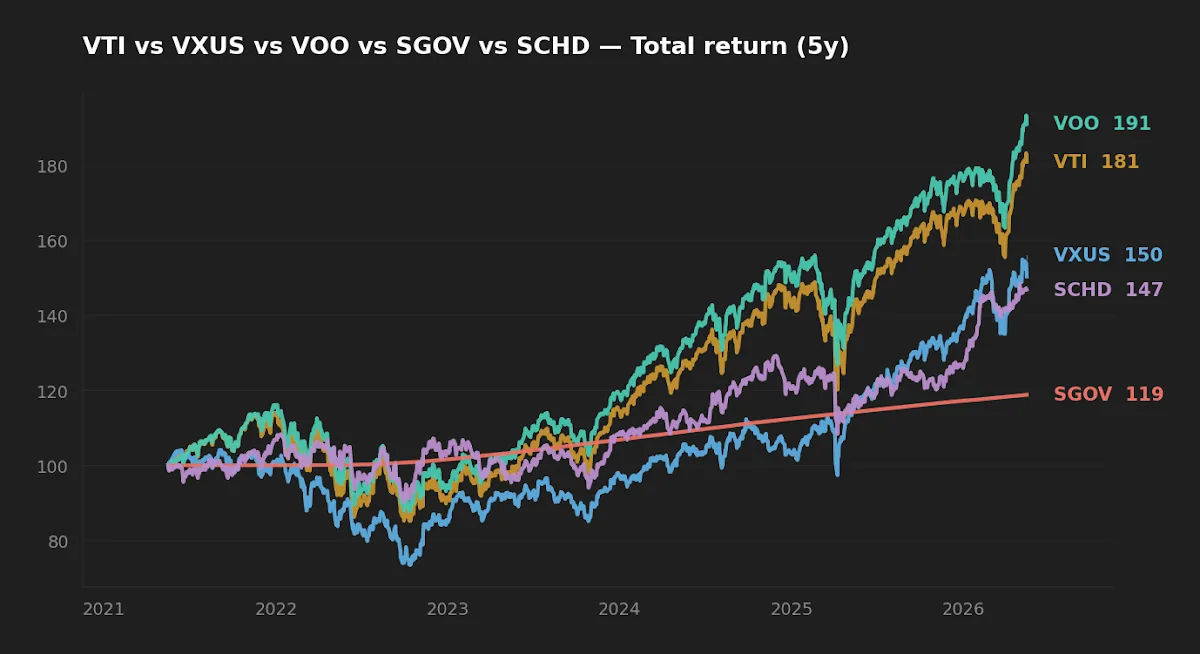
The table below uses live data pulled 2026-05-16. Expense ratios cross-checked against issuer fact sheets; price-return series from Yahoo Finance via yfinance.
| Ticker | Scope | ER | AUM | Yield | 5Y CAGR | 5Y vol | Max DD | Fact sheet |
|---|---|---|---|---|---|---|---|---|
| VTI | US total market | 0.03% | $2,202.6B | 1.1% | 12.7% | 17.4% | -25.4% | Vanguard |
| VOO | S&P 500 | 0.03% | $1,600.2B | 1.1% | 13.9% | 16.8% | -24.5% | Vanguard |
| VXUS | Ex-US developed + EM | 0.05% | $629.1B | 2.8% | 8.5% | 16.0% | -29.4% | Vanguard |
| SCHD | US dividend-quality | 0.06% | $91.1B | 3.3% | 8.2% | 14.4% | -16.8% | Schwab |
| SGOV | 0–3 mo Treasuries | 0.09% | $85.2B | 3.9% | 3.5% | 0.2% | -0.0% | iShares |
A few details worth pausing on. VOO's 5Y CAGR of 13.9% beats VTI's 12.7% by 120 basis points — small- and mid-caps have been a drag over this specific window, not a tailwind. VXUS at 8.5% trails VOO by 540 bps over the same period and carries a deeper max drawdown (-29.4% vs -24.5%). SCHD's max drawdown of -16.8% is meaningfully shallower than VOO's, and its 14.4% realized vol is the lowest of the equity sleeves — the quality-dividend tilt has done what the literature suggests it should.
The framework before the tickers
Before opening a brokerage account, write down four answers on one page:
- Horizon. If the answer is "I might need this in five years for a house," ETFs designed for 30-year holders are a poor fit. The sleeves below assume at least 15 years.
- Account type. Tax-advantaged (Roth IRA, 401(k), HSA) versus taxable. The same allocation behaves very differently. A high-yielding fund in a 32% federal bracket inside a taxable account loses materially more to tax drag than the same fund in a Roth.
- Target allocation. The high-level split — say, 70% equity / 20% bonds / 10% cash — drives the bulk of the variance in long-horizon outcomes. The specific equity tickers drive the rest. The asset-allocation gap is where most multi-decade dispersion lives.
- Rebalancing rule. Pick one and write it down before you need it. Two defensible options: calendar (once a year on a fixed date) or band-based (rebalance any sleeve that drifts beyond ±15% or ±25% of its target weight, per Daryanani 2008 and Vanguard's 2024 rebalancing research). The point is to remove the in-the-moment decision; the worst rebalancing rule is whichever one you invent during a drawdown.

The four building blocks, weighted
For a long-horizon, US-domiciled investor, a working starting allocation looks like this:
- Broad US equity (50–70% of the equity sleeve). VTI or VOO. The S&P 500 captures ~80% of US market cap; VTI extends to small- and mid-caps. At a 0.03% ER for both, the choice is closer to aesthetic than economic.
- Ex-US equity (20–40% of the equity sleeve). VXUS. Whether to hold international is genuinely contested. The case rests on regime diversification, not on the assumption that international will outperform. The last fifteen years has been a poor advertisement for that case — the next fifteen may not be.
- Cash / short-duration sleeve (5–15% of the portfolio). SGOV. With the front end of the curve at 3.94% yield and the 10Y at 4.47%, cash earns a real return for the first time in over a decade. This sleeve does two jobs: it lets you rebalance into drawdowns without forced selling, and it preserves optionality. Strategic cash is not a drag — it is a tool.
- Optional tilt (0–20% of the equity sleeve). A factor or income sleeve — SCHD for quality-dividend, a small-cap value ETF for the AQR-style tilt, or similar. Preference legitimately enters here. Skip it entirely and you still have a fully defensible portfolio.
What is not on this list: thematic funds, single-country plays outside the home market, and leveraged products. The case for leveraged ETFs in a long-horizon portfolio is narrow and well-bounded; for a beginner, the right default is to stay out.
The variables that remain after cost is solved — framework, behavior, tax friction — are exactly the variables that beginner guides skip, and exactly the ones where new investors actually lose money.
Realized risk: what the drawdown chart shows
The drawdown chart below plots each ETF's underwater curve over the past five years. A few things stand out. SGOV is essentially a flat line at zero — max drawdown of -0.03% over five years, with realized vol of 0.2%. That is the entire point of the cash sleeve: not return, but option value during equity drawdowns. SCHD's -16.8% trough is shallower than VOO's -24.5% and VXUS's -29.4%. That is the empirical signature of a quality screen — lower-beta names with healthier balance sheets recover faster from regime stress.
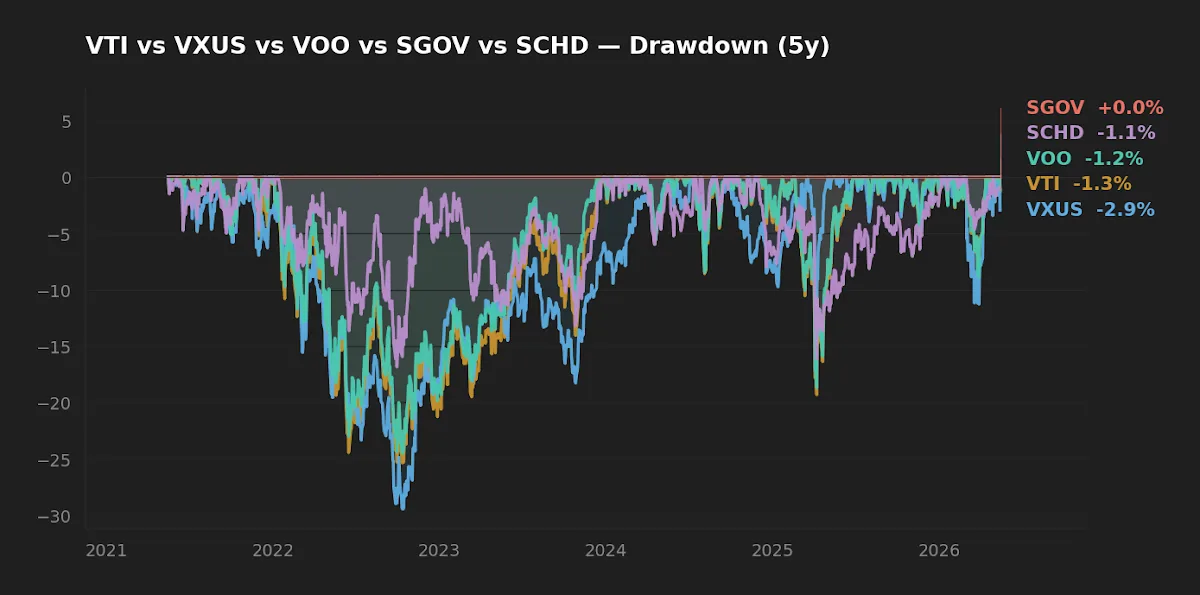
The non-obvious observation: VXUS carries the deepest drawdown and the lowest 5-year return. That combination is what makes the "international, yes or no?" question genuinely hard. The case for it is regime coverage — the fifteen-year underperformance window is real, but it is a single regime. Excluding ex-US equity is a bet that the next regime will look like the last one.
What the 2026 macro tape means for someone just starting
The numbers at the top of this article define the regime in which a new investor is making first decisions:
- 10-year Treasury at 4.47% (FRED, asof 2026-05-14). For the first time since the 2010s, the risk-free rate is materially positive in real terms. The opportunity cost of holding cash is no longer punitive; it is a real choice.
- Fed funds at 3.64% (FRED, asof 2026-04-01). The cutting cycle is well underway but not finished. Front-end yields remain attractive — but the carry compresses as cuts progress.
- VIX at 17.26 (FRED, asof 2026-05-14). Mid-teens VIX is a low-stress regime. Strategies that look great in low-vol regimes — concentrated single-country, levered long, short-volatility carry — historically lose their advantage in the next regime change.
- CPI YoY at 3.9% (FRED, asof 2026-04-01). Still above the Fed's 2% target. Real returns on cash are positive but slim; equity remains the only asset class with a structural inflation hedge over multi-decade horizons.
The implication is not "buy now" or "wait." It is that this regime is a poor moment to make regime-specific bets. Disciplined contributions across the cycle are the appropriate response.
Implementation friction the slick guides skip
Three details matter more than they look:
- Bid-ask and trade timing. For high-AUM ETFs (VTI, VOO, VXUS), spreads at 9:30 AM and 3:55 PM Eastern are noticeably wider than mid-session. For small-AUM funds, spreads at any time can erode 5–10 basis points per round-trip. Trade in mid-session, in normal market conditions, in round lots where possible.
- Tax-cost ratio is not the expense ratio. A 0.06% ER fund with high turnover and ordinary-income distributions can carry a tax-cost ratio of 0.5%+ in a taxable account. The fee on the label is not the fee on your statement.
- Asset location. Put high-yield, ordinary-income generators (bonds, REITs, high-yield equity income) in tax-advantaged accounts. Put low-distribution, qualified-dividend equity in taxable. The same allocation, optimally located, can save 30–50 basis points per year over a multi-decade horizon — comparable to the cost gap between a typical active fund and an index fund.
The behavioral test most new investors fail
The first 5% drawdown is uneventful. The first 20% drawdown — and a long-horizon portfolio will see several — is when the framework is tested. Risk in a long-horizon ETF strategy is less about volatility than about the probability you abandon the plan during a regime you didn't pre-commit to. The fix is mechanical: write the rebalancing rule, write the contribution schedule, automate both, and let the system carry you through the part where conviction would otherwise fail.
Scoreboard: which sleeve wins on which axis
| Category | Winner | Why |
|---|---|---|
| Cost | VTI / VOO (tie) | 0.03% ER, the floor of the market |
| Realized 5Y return | VOO (13.9%) | Large-cap concentration paid off in this regime |
| Realized 5Y risk | SGOV / SCHD | SGOV near-zero DD; SCHD -16.8% vs broad market -25% |
| Diversification breadth | VTI + VXUS | Captures global market cap, not single-country |
| Income | SGOV (3.9%) | Above SCHD's 3.3%, with near-zero risk |
Frequently asked questions
Should I wait for a market dip to start? The academic literature on lump-sum versus dollar-cost averaging is consistent: lump-sum wins roughly two-thirds of the time, simply because markets rise in most twelve-month windows (Vanguard, "Dollar-cost averaging just means taking risk later," 2012). For most beginners, the practical answer is: start now with an appropriate amount, automate monthly contributions, ignore the entry price.
How many ETFs do I actually need? Two is enough (VTI + SGOV, or VTI + a bond fund). Three to four is typical (add VXUS, optionally a tilt). Beyond five core funds, marginal diversification benefit approaches zero while complexity costs rise.
Is dollar-cost averaging better than lump sum? Statistically no, behaviorally often yes. If lump-sum makes you anxious enough to sell at the next 10% pullback, the statistical edge does not survive. DCA is a behavioral tool with a small expected-return cost.
Do I really need international exposure? The honest answer is "we don't know, and the data after 2008 has been a poor advertisement for it." The case rests on regime diversification, not expected outperformance. Holding 20–30% international in the equity sleeve is defensible; zero is also defensible; 50% is harder to justify on the current evidence.
How often should I rebalance? Once a year on a fixed date is sufficient for most investors. Band-based rebalancing (±15% drift on any sleeve) captures slightly more of the rebalancing premium but requires monthly checking. Pick whichever rule you will actually follow.
Scenarios where each block fits
- Reader in their 30s, 401(k)-only, no current equity exposure → VTI or VOO at ~80% of the equity sleeve, VXUS at ~20%, SGOV at 5–10% for the rebalancing reserve. Skip the tilt.
- Reader with a Roth IRA + taxable account → high-yield sleeves (SCHD, any bond exposure) in the Roth; VTI/VOO in taxable for tax efficiency. Asset location matters more than ticker selection here.
- Reader saving for a horizon under 7 years → SGOV-heavy. Equity sleeve sized to the loss tolerance, not the return target.
- Reader who already holds VTI and wants a defensible second sleeve → VXUS for regime diversification, or SCHD if the goal is realized-volatility reduction.
What this guide can and can't tell you
This roadmap is general; your situation is specific. The 5- and 10-year CAGRs above are realized history over a single regime — a regime defined by zero rates, a pandemic shock, rapid rate hikes, and a large-cap-led recovery. None of those numbers should be read as forward expected returns. The dataset cannot tell you the right equity weight for your horizon, the tax treatment of distributions in your jurisdiction, or whether your specific 401(k) has lower-cost institutional share classes than the retail tickers shown. The framework is the scaffolding; the numbers go in based on the four answers you write down for yourself.
Editor's read
If the editor were starting from scratch in May 2026, the sequence would be: open a Roth-equivalent tax-advantaged account first (highest leverage), pick a single broad-market US equity ETF as the anchor (VTI or VOO — toss a coin), add VXUS at roughly one-third of the equity sleeve only after deliberately deciding international diversification is wanted, and route the cash sleeve into SGOV while the front end of the curve still pays 3.9%. Skip the factor tilt entirely for the first 12–24 months. The marginal hour is far better spent automating contributions than choosing between SCHD and a small-cap value tilt.
The editor holds a long-horizon portfolio built around broad-market US and ex-US index ETFs plus a short-duration cash sleeve. Specific weights and ticker-level positions are not disclosed.
Key takeaways
- The four-decision framework (horizon, account, allocation, rebalancing rule) does more work than ticker selection ever will.
- Cost is solved at 0.03–0.09% across the canonical building blocks; the remaining variables are framework, behavior, and tax friction.
- Realized 5-year data shows VOO at 13.9% CAGR vs VXUS at 8.5% — but with VXUS carrying a deeper drawdown, the case for ex-US rests on regime coverage, not expected return.
- The 2026 regime (10Y at 4.47%, VIX 17.26, CPI 3.9%) is a poor moment for regime-specific bets and a fine moment for disciplined contributions.
- The behavioral test is the binding constraint; automating contributions and rebalancing pre-empts it.
Methodology
Expense ratios, AUM, NAV, trailing yield, and return/volatility/drawdown statistics for VTI, VOO, VXUS, SCHD, and SGOV were pulled via yfinance on 2026-05-16. Issuer fact sheets (Vanguard, Schwab, iShares) were used to cross-check expense ratios. Macro inputs (10Y Treasury, fed funds rate, VIX, CPI YoY) are from FRED with asof dates shown inline. Rebalancing-rule references: Daryanani (2008), Opportunistic Rebalancing, and Vanguard 2024 rebalancing research. The 5- and 10-year windows are single-regime samples and should not be read as forward expected returns.
This article is for educational purposes and does not constitute personalized financial advice. See Disclaimer.