
Photo by Brecht Corbeel on Unsplash
The short version
- XLC and VOX both label themselves "communication services," but the sector is functionally a large-cap growth vehicle: Meta, Alphabet, and Netflix dominate the top weights in each.
- The fee gap is one basis point (0.08% vs 0.09%) — trivial. The real divergence is construction: XLC is S&P 500 large-caps only; VOX reaches down into mid- and small-caps through a broader index.
- Bottom line: XLC suits a reader who wants a concentrated S&P 500 sector slice; VOX suits one who prefers a slightly wider, longer-track-record wrapper on the same names.
The communication-services sector is one of the more misunderstood corners of the market. After the 2018 GICS reclassification pulled Alphabet, Meta, and Netflix out of technology and consumer discretionary and dropped them into "communication services," the label stopped describing telephone companies and started describing some of the largest growth franchises in the index. The central question here is narrow but practical: if you want exposure to that sector, does it matter whether you use XLC or VOX?
Context: what "communication services" actually holds
Both funds track a communication-services benchmark, and both are dominated by the same handful of mega-cap names. That is the first thing to internalize. When a reader buys either ticker expecting a defensive telecom sleeve — the old dividend-heavy, utility-adjacent sector — they are instead buying a concentrated bet on interactive media and internet advertising. Verizon and AT&T are in there, but they are not what moves the fund.
The two products differ in their parent index and their coverage depth. XLC, the State Street SPDR fund, holds only communication-services members of the S&P 500 — large-cap, U.S., roughly two dozen positions. VOX, the Vanguard fund, tracks a broader U.S. investable-market benchmark that reaches into mid- and small-cap names, giving it a longer holdings list. Both apply diversification caps (the 25%/50% rules that keep any single position and the cluster of large positions within regulated limits), so neither lets one stock run unbounded. The practical consequence: the top of each portfolio looks nearly identical, and the tail is where they part ways.
The data
| Metric | XLC | VOX |
|---|---|---|
| Name | SPDR Communication Services Select Sector | Vanguard Communication Services Index |
| Expense ratio | 0.08% | 0.09% |
| AUM | $22.3B | $5.9B |
| Inception | 2018-06-18 | 2005-03-11 |
| Dividend yield | 1.3% | 1.1% |
| 5Y CAGR | 8.1% | 7.5% |
| 10Y CAGR | n/a (2018 inception) | 8.6% |
| 5Y volatility (ann.) | 20.8% | 21.3% |
| Max drawdown (5Y) | -46.7% | -46.8% |
Return and volatility figures are computed from yfinance price history (pulled 2026-07-16); expense ratio, AUM, inception, and yield are from the issuer fact sheets — State Street SPDR (XLC) and Vanguard (VOX).
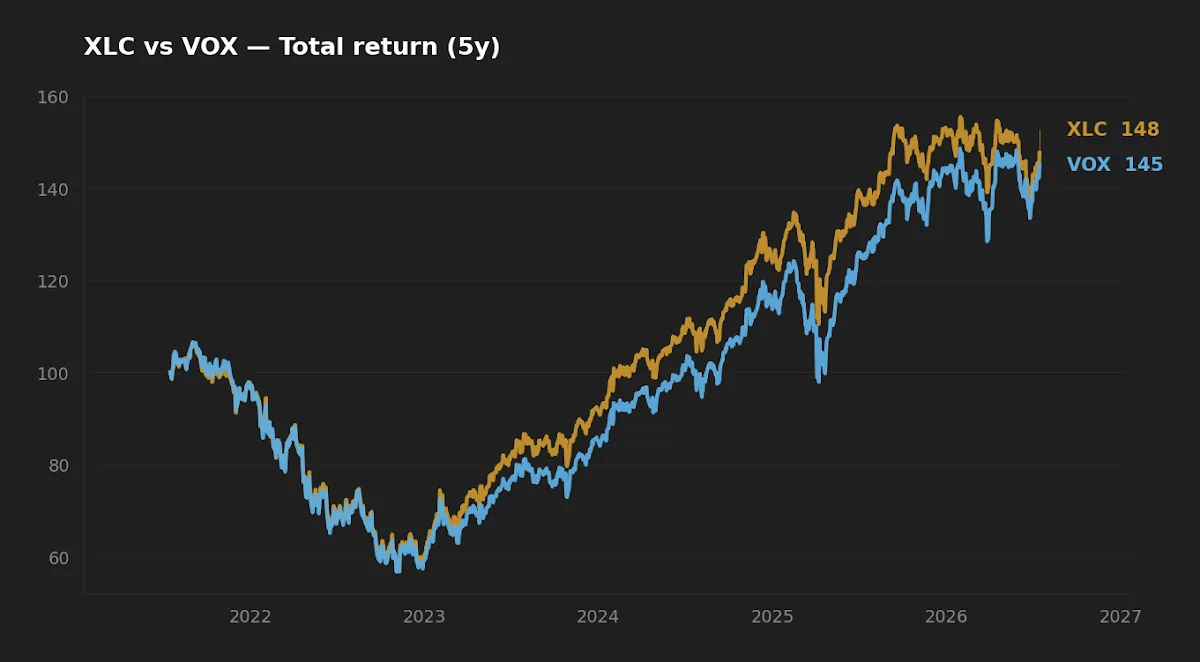
Cost is a rounding error here
The expense ratios are 0.08% and 0.09% — a one-basis-point gap. On a $10,000 position that is one dollar a year. I usually argue that basis points compound and deserve attention, and they do; but the honest read is that at this scale the fee difference is not a decision variable. It would take an implausibly long horizon for a single basis point to overcome any tracking difference or spread cost between the two. When two funds are this close on cost, the cost column is a tie and the analysis has to move on to construction and behavior.
Liquidity is the one cost dimension where XLC has a genuine edge. At $22.3B in assets against VOX's $5.9B, XLC is the deeper, more heavily traded vehicle, which tends to translate into tighter bid-ask spreads for anyone trading in size. For a buy-and-hold reader adding a few hundred dollars a month, that spread advantage is close to invisible. For a larger lump-sum rebalance, it is worth a glance at the quote before submitting.
Where the returns diverge — and why it is smaller than it looks
Over the trailing five years, XLC compounded at 8.1% and VOX at 7.5% — a 0.6-percentage-point annual gap. That is not nothing over a decade, but before treating it as a verdict, look at what drives it. Both funds are anchored by the same mega-cap names, so their top-weight behavior is nearly identical. The gap comes almost entirely from the tail: VOX's exposure to mid- and small-cap communication names, which have lagged the mega-cap leaders through this particular cycle.
This is the non-obvious point. VOX is the more diversified fund, and in a period where the largest names carried the sector, broader diversification was a mild drag rather than a benefit. XLC's narrower, S&P-500-only construction concentrated capital in exactly the names that led. Read the five-year gap not as "XLC is the better fund" but as "the mega-cap leadership regime favored the more concentrated wrapper." A different regime — one where the mega-caps stall and mid-caps catch up — would flip the sign of that gap. The data captures one regime, not a structural edge.
It is also worth framing the yields against the macro backdrop. XLC yields 1.3% and VOX 1.1%, while the 10-year Treasury sits at 4.58% (FRED, asof 2026-07-14). Neither of these is an income instrument, and a reader reaching for yield would find better-defined tools elsewhere. The dividend here is incidental to a growth-oriented equity sleeve, not the reason to own it.
The five-year return gap is not evidence that one fund is better built — it is evidence that mega-cap leadership rewarded the more concentrated wrapper. A different regime flips the sign.
Realized risk: nearly indistinguishable
On the risk side, the two funds are effectively twins. Five-year annualized volatility is 20.8% for XLC and 21.3% for VOX. Maximum drawdown over the same window is -46.7% for XLC and -46.8% for VOX — a difference well inside measurement noise. Both funds fell roughly in half at their worst point, which lines up with the 2022 drawdown in growth and internet names, when rising rates repriced long-duration equity cash flows.
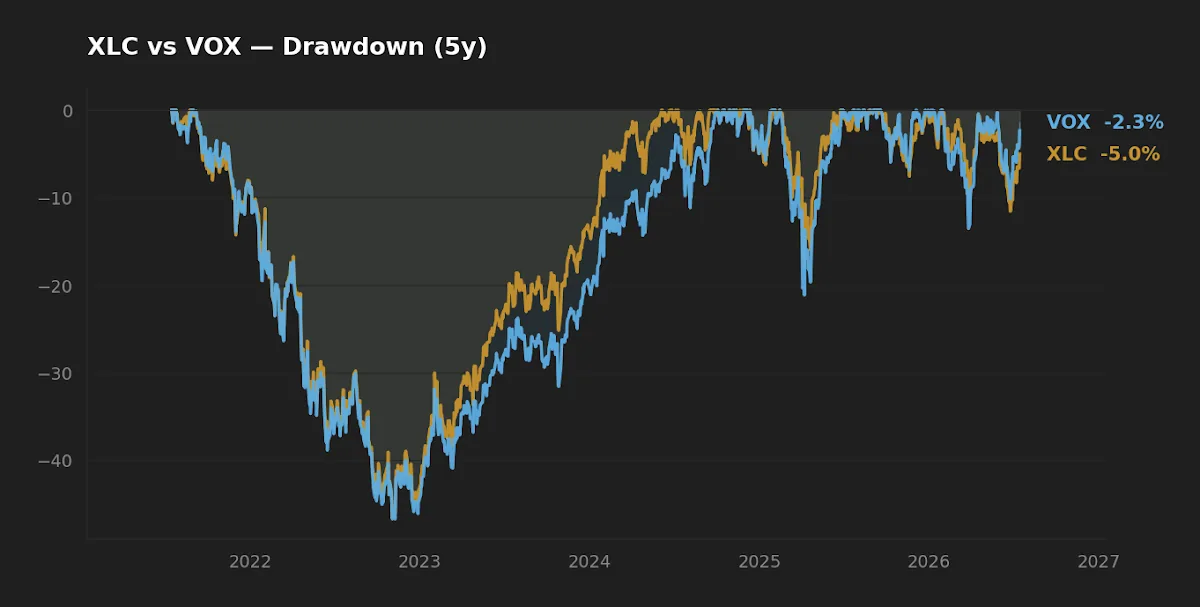
The lesson from the drawdown chart is not which fund fell less — they fell the same. It is the depth itself. A near-50% peak-to-trough decline is the cost of admission for a concentrated sector sleeve built on high-multiple growth names. Any reader sizing this sector into a long-horizon portfolio should assume that kind of drawdown will recur, and should size the position so that behavior in stress stays disciplined. The current calm — VIX at 16.5 (FRED, asof 2026-07-14) — is not the environment to plan around; the drawdown environment is.
Construction and the diversification illusion
The word "diversified" needs care here. VOX holds many more names than XLC, so on a holdings count it is the more diversified fund. But because both apply concentration caps and both are dominated by the same three or four mega-caps, the effective diversification — how much the extra names actually change the return stream — is modest. The correlation between the two funds' returns is very high; you are not choosing between two different exposures, you are choosing between two very similar exposures with slightly different tails.
Readers who want to think about how sector sleeves fit a broader allocation may find the related discussion in VGT vs XLK and the rebalancing math behind cyclical sector sleeves useful, since the same concentration and overlap questions apply. Communication services overlaps heavily with any large-cap growth or Nasdaq-100 holding a reader already owns — a point worth checking before adding it as a standalone position.
FAQ
Is XLC or VOX cheaper to own? XLC is marginally cheaper at 0.08% versus 0.09%, a one-basis-point gap that is immaterial for practical purposes. XLC's larger asset base ($22.3B vs $5.9B) more likely matters through tighter trading spreads than through the headline fee.
Why do XLC and VOX perform so similarly? Both are dominated by the same mega-cap communication-services names — interactive media and internet companies — so their top holdings drive most of the return. The five-year CAGR gap (8.1% vs 7.5%) comes from VOX's additional mid- and small-cap exposure, which lagged in the recent mega-cap-led regime.
Are these funds a defensive telecom play? No. Despite the "communication services" name, both are growth-oriented, concentrated in internet and media franchises. The traditional telecom names are present but are a small part of the return. Yields of roughly 1.1%–1.3% sit well below the 4.58% 10-year Treasury, so neither is an income vehicle.
Which fund is more diversified? VOX holds more names because its index reaches into mid- and small-caps, but concentration caps and the dominance of a few mega-caps mean the two funds behave very similarly. The extra holdings in VOX change the tail, not the core.
How large a drawdown should I expect? Both funds fell roughly 47% at their worst over the past five years, during the 2022 repricing of high-multiple growth equity. A concentrated sector sleeve of this type should be assumed capable of a similar decline again.
Editor's read
If forced to choose one, the editor leans slightly toward XLC for a reader who specifically wants the S&P 500 slice — deeper liquidity, a one-basis-point lower fee, and a cleaner large-cap definition of the sector. VOX is the better fit for someone who prefers the broader investable-market wrapper and its longer live track record back to 2005. But the more important point is upstream of the ticker choice: both are concentrated, high-drawdown, growth-heavy sleeves that overlap substantially with any large-cap growth exposure a reader already holds. The decision that matters is whether the sector belongs in the portfolio at all and at what size — not which of these two nearly identical vehicles delivers it.
Editor's holdings disclosure: The editor does not hold either XLC or VOX at the time of writing.
What this comparison can and can't tell you: The return and risk figures cover a single five-year window (XLC has no ten-year history; it launched in 2018), which is dominated by one regime of mega-cap leadership and one major drawdown. It does not tell you how the funds would behave if mid- and small-cap communication names led, nor does it stress-test a prolonged sideways market. Treat the trailing numbers as a description of what happened, not a forecast.
Scenarios where each fund fits: A reader in their 30s, 401(k)-only, already holding a total-market or S&P 500 index fund, would find either XLC or VOX largely redundant — the sector is already inside the core holding. A reader deliberately overweighting communication services in a taxable account, trading in size, would tilt toward XLC for liquidity. A reader who values the broadest possible sector definition and a longer live record would prefer VOX.
Key takeaways
- The one-basis-point fee gap is a tie; construction and overlap are the real decision variables.
- XLC's 0.6-point five-year return edge reflects mega-cap leadership favoring its concentrated build, not a structural advantage.
- Risk is nearly identical: ~21% volatility and ~-47% max drawdown for both.
- Neither is an income or defensive play despite the sector name; both are large-cap growth in disguise.
- Check overlap with existing growth holdings before adding either as a standalone sleeve.
Methodology: Price and return series (5Y/10Y CAGR, annualized volatility, maximum drawdown) computed from yfinance daily price history, pulled 2026-07-16. Expense ratio, AUM, inception date, and dividend yield from issuer fact sheets (State Street SPDR for XLC; Vanguard for VOX). Macro reference figures — 10-year Treasury 4.58%, VIX 16.5 — from FRED, asof 2026-07-14. Window analyzed: trailing five years through 2026-07-16.
This article is for educational purposes and does not constitute personalized financial advice. See our Disclaimer.