
Photo by Vincent Y @USA on Unsplash
The short version
- Currency hedging removes exchange-rate volatility from a foreign equity position — the realized data shows it lowered both total volatility and drawdown over the past five years, but at a higher expense ratio.
- HEDJ isn't a clean test of hedging alone: it bundles a Europe-only, exporter-weighted factor tilt with the currency hedge, so its returns reflect more than the FX decision. DBEF versus VEA is the cleaner comparison.
- Bottom line: hedged funds fit shorter horizons and low-FX-tolerance investors; for a multi-decade unhedged core, the cost gap and the regime-dependence of the recent hedging edge argue for restraint.
Currency hedging is one of the few portfolio decisions where the marketing and the mechanics point in different directions. The pitch is intuitive: strip out exchange-rate noise and you own the foreign business, not a bet on the dollar. The mechanics are subtler — hedging carries an ongoing cost, earns or pays a rate-differential carry, and quietly changes which regime rewards you. The central question here is narrow and answerable: over a real holding period, did hedging your developed-market exposure help, and is the recent edge something a long-term investor should expect to persist?
Context: what hedging actually does
When a U.S. investor buys a European or Japanese stock, the return has two moving parts: the local-currency price change and the euro-or-yen-to-dollar move. An unhedged fund like VEA lets both flow through. A hedged fund uses currency forwards to neutralize the second part, so you receive close to the local-currency return converted at a fixed rate. That forward contract is not free, but its net cost is dominated by the interest-rate differential between the two currencies, not the fund's expense ratio. When U.S. short rates sit above foreign short rates — as they do now, with the fed funds rate at 3.63% (FRED, asof 2026-06-01) against lower policy rates in the euro area and Japan — the hedger earns that differential as positive carry. That carry has been a tailwind, not a drag, for the past several years. It is the single most important thing to hold in mind before reading any hedged-fund performance number.
The three funds here are not interchangeable, and the differences matter. VEA is broad, cap-weighted, unhedged developed-markets exposure. DBEF hedges the MSCI EAFE index — the closest thing to a clean "same index, currency removed" counterpart to a broad developed fund. HEDJ is narrower still: WisdomTree screens for European exporters and weights by dividends, then hedges the euro. So HEDJ answers a compound question — European exporters, plus a dividend tilt, plus a currency hedge — while DBEF isolates the hedge itself. Keep that distinction; it explains most of the return spread below.
The data
| Metric | HEDJ | VEA | DBEF |
|---|---|---|---|
| Name | WisdomTree Europe Hedged Equity | Vanguard FTSE Developed Markets | Xtrackers MSCI EAFE Hedged Equity |
| Expense ratio | 0.58% | 0.03% | 0.35% |
| AUM | $1.8B | $316.3B | $9.0B |
| Distribution yield | 1.8% | 2.5% | 2.3% |
| Inception | 2009-12-31 | 2001-01-04 | 2011-06-09 |
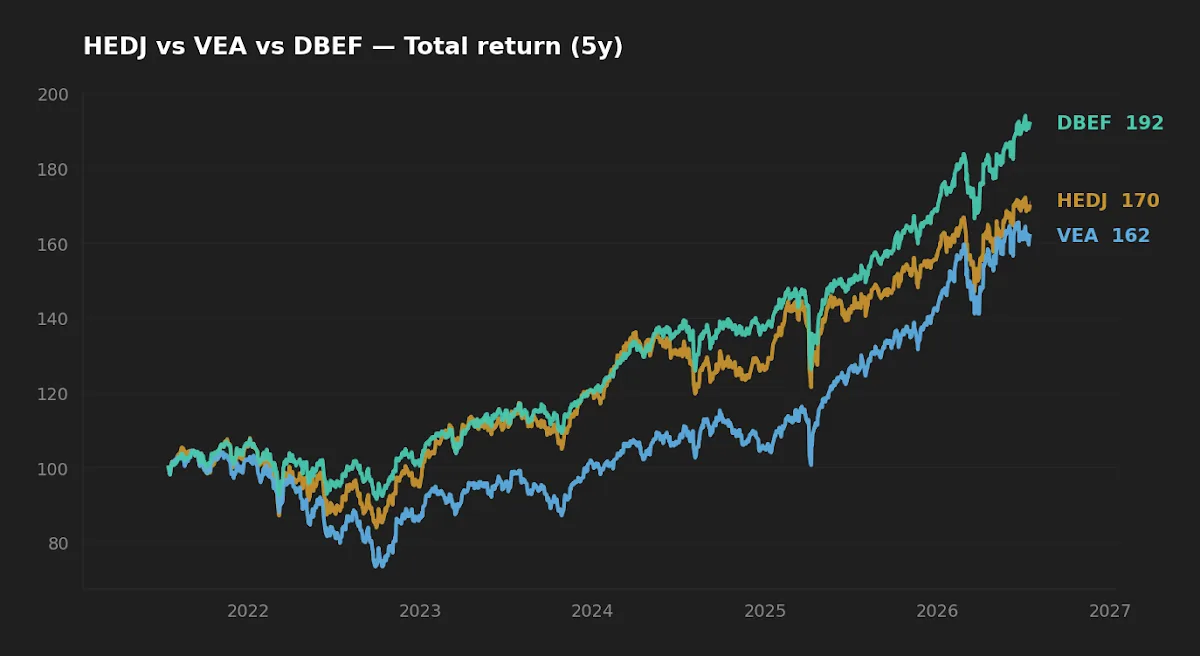
| 5Y CAGR | 11.5% | 10.2% | 14.0% |
| 10Y CAGR | 11.5% | 10.6% | 12.8% |
| 5Y volatility (annualized) | 16.8% | 16.8% | 13.8% |
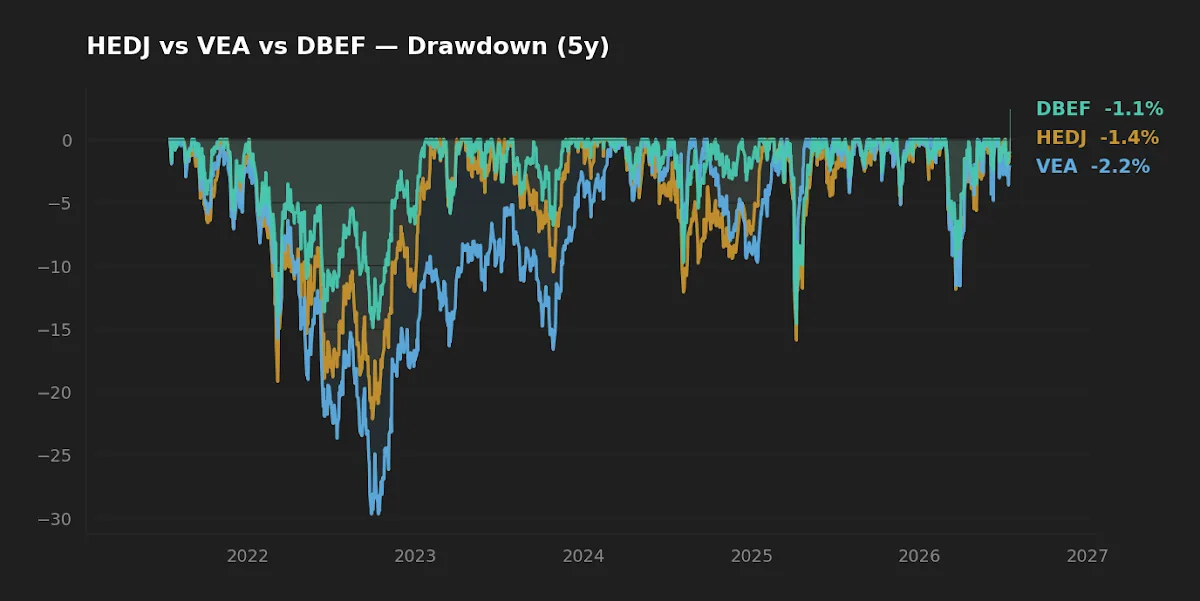
| 5Y max drawdown | -22.2% | -29.7% | -15.0% |
Price, return, volatility, and drawdown from yfinance, pulled 2026-07-16; five-year and ten-year windows ending that date. Expense ratio, AUM, yield, and inception from issuer fact sheets: HEDJ (WisdomTree), VEA (Vanguard), DBEF (Xtrackers).
Reading the return spread — carefully
The headline gap is real: DBEF compounded at 14.0% over five years against VEA's 10.2%, a 3.8-percentage-point annual difference. It is tempting to bank that as "hedging wins." It doesn't say that cleanly. Three forces are tangled inside it.
First, the currency regime. The dollar was broadly firm across much of this window, which mechanically penalizes unhedged holders — when the euro and yen fall against the dollar, VEA's return absorbs the loss and DBEF sidesteps it. Second, positive carry. With U.S. rates above foreign rates, the forwards inside DBEF added return rather than subtracting it. Third — and only for HEDJ — a factor and geography bet. HEDJ's 11.5% five-year CAGR sits below DBEF's despite also hedging, because its European-exporter, dividend-weighted portfolio is a different animal from broad EAFE. That HEDJ trails a broad hedged fund is the tell: the currency hedge is not the whole story for HEDJ, and treating it as a pure "hedged international" proxy misreads what you own.
Initially I read the DBEF-over-VEA gap as evidence that hedging is structurally additive. Then I framed it against the rate differential and the dollar path, and the edge is better described as regime-conditional: it is what a hedged fund should deliver when the dollar is strong and U.S. rates are high, and it is precisely what would reverse if either condition flips. The academic literature on currency hedging is consistent on the long-run point — over multi-decade horizons, hedged and unhedged developed-equity returns tend to converge, because currency movements are roughly mean-reverting and add no expected return of their own. What hedging reliably changes is not the destination but the path.
Hedging doesn't add expected return over decades — it trades exchange-rate volatility for a cost, and its recent edge is a regime rented, not a premium owned.
Realized risk: the part hedging actually delivers
If return is the noisy story, risk is the clean one. DBEF's five-year volatility of 13.8% against VEA's 16.8% is exactly what the theory predicts: removing FX variance from the return stream lowers total variance, because currency moves are an additional, imperfectly correlated source of fluctuation. The drawdown figures make the same point more viscerally — DBEF's worst five-year drawdown was -15.0% versus VEA's -29.7%. Part of that gap reflects the strong-dollar window (unhedged holders took an extra hit as foreign currencies fell during the drawdown), but part is structural: a hedged fund simply has fewer independent ways to lose value on any given day.
This is the honest case for hedging, and it has nothing to do with the return table. If your objective function penalizes drawdown and path volatility — because you are drawing income, because your horizon is measured in years not decades, or because you know your own behavior in stress — the volatility reduction is a benefit you can count on far more than the return premium you cannot.
Cost, scale, and implementation friction
VEA's 0.03% expense ratio against HEDJ's 0.58% is a 0.55-percentage-point annual gap, and DBEF's 0.35% sits in between. Basis points compound: on a long horizon, 55 bp a year is a meaningful, guaranteed subtraction that the fund must overcome before it adds anything. But the expense ratio understates hedged-fund cost. The forward-rolling process carries transaction friction and a carry component that is a headwind whenever foreign rates exceed U.S. rates — the mirror image of today's tailwind. Netting the two, the true cost of a hedge is state-dependent and can be materially higher or lower than the sticker fee.
Scale is worth a glance too. VEA's $316.3B versus HEDJ's $1.8B is a difference in liquidity, bid-ask spread, and closure risk. None of the three is at closure risk, but the tighter secondary market and deeper creation/redemption of a $300B-plus fund is a small, real edge for a buy-and-hold holder who values frictionless entry and exit across decades. For readers weighing whether to hold international at all, the prior questions of whether you need international exposure and how to split developed versus emerging markets come before the hedging decision, not after it.
| Category | Winner | Why |
|---|---|---|
| Cost | VEA | 0.03% vs 0.35% / 0.58%, plus no forward-roll carry exposure |
| Realized risk (5Y) | DBEF | Lowest volatility (13.8%) and shallowest drawdown (-15.0%) |
| Realized return (5Y) | DBEF | 14.0% CAGR — but regime-conditional, not a durable premium |
| Suitability as unhedged core | VEA | Breadth, cost, and no bet on the currency regime |
FAQ
Does currency hedging add return over the long run? The evidence says no — over multi-decade horizons, hedged and unhedged developed-equity returns tend to converge because currency moves add no expected return. What hedging reliably changes is volatility and drawdown, not the long-run destination.
Why did DBEF beat VEA by so much over five years? Three overlapping reasons: a broadly strong dollar penalized unhedged holders, positive carry (U.S. rates above foreign rates) rewarded the hedge, and DBEF avoided the FX drawdown VEA absorbed. All three are regime features that can reverse.
Is HEDJ just a hedged version of VEA? No. HEDJ is Europe-only, screens for exporters, and weights by dividends before hedging the euro. It bundles a factor and geography bet with the currency hedge, so it isn't a clean proxy for "hedged international." DBEF versus VEA is the cleaner hedged-versus-unhedged comparison.
What happens to hedged funds if U.S. rates fall below foreign rates? The carry flips from tailwind to headwind — the hedge would start costing the rate differential rather than earning it. That, combined with any dollar weakness, would erode the recent hedged-fund advantage.
Does hedging matter for account location? It can. Hedged funds' distributions and any forward-related income interact with your account type; the broader question of what belongs in a taxable versus tax-advantaged account is covered in this piece on account location.
What this comparison can and can't tell you
The five- and ten-year windows here cover a specific and unusually favorable regime for hedgers: a strong dollar and a positive U.S. rate differential. It does not include a sustained dollar-weakening period, which is exactly when unhedged VEA would be expected to outperform. Three funds, one currency-hedge implementation each, and a single decade is a thin sample for a decision whose payoff is regime-dependent. Treat the volatility and drawdown gaps as robust — they follow from mechanics — and the return gap as conditional on conditions that may not repeat.
Scenarios where each fund fits
Reader in their 30s, 401(k)-only, decades to compound, no current international sleeve → the currency decision is close to a wash over that horizon; the cost and breadth of unhedged broad exposure (VEA) is the low-friction default. Reader in or near retirement drawing income, low tolerance for FX-driven drawdown → the realized volatility and drawdown reduction of a broad hedged fund (DBEF) is a benefit worth paying 32 bp for. Reader with an explicit thesis on European exporters and a dividend tilt → HEDJ expresses that, but recognize you are buying three bets at once, not a pure hedge.
Editor's read
For a long-term unhedged core, the editor leans toward VEA. Currency hedging adds no expected return over decades, the recent hedged-fund edge is better read as rented from a strong-dollar, positive-carry regime than owned as a premium, and the 32-to-55 bp cost is a guaranteed subtraction against an uncertain benefit. DBEF is the more interesting fund than HEDJ — it isolates the hedge cleanly and its realized volatility and drawdown reduction are genuine — and it earns a place for shorter horizons or investors who know FX volatility would move their behavior. HEDJ's compound bet is a satellite position at most, not a core.
The editor holds broad unhedged international developed-market equity and does not hold HEDJ or DBEF at the time of writing.
Methodology. Price, total return, annualized volatility, and maximum drawdown computed from yfinance daily data, pulled 2026-07-16, over trailing five- and ten-year windows ending that date. Expense ratio, AUM, distribution yield, and inception from issuer fact sheets (WisdomTree, Vanguard, Xtrackers). Macro figures from FRED: fed funds rate 3.63% (asof 2026-06-01), 10-year Treasury 4.58% (asof 2026-07-14). CAGR, yield, and drawdown are reported to one decimal place.
This article is for educational purposes and does not constitute personalized financial advice. See our full Disclaimer.