Photo by Mick Haupt on Unsplash
The short version
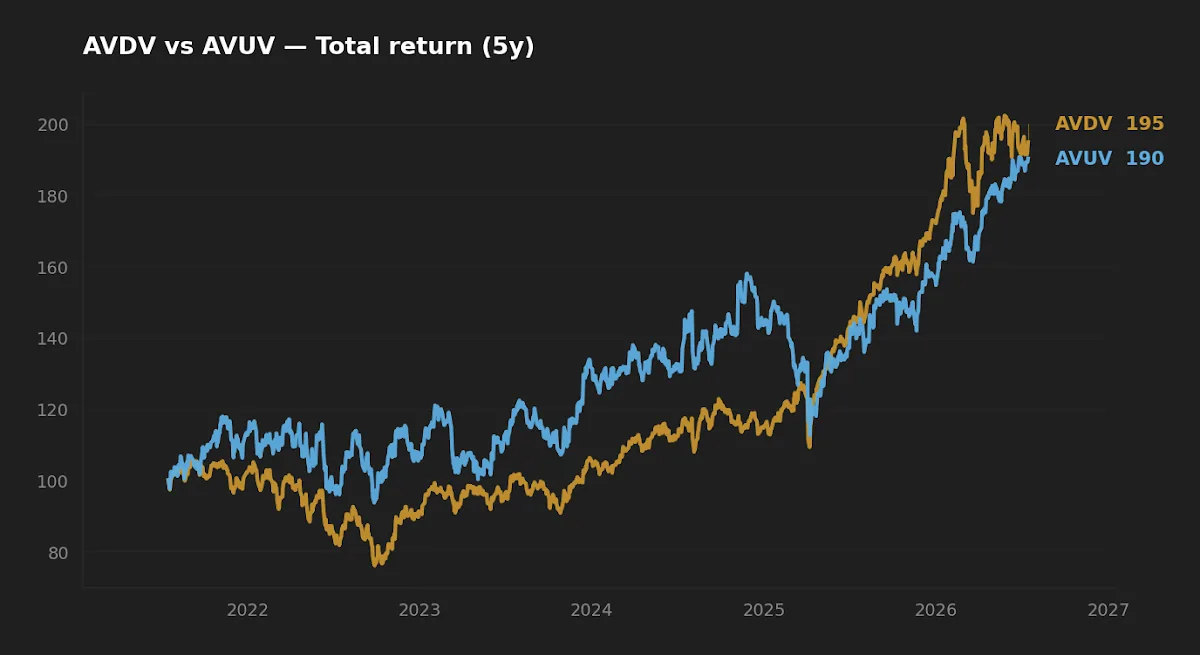
- Over the trailing five years, AVDV (developed ex-US small-cap value) compounded at 14.3% with 17.4% volatility, while AVUV (US small-cap value) compounded at 13.2% with 22.5% volatility — the overseas fund delivered a marginally higher return at meaningfully lower realized risk.
- The fee gap is 0.11% (0.36% vs 0.25%), and the two funds share an issuer, an inception date, and a factor construction — so the differences you see are exposure and currency, not process.
- Bottom line: these are complements, not substitutes. The overseas premium did travel, but a five-year sample sits inside one broad regime and can't settle the question of persistence.
The small-cap value premium is one of the most documented anomalies in the empirical asset-pricing literature, from Fama and French's original three-factor work through their later five-factor extension. The harder question for a long-term investor isn't whether the premium existed in US data — it's whether it shows up outside the United States, and whether an international implementation is worth holding alongside a domestic one. AVUV has become the default US expression of that idea; AVDV is Avantis's developed-markets-ex-US sibling. This comparison uses five years of realized data to ask what actually changed when the same process crossed the border.
Context: two funds, one process, different maps
Avantis International Small Cap Value ETF (AVDV) and Avantis US Small Cap Value ETF (AVUV) both launched on 24 September 2019 and both use the firm's systematic, quasi-index approach: rather than tracking a published benchmark, they screen a broad small-cap universe and overweight companies trading at lower valuations with higher profitability. The two funds are the closest thing available to a controlled experiment — same manager, same inception, same factor recipe — differing mainly in geography. AVUV holds US small caps. AVDV holds small caps across developed markets outside the US: Japan, the UK, Canada, Australia, and Western Europe carry most of the weight, which means AVDV also carries currency exposure that AVUV does not.
That currency layer matters more than most fund pages let on. A US-based holder of AVDV owns two bets stacked together: the local-currency return of overseas small-cap value, and the movement of those currencies against the dollar. Over some windows those add; over others they cancel. Keep that in mind before reading too much into any single five-year number.
The data
| Metric | AVDV | AVUV |
|---|---|---|
| Name | Avantis Int'l Small Cap Value | Avantis US Small Cap Value |
| Expense ratio | 0.36% | 0.25% |
| AUM | $19.2B | $29.1B |
| Inception | 2019-09-24 | 2019-09-24 |
| Distribution yield | 2.8% | 1.3% |
| 5Y CAGR | 14.3% | 13.2% |
| 5Y volatility (annualized) | 17.4% | 22.5% |
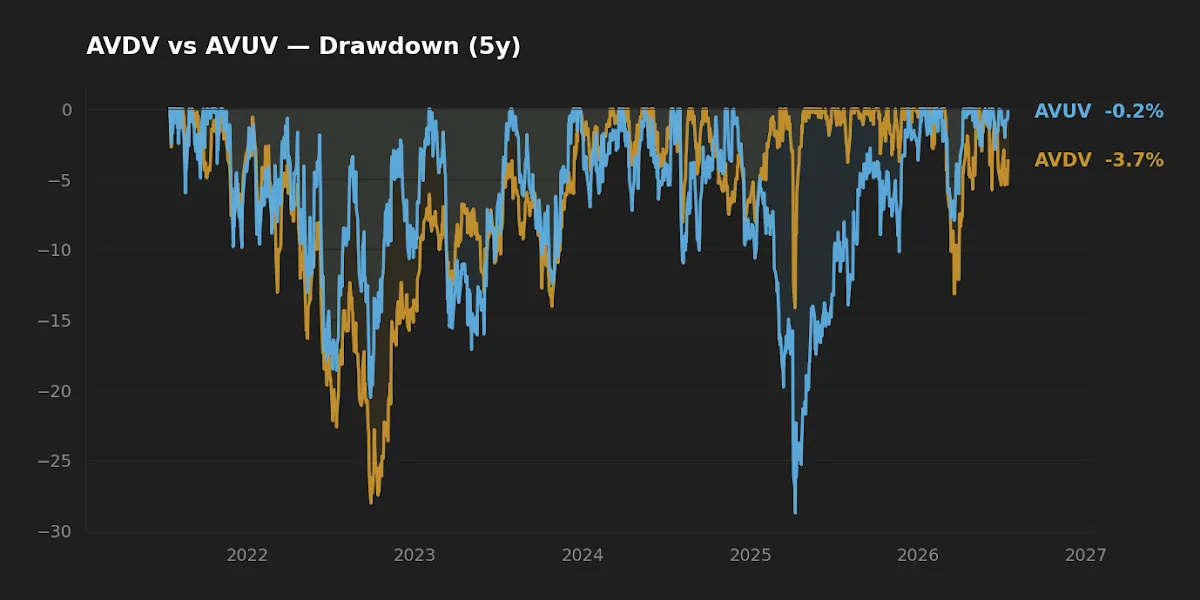
| 5Y max drawdown | −28.1% | −28.8% |
| NAV | $103.95 | $124.10 |
Price and return figures are from yfinance, pulled 2026-07-16; expense ratio, AUM, and yield are from the Avantis fund pages (AVDV fact sheet, AVUV fact sheet). CAGR and 10-year figures are unavailable for a full decade because both funds are not yet six years old — a constraint worth holding onto as you read the rest.
Return, adjusted for what it cost in risk
The headline that surprises people: over this window the international fund won on both axes. AVDV returned 14.3% annualized against AVUV's 13.2%, and it did so with 17.4% volatility versus 22.5%. On a crude return-per-unit-of-risk basis, AVDV's ratio (roughly 0.82) sits well above AVUV's (roughly 0.59). Initially I expected the domestic fund to dominate on return given how strong US equities have been broadly — but the small-cap value corner of the US market lagged its large-cap growth neighbors for much of this period, while overseas small-cap value, starting from cheaper valuations and helped in stretches by dollar weakness, closed the gap and then some.
The caution is that a Sharpe-style comparison over a single five-year window is a fragile thing. Currency contributed an unknown but non-trivial share of AVDV's edge, and the dollar's path over the next five years is not something the last five years can forecast. The volatility difference is more structural: developed-market small caps span many economies and currencies, and that diversification genuinely dampens portfolio-level swings relative to a concentrated US small-cap book. That part is more likely to persist than the return ranking.
The overseas premium didn't just survive the trip abroad — over this window it arrived with lower realized volatility than its domestic sibling. Whether the return edge repeats is a currency question the data can't answer.
Realized risk: how deep, and for how long
Drawdown depth was nearly identical — AVDV bottomed at −28.1% and AVUV at −28.8% over the five years. That symmetry is a useful reminder that geographic diversification lowers day-to-day volatility more reliably than it protects against a synchronized global sell-off. When risk assets fall together, small-cap value falls together, dollar or no dollar. What differs is the texture of the ride between troughs, and there the lower-volatility profile of AVDV shows up as a somewhat smoother path to a similar worst case.
The macro backdrop frames why realized risk has been contained lately: the VIX sat near 16.5 in mid-July 2026 (FRED, asof 2026-07-14), a subdued reading, with the 10-year Treasury at 4.58% and CPI running 3.7% year over year (FRED, asof 2026-06-01). Small-cap value tends to be sensitive to the rate and growth cycle; a calm-volatility, still-elevated-rate regime is only one of the environments these funds will have to pass through. Neither five-year track record includes a genuine 2008-style credit event, and that absence is the single biggest gap in this dataset.
Cost, yield, and the mechanics of holding both
AVDV charges 0.36% and AVUV 0.25%, an 0.11% gap. That premium buys international custody, currency handling, and a broader, harder-to-trade universe — it is not obviously overpriced for what it does, but it is a real drag that compounds, and faithfulness in small things means naming it rather than waving it away. Over decades, 11 basis points is not decisive on its own; it becomes one input among several.
The yield difference is larger and more structural. AVDV distributes 2.8% against AVUV's 1.3%, reflecting the higher payout culture of many developed-market companies outside the US. For a taxable holder, more of AVDV's total return arrives as current distributions — some of which may be non-qualified and taxed at ordinary rates, and foreign withholding can complicate the picture — so the after-tax gap between these funds can be wider than the pre-tax numbers suggest. In a tax-advantaged account that friction largely disappears. One more implementation note: both funds are well past the closure-risk and bid-ask-spread concerns that dog smaller ETFs, with AVUV at $29.1B and AVDV at $19.2B in assets.
The scoreboard
| Category | Edge | Why |
|---|---|---|
| Cost | AVUV | 0.25% vs 0.36% — 0.11% cheaper |
| Realized risk (5Y) | AVDV | 17.4% vol vs 22.5%; near-identical drawdown |
| Realized return (5Y) | AVDV | 14.3% vs 13.2% CAGR, currency-aided |
| Suitability as a core sleeve | AVUV | No currency layer; simpler role for a US-based holder |
What this comparison can and can't tell you
It can tell you that over one specific 2019–2026 window, an international implementation of small-cap value matched and slightly beat the domestic one on return while running lower volatility. It cannot tell you how much of that was currency versus underlying equity performance, and it cannot tell you whether the ranking persists — five years is a single, fairly benign regime with no full-blown credit crisis in it. There is also look-ahead comfort in studying two funds that both survived and grew; that is a mild survivorship lens, even if a minor one for two large, established products. Treat the volatility and diversification findings as more durable than the return ranking.
Scenarios where each fund fits
A reader in their 30s, 401(k)-only, who already holds a US total-market and a US small-cap value tilt, is mostly missing overseas exposure — AVDV plugs a genuine gap and the tax friction is neutralized in the retirement account. A taxable investor sensitive to distribution drag and wanting a single small-cap value satellite may prefer AVUV's lower yield and cleaner qualified-dividend profile. And an investor building a factor-diversified core from scratch has a reasonable case for owning both in modest weights, letting the low correlation between US and overseas small-cap value do some of the work — an idea consistent with a broadly diversified multi-ETF core.
Frequently asked questions
Is AVDV just AVUV for foreign stocks? Structurally, close — same issuer, same inception, same systematic value-and-profitability screen. The differences are geography (developed ex-US vs US) and the currency exposure that comes with holding non-dollar assets.
Why did the international fund have lower volatility? AVDV spreads across many economies and currencies, which diversifies away some of the single-market swings concentrated in a US-only small-cap book. That diversification is structural and more likely to persist than the return edge.
Does AVDV's higher yield make it better income? It distributes more (2.8% vs 1.3%), reflecting overseas payout norms, but some distributions may be non-qualified and foreign withholding can apply — so the after-tax advantage is smaller than the headline yield suggests, especially in a taxable account.
Should I own both, or pick one? That depends on whether you want international small-cap value exposure at all. The two are complements: US and developed-ex-US small-cap value are imperfectly correlated, so holding both diversifies the factor bet rather than doubling it.
Is a five-year track record enough to judge these? No. Both funds launched in 2019 and have not lived through a full credit-crisis regime. The volatility and diversification signals are informative; the precise return ranking should be held loosely.
Editor's read
If the question is which single fund carries the small-cap value sleeve, the editor leans AVUV for a US-based holder: no currency layer, lower fee, and a cleaner role in the portfolio. But the more interesting reading of this data is that AVDV earned its place beside AVUV rather than instead of it — the lower realized volatility is structural, and the imperfect correlation between the two is exactly the kind of diversification a factor tilt should want. The return edge over this window is real but currency-aided, and I'd not extrapolate it.
Disclosure: the editor holds AVUV; does not hold AVDV at the time of writing.
Key takeaways
- Over five years AVDV compounded slightly faster (14.3% vs 13.2%) at lower volatility (17.4% vs 22.5%), with near-identical drawdowns — the overseas premium travelled, at least in this sample.
- The 0.11% fee gap and AVDV's currency exposure are the real costs of going international; the lower volatility is the structural benefit.
- AVDV's 2.8% yield versus AVUV's 1.3% carries tax friction that narrows the after-tax gap, especially in taxable accounts.
- Five years spans one broad regime with no full credit crisis — treat the diversification finding as durable and the return ranking as tentative.
- For most US-based holders these are complements, not substitutes.
Methodology: return, volatility, and drawdown computed from daily adjusted close via yfinance over the trailing five years, pulled 2026-07-16; expense ratio, AUM, and distribution yield from Avantis fund fact sheets; macro figures from FRED (10Y Treasury and VIX asof 2026-07-14, Fed funds and CPI asof 2026-06-01).
This article is for educational purposes and does not constitute personalized financial advice. See our Disclaimer.