Photo by Behnam Norouzi on Unsplash
The short version
- IEMG and VWO are near-twins in size and cost, but they track different index families — and the index provider decides which countries even count as "emerging."
- The largest single difference is South Korea: MSCI keeps it emerging (so IEMG holds it), FTSE calls it developed (so VWO holds none). That one classification quietly changes each fund's semiconductor and factor exposure.
- Bottom line: IEMG carried more Korea-driven tech beta over the past five years and posted a higher return with more volatility; VWO is the cheaper, slightly steadier build without Korea.
Two funds sit at the center of low-cost emerging-market indexing: iShares Core MSCI Emerging Markets (IEMG) and Vanguard's FTSE-based emerging-markets fund (VWO). They are within three basis points of each other on fee and within a few billion dollars of each other on assets. On the surface they look interchangeable. They are not — and the reason has almost nothing to do with cost. It has to do with which countries each index provider is willing to call "emerging" in the first place.
This matters because emerging-market returns are concentrated in a handful of countries, and a single reclassification can move several percent of a portfolio's weight. If you are building the international sleeve of a long-horizon portfolio, the question is not "which fund is cheaper" but "which map of the emerging world do I actually want to own."
Context: what each fund tracks
IEMG tracks the MSCI Emerging Markets Investable Market Index (IMI), a broad benchmark that reaches down into small-caps and holds roughly 2,900 securities. VWO tracks the FTSE Emerging Markets All Cap China A Inclusion Index. Both are market-cap-weighted, both are fully diversified across the large emerging economies, and both include mainland China A-shares.
The divergence is at the classification layer. Index providers run their own country-classification committees, and the two largest — MSCI and FTSE Russell — disagree on one consequential call. FTSE promoted South Korea to developed-market status years ago; MSCI still classifies it as emerging. Because IEMG follows MSCI and VWO follows FTSE, IEMG holds South Korea and VWO holds none of it. For readers splitting international exposure, this pairs directly with the broader developed-versus-emerging allocation question: if your developed fund follows an MSCI map and your emerging fund follows a FTSE map, Korea can fall into a gap — or get double-counted — depending on how the two are paired.
The data
| Metric | IEMG | VWO |
|---|---|---|
| Name | iShares Core MSCI Emerging Markets | Vanguard Emerging Markets Stock Index |
| Expense ratio | 0.09% | 0.06% |
| AUM | $160.7B | $163.3B |
| Inception | 2012-10-18 | 2006-06-23 |
| Distribution yield | 2.2% | 2.3% |
| 5Y CAGR | 7.5% | 6.0% |
| 10Y CAGR | 9.7% | 8.6% |
| 5Y volatility (annualized) | 19.1% | 17.6% |
| 5Y max drawdown | -34.2% | -30.9% |
| NAV | $79.42 | $58.87 |
Price and return figures are from yfinance, pulled 2026-07-16. Expense ratio, AUM, and index methodology are from the issuer fact sheets: iShares IEMG fact sheet and Vanguard VWO fact sheet. Both funds distribute yields (2.2–2.3%) that sit well below the 10-year Treasury at 4.58% (FRED, asof 2026-07-14) — a reminder that emerging-market equity is held for growth and diversification, not for income relative to risk-free cash.
Why IEMG returned more — and it isn't the fee
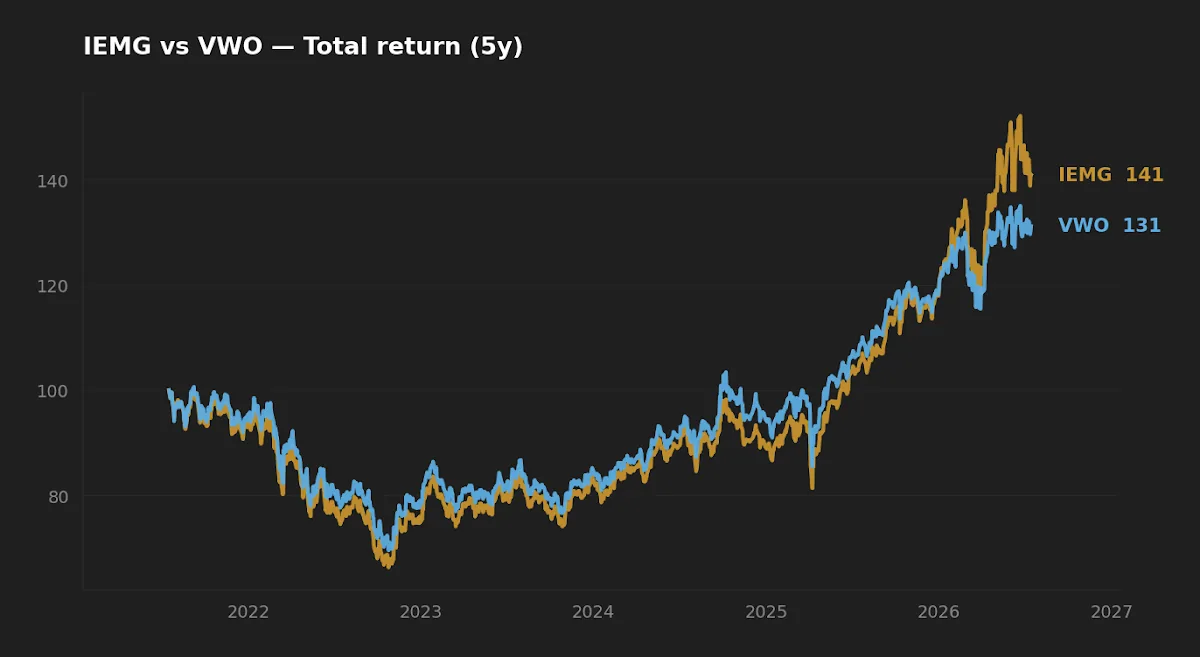
Over five years IEMG compounded at 7.5% versus VWO's 6.0%, a 1.5-point annual gap that dwarfs the 0.03% fee difference. A gap that large in two funds this similar cannot come from expenses; it has to come from what they hold. The most likely driver is South Korea.
Korea's index weight is dominated by large semiconductor and memory names, and the past five years were a strong stretch for that complex, carried in part by AI-related demand for memory and logic. IEMG held that exposure; VWO, by construction, did not. That single classification difference plausibly accounts for a meaningful share of the return spread. It is a clean example of a second-order effect: a decision made by a classification committee, not by either fund manager, ended up being one of the largest performance levers in the comparison.
Initially I assumed the return gap would trace mostly to China A-share weighting or small-cap inclusion, since IEMG's IMI methodology reaches deeper into small-caps. But the small-cap tilt is modest in weight terms, and both funds include A-shares — the Korea line item is simply larger and moved more. The lesson is one the factor literature keeps repeating: unpriced concentration, not the headline expense ratio, tends to explain the tracking gap between "similar" funds.
A classification committee's decision on whether South Korea is "emerging" ended up being one of the largest performance levers between these two funds — larger than any fee, holding, or manager choice.
Realized risk: the same exposure, a little more of it
IEMG's higher return came with higher realized risk. Its five-year annualized volatility was 19.1% against VWO's 17.6%, and its worst drawdown reached -34.2% versus VWO's -30.9%. The direction is consistent with the return story: adding a concentrated, cyclical semiconductor exposure raises both the upside and the amplitude of the swings. This is not a free lunch that IEMG captured and VWO missed; it is the same beta, dialed slightly higher.
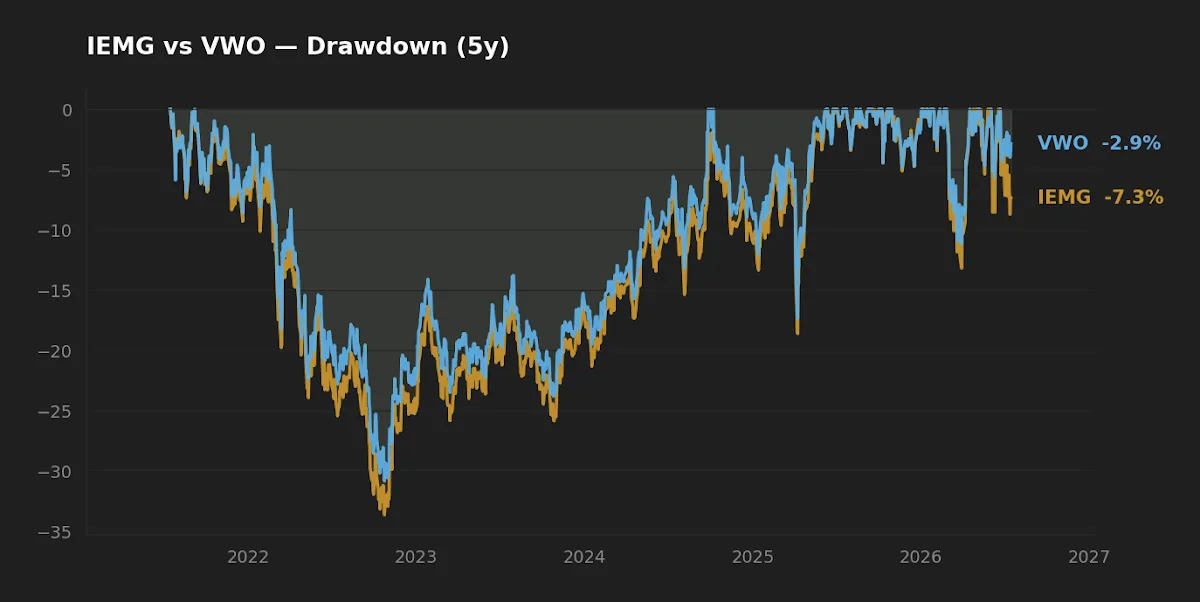
The drawdown chart shows the two funds falling and recovering largely in step — the shape of emerging-market equity as an asset class — with IEMG's trough consistently a few points deeper. For a long-horizon holder, a 3-point difference in maximum drawdown is unlikely to change behavior in a crisis; both funds will test your patience by roughly the same amount. What the volatility markets have been calm about lately — the VIX sat at 16.5 (FRED, asof 2026-07-14) — should not be mistaken for a permanent feature of an asset class that has drawn down more than 30% twice in a decade.
Implementation friction and the things the fee hides
At this scale — both funds hold roughly $160B — bid-ask spreads and closure risk are non-issues. Liquidity is deep and both wrappers are core products their issuers will keep. The frictions that actually matter in emerging-market funds are subtler: withholding taxes on foreign dividends, the tracking cost of holding thousands of illiquid small lines, and the qualified-versus-ordinary split on distributions. Emerging-market ETFs tend to pass through a higher share of ordinary (non-qualified) dividends than a US-large-cap fund, which makes account location — taxable versus tax-advantaged — more consequential than the 3-basis-point fee gap.
On methodology, IEMG's IMI construction (more holdings, deeper small-cap reach) gives marginally broader coverage; VWO's slightly lower fee and Vanguard's patient-trading approach are its edge. Neither difference is decisive. If you already hold a total-international or three-fund structure, the more useful exercise is checking for overlap and gaps rather than optimizing basis points; the mechanics are the same ones examined in the three-fund portfolio review.
Scoreboard: winner by category
| Category | Edge | Why |
|---|---|---|
| Cost | VWO | 0.06% vs 0.09% — a 0.03% edge, small but real over decades. |
| Realized risk | VWO | Lower 5Y volatility (17.6% vs 19.1%) and shallower drawdown (-30.9% vs -34.2%). |
| Realized return | IEMG | Higher 5Y (7.5% vs 6.0%) and 10Y (9.7% vs 8.6%) CAGR, largely via Korea. |
| Suitability | Depends | Whether you want South Korea inside your "emerging" bucket decides it. |
FAQ
Why does VWO hold no South Korea when IEMG does? The index providers disagree. FTSE Russell (which VWO follows) classifies South Korea as a developed market; MSCI (which IEMG follows) still classifies it as emerging. The funds simply mirror their benchmarks.
Does that mean VWO is less diversified? Not less diversified so much as differently mapped. VWO reallocates the space Korea would occupy to other emerging countries. If your developed-market fund already includes Korea, VWO avoids double-counting it — a point worth checking when you pair funds.
Is the 0.03% fee difference worth switching for? On its own, no. Three basis points on a core holding is real but tiny next to the 1.5-point annual return gap driven by country weights over the past five years. Choose on exposure first, fee second.
Which had lower risk historically? Over the trailing five years VWO showed lower annualized volatility (17.6% vs 19.1%) and a shallower maximum drawdown (-30.9% vs -34.2%), consistent with not holding concentrated Korean semiconductors.
Can I hold both? You can, but the overlap is high outside of Korea, so holding both mostly just adds a partial Korea position to VWO. If you want Korea, IEMG alone delivers it more cleanly than blending the two.
What this comparison can and can't tell you
The return and risk figures cover a single five- and ten-year window. That window happened to reward Korean semiconductors, which flatters IEMG; a different regime — a commodity-led emerging cycle, or a China-led one — could reverse the ranking. Trailing CAGR is a look-back, not a forecast, and a decade is a small sample for an asset class this cyclical. The analysis also does not model your tax situation, currency views, or how either fund interacts with the rest of your portfolio. Treat the numbers as a description of what happened, not a prediction of what will.
Scenarios where each fund fits
Reader in their 30s, 401(k)-only, developed-market fund already includes Korea: VWO avoids double-counting Korea and shaves the fee — a tidy fit alongside an existing developed sleeve.
Reader who wants full emerging-market breadth in one ticker, including Korean tech: IEMG's MSCI map captures Korea and reaches deeper into small-caps, giving the broadest single-fund coverage.
Reader holding a total-international fund already: Check what that fund's provider does with Korea before adding either, so you neither gap it nor double it.
Editor's read
If forced to choose one for a long-term core sleeve, the editor leans slightly toward VWO — not for its recent return, which trailed, but because its lower fee, lower realized volatility, and clean exclusion of Korea make it easier to pair with a developed-market fund without accidental overlap. IEMG is the better choice for a reader who specifically wants Korean semiconductor exposure inside "emerging," and is comfortable owning the extra volatility that came with it. The decision is about which country map you want, not which fund is cheaper.
Holdings disclosure: the editor does not hold either IEMG or VWO directly at the time of writing.
Methodology: Price, return, volatility, and drawdown figures computed from yfinance data pulled 2026-07-16; the analysis window covers trailing 5-year and 10-year total-return CAGR. Expense ratio, AUM, inception, and index methodology are from the iShares and Vanguard issuer fact sheets. Macro reference figures are from FRED, asof 2026-07-14.
This article is for educational purposes and does not constitute personalized financial advice. See our full Disclaimer.