
Photo by Hennie Stander on Unsplash
The short version
- Daryanani's 2008 paper is widely cited and widely misread. The actual finding was not "5/25" — it was that relative drift bands of roughly 20% of the target allocation outperformed calendar rebalancing across most asset pairs studied.
- Calendar rebalancing (annual, quarterly) systematically forfeits the rebalancing bonus the literature documents. The cost is small in any one year and material across decades.
- A single portfolio-wide band is wrong by construction: a 50% core and a 5% satellite cannot share the same threshold without one of them being mistuned.
The interesting question about rebalancing isn't whether to do it. That fight was settled by the academic literature decades ago. The interesting question is when — and on this point, most individual investors are operating on a stylized version of Gobind Daryanani's 2008 paper that doesn't match what the paper actually argued. The result is portfolios that drift longer than they should, rebalance more bluntly than they need to, and forfeit a measurable share of the rebalancing premium that the methodology was designed to capture.
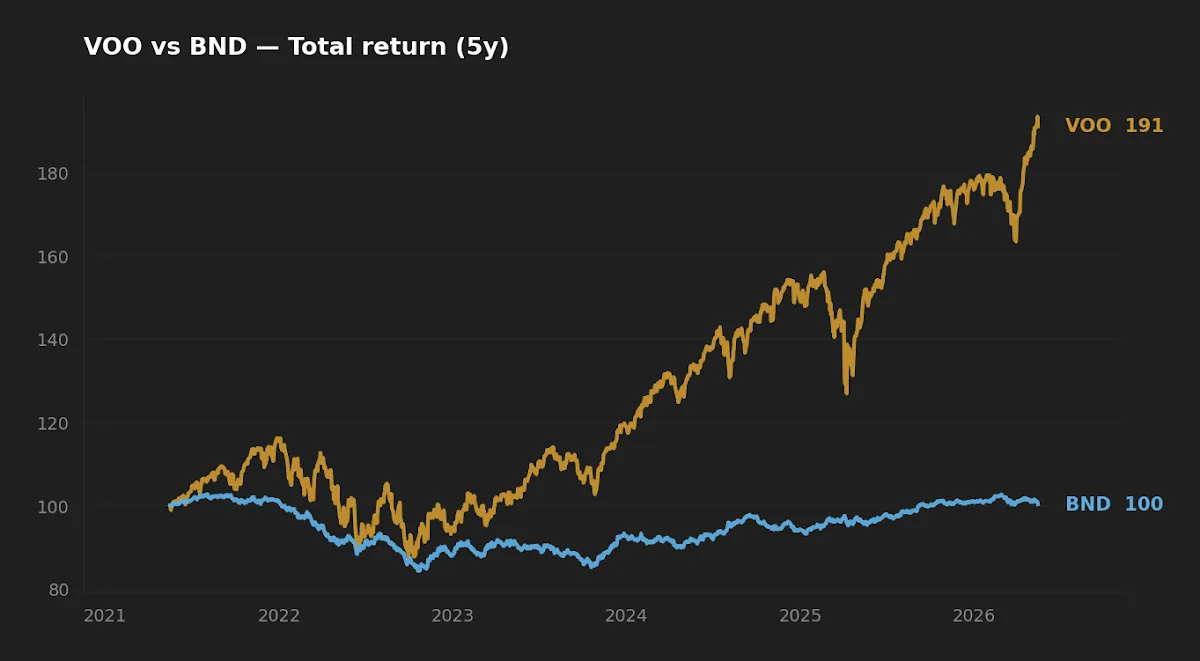
This piece works through what the paper said, where the common "5/25 rule" came from, why a single band applied portfolio-wide is mistuned by construction, and how the rule changes when the two assets in question are as different as VOO and BND — funds whose 5-year return paths and volatility profiles diverge in ways the band rule must accommodate.
What Daryanani actually wrote
The 2008 paper "Opportunistic Rebalancing: A New Paradigm for Wealth Managers" (Journal of Financial Planning) compared three approaches: (1) calendar rebalancing at fixed intervals, (2) threshold rebalancing using absolute deviations from target, and (3) opportunistic rebalancing using relative deviations from target, checked at high frequency but only acted on when triggered. Across simulations on multiple multi-asset portfolios over 1996–2007, the third approach produced the highest risk-adjusted return.
The key parameter was the relative band — typically tested at 20% of the target allocation. For a 50% target asset, that translates to a 10 percentage-point absolute band (rebalance when the position drifts to 40% or 60%). For a 5% target satellite, the same 20% relative rule means a 1 percentage-point absolute band (rebalance at 4% or 6%). Same logic, very different absolute thresholds.
Vanguard's 2024 update to its long-standing rebalancing research broadly confirmed Daryanani's framing for retail-scale portfolios: drift-band triggers, checked frequently, beat calendar rebalancing when transaction costs and taxes are modest. The retail "5/25 rule" — rebalance on the larger of 5% absolute or 25% relative — is a reasonable approximation of this logic for portfolios where the core positions are roughly 20–60% of the total. For very small satellite positions it under-triggers; for very large core positions it over-triggers.
The two funds we'll use as the case study
To make the band logic concrete, the rest of this article uses a stylized 60/40 portfolio of VOO and BND. These are both Vanguard funds with identical 0.03% expense ratios but very different return and risk profiles — exactly the asymmetry that band-based rebalancing is designed to exploit.
| Field | VOO | BND |
|---|---|---|
| Name | Vanguard S&P 500 ETF | Vanguard Total Bond Market ETF |
| Expense ratio | 0.03% | 0.03% |
| AUM | $1,600.2B | $389.7B |
| Inception | 2000-11-13 | 2001-11-12 |
| Distribution yield | 1.1% | 3.9% |
| 5Y CAGR | 13.9% | 0.1% |
| 10Y CAGR | 15.6% | 1.6% |
| 5Y annualized volatility | 16.8% | 6.0% |
| 5Y max drawdown | -24.5% | -17.9% |
Source: yfinance, data pulled 2026-05-16. Issuer fact sheets: Vanguard VOO; Vanguard BND. Macro framing values (10Y Treasury 4.47%, Fed funds 3.64%, CPI YoY 3.9%, VIX 17.3) per FRED, asof 2026-05-14.
Why calendar rebalancing leaves money on the table
Take a 60/40 VOO/BND portfolio rebalanced once a year on January 1. Over the past five years, equity compounded at 13.9% annually and bonds at essentially zero. Without any rebalancing, $60 in VOO grows to roughly $115; $40 in BND stays near $40. The equity weight drifts from 60% to about 74% — a 14-percentage-point overshoot.
An annual calendar rule catches some of this, but not at the right moments. Calendar rebalancing acts on a fixed schedule that has no relationship to when valuation gaps actually open between assets. Daryanani's empirical finding was that drift-triggered trades, on average, occurred near local extremes in the relative price relationship — selling the stretched asset, buying the lagging one. Calendar trades occurred whenever the calendar said so, which is uncorrelated with that signal.
In the Vanguard 2024 simulations the gap between annual calendar and a well-calibrated drift band typically ran 10–30 basis points per year in risk-adjusted return. That sounds small. Over 30 years on a serious portfolio it isn't — and that is before accounting for the behavioral benefit of having a rule that tells you when, not just whether, to act.
The mistake: applying one band to every asset
The most common retail implementation of "rebalance at 5% drift" applies that absolute number to every position in the portfolio. This is incorrect for the same reason a one-size shoe is incorrect.
Consider a five-asset portfolio with targets of 50%, 20%, 15%, 10%, and 5%. A flat 5% absolute band means the 50% core has to drift to 45% or 55% before action — a 10% relative move, which Daryanani's data suggests is too tight (more trading than necessary, more taxable events than necessary). At the other end, the 5% satellite has to drift to 0% or 10% to trigger — a 100% relative move, which is far too loose. The satellite could double in weight and the rule wouldn't notice.
The correct implementation, which the paper actually argues for, is to set bands as a constant percentage of the target weight. A 20% relative band gives:
- 50% target → 40%–60% band (10pp wide)
- 20% target → 16%–24% band (4pp wide)
- 15% target → 12%–18% band (3pp wide)
- 10% target → 8%–12% band (2pp wide)
- 5% target → 4%–6% band (1pp wide)
The math is the same logic the editor's own in-house weekly portfolio review framework uses — modeled directly on Daryanani's relative-band rule and Vanguard's ±15/±25 implementation guidance, applied to a single buy-and-hold target allocation. The point of mentioning this isn't to recommend a specific number for the reader's portfolio; it's to flag that the theory only earns its keep when it survives contact with the implementation. A rule you cannot actually run weekly with a checklist is a rule that quietly defaults to "never."
Calendar rebalancing acts on a fixed schedule that has no relationship to when valuation gaps actually open between assets. Drift bands do — that is the entire source of the rebalancing premium the literature documents.
Drawdown behavior: when the band rule earns its fee
The strongest case for drift bands isn't the average year. It's the bad year. Between 2022 and the bottom of the rates-driven drawdown, both VOO and BND fell together — an unusual coincidence that hurt 60/40 portfolios badly. The 5-year max drawdown figures (-24.5% for VOO, -17.9% for BND) capture this regime.
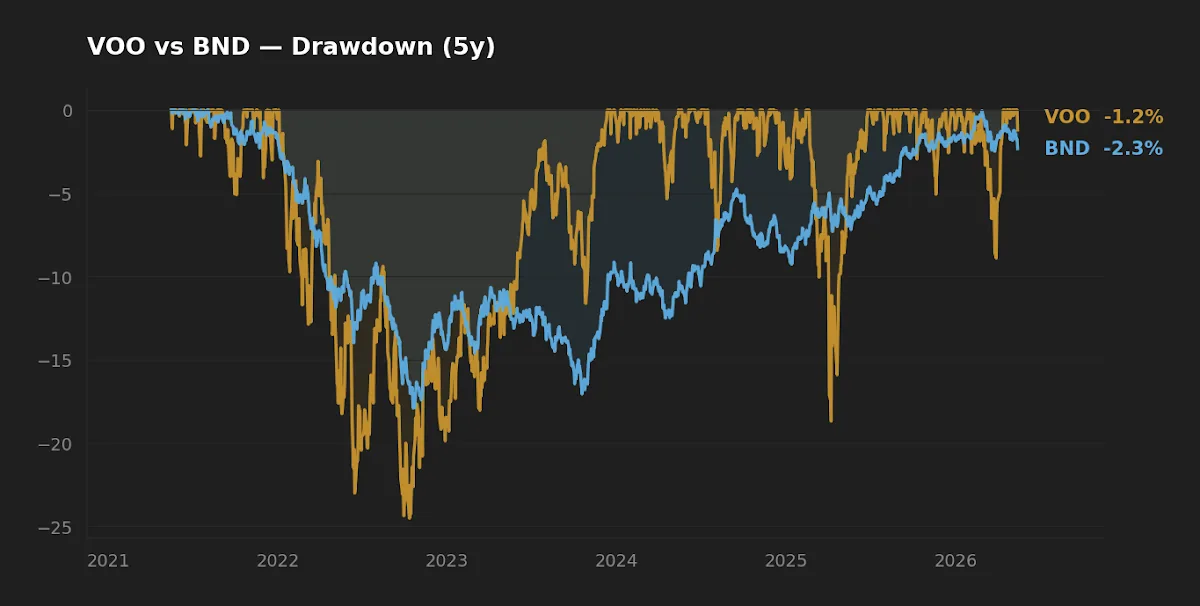
Two observations from the chart matter for the band discussion. First, the two drawdowns are not perfectly synchronized — bonds bottomed at a different point than equities, which is precisely the kind of gap a drift band exploits. Second, the recovery paths diverge sharply: equities recovered into a strong bull tape while bonds compounded near zero. A portfolio rebalanced only annually would have spent much of that period structurally overweight whichever asset had just rallied — the opposite of what the rebalancing premium captures.
Worth noting against today's macro backdrop: with the 10Y Treasury at 4.47% and CPI running at 3.9% YoY (FRED, asof 2026-05-14), the real yield on bonds is positive but thin. That changes the rebalancing math at the margin — selling stretched equity into bonds is no longer the same trade it was in a zero-rate regime, but it is a more defensible one than it was three years ago. The relevant point is that band-based rules absorb regime changes automatically; calendar rules do not.
Implementation friction: where the rule meets the broker
None of this matters if the rule cannot be executed cleanly. Three frictions deserve real attention:
Taxes. In a taxable account, every rebalance trade is potentially a taxable event. The drift band should be widened to reflect this — a tighter band that triggers more often gives up more in tax-cost drag than it gains in rebalancing premium. In a 401(k) or IRA, this consideration vanishes and tighter bands become reasonable.
New contributions and distributions. The cleanest way to rebalance, when available, is to direct new money to the underweight asset rather than selling the overweight one. This is "rebalancing through flows," and it converts the drift-band trigger into a buy-only signal — no tax cost, no trading cost. For an investor still in the accumulation phase, most rebalancing should be done this way; outright sells become a backup mechanism for when contributions can't close the gap.
Bid-ask and minimum trade sizes. Not a real issue for VOO and BND at their current AUM scale, but it bites for thinly traded niche ETFs and is worth thinking about before adding a satellite position with a tight band attached.
For more on how implementation friction reshapes textbook strategy, see the editor's earlier note on why leveraged ETFs misbehave under compounding and the broader piece on factor investing in the AI era — both touch on the same gap between theory and execution.
At-a-glance scoreboard
| Decision | Better choice | Why |
|---|---|---|
| Calendar vs drift band | Drift band | Captures drift-driven premium that calendar misses |
| Absolute-only vs relative band | Relative (or hybrid) | Scales correctly across core and satellite positions |
| Tight band in taxable account | Wider band | Tax cost erodes the rebalancing premium |
| Sell-to-rebalance vs flow-to-rebalance | Flow first | No tax, no trading cost; sells as backup |
| Portfolio-wide trigger vs asset-level trigger | Asset-level | Rebalance only the asset that crossed; leave the rest |
Editor's read
If forced to pick a single starting point, the editor leans toward a 20% relative band, checked weekly, executed primarily through new contributions and only secondarily through sells. That is the version of Daryanani's rule that survives both the academic backtest and the weekly reality of a working investor with limited time. The "5/25 rule" is a reasonable shortcut for the middle of a portfolio, but treating it as the rule rather than as a heuristic loses something at both ends of the weight spectrum. Doing nothing — the implicit default of every investor who never sets a rule — is not a neutral choice; it is a choice to let the most volatile asset in the portfolio gradually become the portfolio.
FAQ
Q. Does drift-band rebalancing work for portfolios with only two assets?
Yes, and it's easier to manage than a multi-asset version. For a 60/40 VOO/BND target with a 20% relative band, the trigger is roughly 48%/72% on the equity side. Checking monthly is sufficient at this granularity; checking weekly is fine if a reader runs a portfolio review already.
Q. What is the "5/25 rule" actually optimal for?
For a portfolio whose target weights cluster in the 15%–40% range, the 5% absolute / 25% relative trigger approximates a constant relative band reasonably well. Outside that range — very large cores or very small satellites — the two halves of the rule diverge, and a pure relative-band approach is cleaner.
Q. How often should I check the bands?
Daryanani's paper checked daily; Vanguard's 2024 update found weekly produced nearly identical results with much less behavioral friction. Daily checking risks turning a long-horizon investor into a part-time trader.
Q. Does the rule change when bond yields are high?
The trigger logic doesn't change, but the after-rebalance expected return does. With the 10Y Treasury near 4.5% (FRED, asof 2026-05-14), trimming equity into bonds is a more defensible trade than it was when bonds yielded nothing. The band rule expresses no view on this; it executes whatever target weight the investor set.
Q. Should the bands be different for taxable vs tax-advantaged accounts?
Yes. Widen the bands in taxable accounts (or rebalance exclusively through new contributions) to limit realized capital gains. Tax-advantaged accounts can run tighter bands without giving up the premium to tax drag.
Key takeaways
- The "5/25 rule" is a useful approximation, but the underlying logic — Daryanani 2008 — is a constant relative band, typically around 20% of target weight.
- Calendar rebalancing gives up a small but persistent share of the rebalancing premium because it acts on a schedule uncorrelated with where the drift signal actually is.
- Applying one absolute band to every asset is mistuned by construction; the band should scale with the target weight.
- In taxable accounts, widen the band or rebalance through new contributions rather than sells.
- A rule that the reader cannot actually run weekly with a checklist will quietly become no rule at all. The implementation matters as much as the theory.
Methodology: ETF return, volatility, and drawdown figures are computed from daily total-return data via yfinance, pulled 2026-05-16. Expense ratios and AUM are from Vanguard issuer fact sheets at the same date. Macro reference values are from FRED (10Y Treasury, Fed funds, CPI YoY, VIX), asof dates noted inline. Academic references: Daryanani, "Opportunistic Rebalancing: A New Paradigm for Wealth Managers," Journal of Financial Planning, 2008; Vanguard Research, "Best practices for portfolio rebalancing," 2024 update.
By the Mulden editor. This article is for educational purposes and does not constitute personalized financial advice. See full Disclaimer.