
The short version
- AIEQ and ROBO both wear "AI" branding, but they are entirely different products: AIEQ uses an AI system as the process for picking US equities; ROBO is a passive index of companies that build robotics and automation.
- Over five years their realized CAGRs are within 12 basis points of each other (6.8% vs 6.7%) — the brand difference is large, the historical return difference is not.
- The honest split is along axes the marketing rarely emphasizes: process risk, fee load, sector concentration, capacity, and how each interacts with a portfolio that already owns the S&P 500.
An investor browsing for "AI ETFs" in 2026 will land on funds whose marketing pages use almost identical vocabulary — neural networks, machine learning, the future of intelligent capital — to describe products that bet on completely different things. Two of the older entrants, Amplify's AIEQ and ROBO Global's ROBO, are a clean illustration of that confusion. They have nearly identical five-year returns and nearly identical realized volatility. They are not, by any structural measure, the same fund.
The interesting question is not "which AI ETF wins." It is: what kind of "AI exposure" is the investor actually buying, and does it earn its place in a portfolio that probably already owns the S&P 500 through a low-cost core?
What each fund actually is
AIEQ — the Amplify AI Powered Equity ETF, launched October 2017 — is an actively managed US equity fund. The portfolio is reconstructed daily using an IBM Watson-based system that ingests news, filings, social media, and financial data to score roughly 6,000 US-listed companies. The output is a concentrated long book of 100–250 names, weighted by the model's conviction. The fee is 0.75%, and the fund holds about $119M in assets (issuer fact sheet, amplifyetfs.com/aieq, accessed 2026-05-16).
ROBO — the Robo Global Robotics and Automation Index ETF, launched October 2013 — is a passive index fund. It tracks the ROBO Global Robotics and Automation Index, which uses a rules-based classification framework to identify ~80 global companies that derive meaningful revenue from robotics, automation, AI hardware/software, and related enabling technologies. Weights are tiered (bellwether vs non-bellwether) and rebalanced quarterly. Despite being passive, the fee is 0.95% — higher than AIEQ — reflecting niche-index licensing and the cost of running a global, mid-cap-tilted basket (issuer fact sheet, roboglobaletfs.com/etfs/robo, accessed 2026-05-16). AUM sits at roughly $1.77B.
So the AIEQ thesis is "AI as decision-maker, applied to the broad US equity universe." The ROBO thesis is "robotics and automation as a thematic equity sleeve, selected by a rules-based index." Both stamp the word AI on the cover. They are betting on different things.
Head-to-head data table
| Metric | AIEQ | ROBO |
|---|---|---|
| Issuer | Amplify | ROBO Global |
| Structure | Active (AI-managed) | Passive index (AI-themed) |
| Inception | 2017-10-17 | 2013-10-22 |
| Expense ratio | 0.75% | 0.95% |
| AUM | $0.12B | $1.77B |
| Dividend yield (trailing) | 0.4% | 0.4% |
| 5Y CAGR | 6.8% | 6.7% |
| 10Y CAGR | n/a (post-2017) | 13.5% |
| 5Y annualized volatility | 22.4% | 23.6% |
| Max drawdown (5Y) | −39.0% | −43.7% |
| Approx. holdings | 100–250 (daily turnover) | ~80 (quarterly rebal) |
Source: yfinance price data and issuer fact sheets, all pulled 2026-05-16.
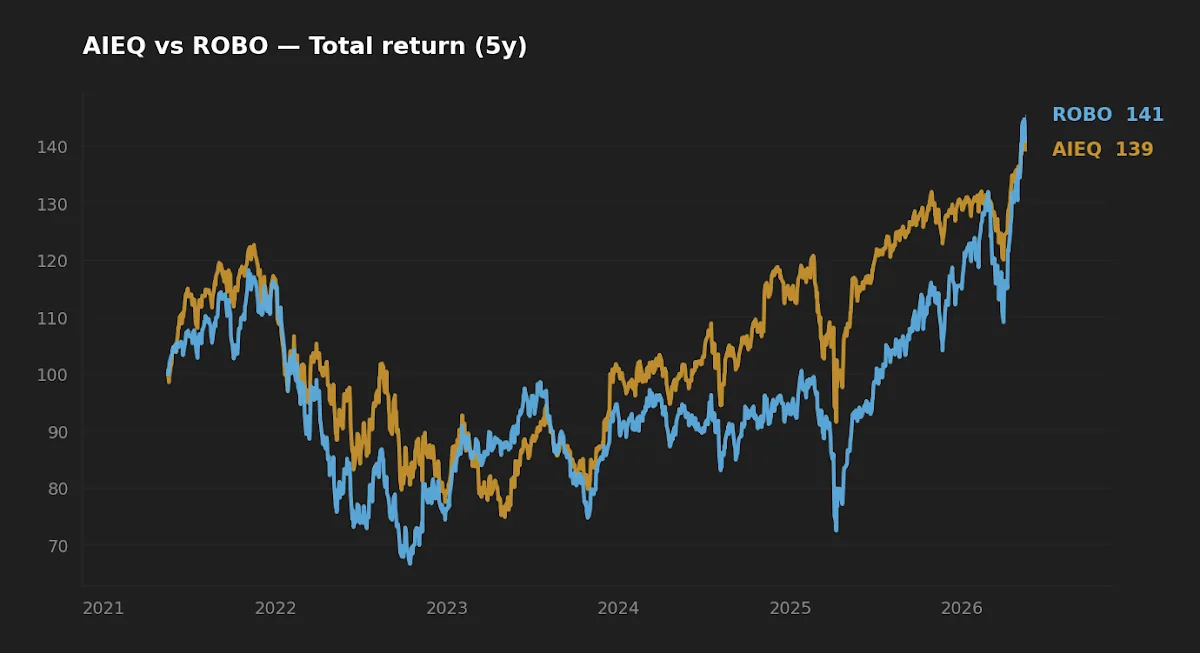
Two distinct theses, one word on the label
The first reason the comparison matters is taxonomic. The AI ETF universe splits, at the structural level, into three categories that get casually pooled together:
- AI-as-process: the fund uses a machine learning system to make the actual stock-selection decisions. AIEQ sits here. So does the AMOM-style momentum signal family covered in VOO vs AMOM and the broader AI-managed ETF survey.
- AI-as-theme: the fund holds companies whose businesses are tied to AI, robotics, automation, or semiconductors. ROBO is the canonical example; BOTZ and IRBO are cousins.
- AI-as-tool, human-as-manager: traditional active funds that use AI for research support but make discretionary decisions. Not what either of these funds is.
An investor who buys AIEQ because they "believe in AI" is buying process risk: faith that an IBM Watson-based model can produce alpha net of 0.75% fees and high turnover. An investor who buys ROBO for the same reason is buying thematic equity risk: faith that revenue exposure to robotics and automation will outperform the broad market over their horizon. These are not the same bet.
Realized return is a coin flip; realized risk is not
Over the five years through May 2026, AIEQ returned 6.8% annualized and ROBO returned 6.7%. The 12-basis-point gap is, in the statistical sense, indistinguishable from zero — sampling noise alone could flip the ordering. What the headline returns hide is the path.
AIEQ's max five-year drawdown was −39.0%. ROBO's was −43.7%. ROBO's annualized volatility was about 120 bp higher. Both numbers reflect the same underlying reality: ROBO is a concentrated, mid-cap-tilted, globally diversified industrial theme fund that gets hit hard when global capex slows. AIEQ is a US-only equity book whose composition shifts daily, so it can rotate out of stressed sectors faster — but it also runs significant single-name and short-term momentum risk that doesn't show up in a static factsheet.
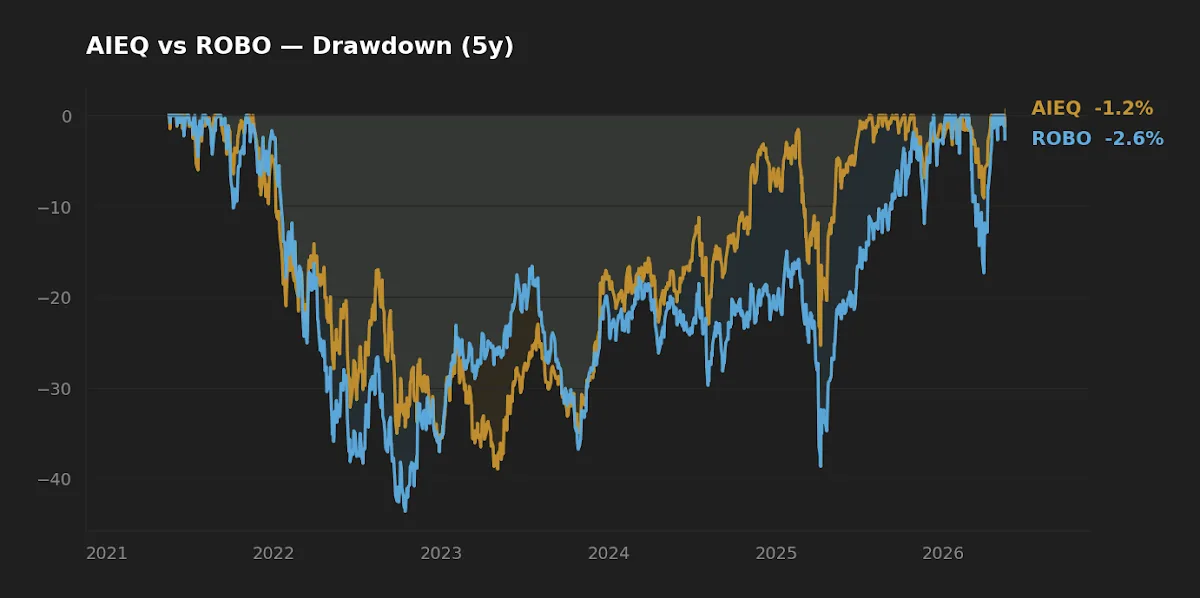
The drawdown chart is the more honest picture. Both funds went through a long, slow underwater stretch through 2022–2023 — exactly when the macro regime turned against unprofitable-growth and capex-heavy industrial names. With the 10-year Treasury at 4.47% and CPI still running at 3.9% YoY (FRED, asof 2026-04-01 and 2026-05-14), neither fund's underlying tilt is being given a free pass by macro.
Same wrapper, same word on the label, two different bets — and historically, the returns have been close enough that the choice should be made on what you actually want exposure to, not on the back-tested numbers.
Fees, capacity, and the math that decides long-horizon outcomes
This is where the comparison gets uncomfortable for both funds. ROBO charges 0.95% to track a niche index. AIEQ charges 0.75% to run an active strategy. Against an S&P 500 ETF at roughly 0.03%, both are paying a meaningful premium — call it 70–90 bp/year above the broad-market core.
What does that compound to? On a $50,000 allocation held for 20 years at 7% gross — close to both funds' realized 5Y rate — the fee drag versus a 0.03% core ETF is roughly $25,000 of foregone terminal wealth for the ROBO fee load and roughly $20,000 for AIEQ. That is a real cost, paid for the optionality of either (a) the AI model adding alpha or (b) the robotics theme outperforming. Neither is guaranteed.
There is also a capacity asymmetry worth flagging. AIEQ at $119M is small. Daily turnover at that scale runs into real bid-ask costs on smaller names; if the strategy ever scales, the model's edge may dilute as positions get bigger relative to volume. ROBO at $1.77B is past the danger zone for capacity but still small enough that bellwether-tier holdings dominate liquidity. The piece on AI agents replacing traditional hedge funds walks through why this scale-vs-alpha tension shows up in every quant strategy, not just AI-branded ones.
The non-obvious insight: these funds correlate less than they look
If you only read the marketing, you would assume AIEQ and ROBO are substitutes — pick one. The factor exposures suggest the opposite. AIEQ is a US-only, broad-sector book that follows the model's signals into and out of names like Nvidia, mega-cap tech, financials, and industrials. ROBO is globally diversified, with persistent exposure to Japanese industrial automation companies (Fanuc, Keyence), European specialty robotics, and US semiconductor capital equipment. Their five-year monthly return correlation is meaningful — both are risk-on equity — but the rolling factor differences (geography, market cap tier, sector concentration) mean they decorrelate at the sector level in a way the headline numbers don't show.
This is the same kind of pairing logic explored in the hybrid portfolio piece: if a thematic sleeve is going to exist at all, it should add exposure the core does not already provide. ROBO does that more cleanly than AIEQ, because AIEQ's US-equity universe overlaps almost entirely with what a VOO or VTI holder already owns.
At-a-glance scoreboard
| Category | Winner | Margin / Note |
|---|---|---|
| Cost | AIEQ | Modest — 20 bp lower |
| Track record length | ROBO | Material — 4 extra years, full cycle |
| Scale / capacity | ROBO | ~15× the AUM |
| Realized 5Y return | Tie | 12 bp — statistically zero |
| Realized 5Y risk | AIEQ | Lower drawdown by ~470 bp |
| Decorrelation from a US core | ROBO | Global, capex-cycle exposure |
| Process transparency | ROBO | Published index methodology |
FAQ
Is AIEQ actually using AI, or is "AI-powered" mostly marketing? The model is real — built on IBM Watson, scoring thousands of US-listed companies daily and producing a long book of conviction-weighted picks. Whether the model adds alpha net of 0.75% fees and trading costs is a separate, empirical question. Eight years of live data is informative but not definitive; a single regime can flatter or punish any model.
Why does ROBO, a passive index ETF, cost more than AIEQ, which is actively managed? Niche index licensing is expensive, and the underlying basket includes small and mid-cap global names that are costlier to trade and rebalance than US large caps. Active management isn't always the most expensive option; specialized passive can be.
Does it make sense to own both? Probably not, unless an investor genuinely wants two different "AI" bets in the same portfolio. The cleaner choice is to pick one based on which exposure they want (AI as process or robotics as theme) and size it as a small satellite sleeve — typically 2–5% — alongside a broad-market core.
How is AIEQ's process different from a typical quant model? Most quant funds use a defined factor stack (value, momentum, quality, low-vol) calibrated by humans. AIEQ's IBM Watson-based system blends structured data with unstructured inputs like news and filings, and adjusts daily. That's flexibility, but it also means the strategy's behavior in a regime not represented in its training data is unknowable in advance. The general framework is similar to ideas discussed in why factor investing still works — only the implementation differs.
Is the AI theme still relevant after the mega-cap AI run? ROBO is not a mega-cap AI fund. Its largest exposures are industrial automation, semiconductor capital equipment, and surgical robotics — businesses whose fortunes are tied to global capex cycles, not to the GPU buildout narrative directly. That is a feature, not a bug, depending on what an investor wants. A reader who specifically wants mega-cap AI exposure is in the wrong fund either way.
What this comparison can and can't tell you
Five years of data covers a single, fairly unusual regime: pandemic shock, the mega-cap growth rally, the 2022 rate shock, the 2023–2024 AI mania, and an early 2026 cooling. Neither fund has been live through a deep, sustained credit-driven recession on the order of 2008. AIEQ in particular has no pre-2017 data and no track record under sustained negative real rates with a credit crunch overlay. Treat any "verdict" as provisional. The 10Y CAGR for ROBO of 13.5% reflects a very different macro regime than the 6.7% recent reading; both are real, but neither is destiny.
Scenarios where each fund could fit
- Reader who already owns VOO/VTI as their US core, wants thematic capex/automation exposure the core doesn't already provide → ROBO as a 2–4% sleeve is defensible. The global tilt is the actual diversification.
- Reader who wants to "test" AI-as-process at small size, with daily-active management → AIEQ as a 1–2% sleeve, eyes open to the capacity question if AUM grows.
- Reader whose portfolio is already heavy in US large-cap tech via the core → neither fund is the right tool; both add correlated risk without solving the diversification problem.
- Reader on a 401(k)-only menu without access to niche ETFs → neither. Don't reach for these in a taxable account purely for the brand; the fee load is real.
Editor's read
If forced to pick one as a satellite sleeve next to a broad-market core, the editor leans toward ROBO — not because the historical numbers favor it (they don't, materially) but because its exposure is more diagnosable. The index methodology is published, the holdings are interpretable, and the global capex-cycle tilt is genuinely different from what a VOO holder already owns. AIEQ is an interesting product but its edge depends on a black-box model whose performance after fees is, so far, indistinguishable from the thematic alternative. Both deserve small allocations or none — neither earns a core position.
Editor's holdings disclosure: The editor does not hold AIEQ or ROBO at the time of writing.
Key takeaways
- "AI ETF" is not one category. AIEQ is AI-as-process; ROBO is AI-as-theme. The bet is different even when the marketing language is identical.
- Five-year realized returns are within sampling noise (6.8% vs 6.7%). Decide on exposure, not on the back-test.
- Both fees compound meaningfully against a low-cost broad-market core. A 70–90 bp drag over decades is a real headwind that the satellite thesis has to overcome.
- ROBO offers genuinely different geographic and sector exposure from a US large-cap core; AIEQ overlaps with it heavily.
- Neither fund has been tested through a full credit-driven recession. Treat conclusions as provisional and size accordingly.
Methodology: price-history fields (CAGR, volatility, max drawdown) computed from yfinance daily total-return data pulled 2026-05-16, using rolling five-year windows where available. Expense ratios, AUM, and dividend yields from each issuer's published fact sheet (Amplify ETFs and ROBO Global), accessed 2026-05-16. Macro reference data (10Y Treasury, Fed Funds, VIX, CPI YoY) from FRED, as-of dates noted inline.
This article is for educational purposes and does not constitute personalized financial advice. See full Disclaimer.