
Photo by Bozhin Karaivanov on Unsplash
The short version
- All three track the same S&P 500 index; over five years their total returns and drawdowns sit within a rounding error of one another.
- The real separation is structural — SPY is a unit investment trust that holds dividends in cash, while VOO and IVV are open-end funds that reinvest and lend securities, a small but persistent edge for long-horizon holders.
- Bottom line: traders pay up for SPY's liquidity; buy-and-hold investors have little reason to accept its higher fee when VOO and IVV charge a fraction.
Three of the largest exchange-traded funds in the world track exactly the same 500 companies. SPY, VOO, and IVV are, at the level of holdings, nearly indistinguishable — so the question worth asking is not which one owns better stocks, but where the small, durable differences in cost and structure actually come from, and whether they matter over a multi-decade horizon. This is a case where the second-order details carry the whole decision.
Context: same index, three wrappers
The S&P 500 is an index, not a product. To own it you buy a fund that replicates it, and the replication is close to commoditized: each of these three holds the constituents in capitalization-weighted proportion and reconstitutes when the index committee changes members. SPDR's SPY launched in January 1993 as the first US-listed ETF; iShares' IVV followed in May 2000 and Vanguard's VOO in November 2000. After more than two decades, all three hold the same names in nearly the same weights. The differences that remain are the fund wrapper, the fee, and the plumbing underneath — and those are exactly the things most retail coverage skips over.
The data, side by side
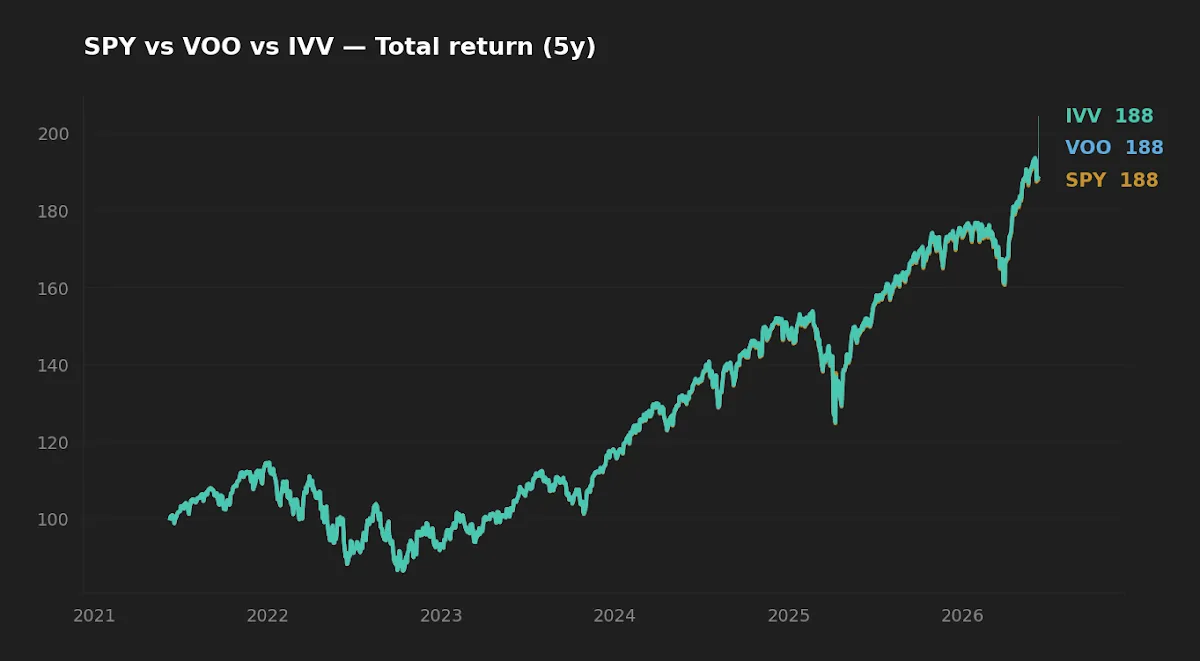
The table below uses price and return data pulled from yfinance on 2026-06-08, with expense ratio, AUM, and inception sourced from each issuer's fact sheet. Five- and ten-year CAGR figures are annualized total returns through the pull date.
| Metric | SPY | VOO | IVV |
|---|---|---|---|
| Issuer | State Street | Vanguard | BlackRock iShares |
| Structure | Unit investment trust | Open-end fund | Open-end fund |
| Expense ratio | 0.09% | 0.03% | 0.03% |
| AUM | $784B | $1,702B | $855B |
| Inception | 1993-01-22 | 2000-11-13 | 2000-05-15 |
| Dividend yield | 1.0% | 1.0% | 1.1% |
| 5Y CAGR | 13.5% | 13.6% | 13.6% |
| 10Y CAGR | 15.3% | 15.3% | 15.3% |
| 5Y volatility | 17.1% | 16.8% | 16.9% |
| 5Y max drawdown | -24.5% | -24.5% | -24.5% |
The headline is the sameness. A 5-year CAGR spread of roughly ten basis points (13.5% vs 13.6%) and a maximum drawdown that agrees to the first decimal place tell you these funds are tracking one index faithfully. The visible separators are the expense ratio — SPY at 0.09% against 0.03% for the other two — and AUM, where VOO has crossed $1.70 trillion.
Why SPY costs more: the unit investment trust legacy
SPY's 0.09% fee is roughly three times what VOO and IVV charge, and the reason is partly historical and partly structural. SPY is organized as a unit investment trust (UIT), the wrapper available in 1993. A UIT is bound by rules that an open-end fund is not. It must hold the index constituents and cannot deviate; it cannot reinvest dividends internally as they arrive, instead parking them in a non-interest-bearing account until the quarterly distribution; and, in its classic form, it has been more constrained in lending out securities.
That dividend-holding rule is the non-obvious cost. Between ex-date and pay-date, incoming dividends sit as idle cash rather than being put back to work in the market. In a rising market, that cash drag is a small headwind — the uninvested portion misses the very appreciation the fund is supposed to capture. It is modest, but it is structural and it recurs every quarter. With short rates near 3.63% (Fed funds, FRED, asof 2026-05-01), the opportunity cost of holding cash that earns nothing is slightly higher today than it was in a zero-rate world, which sharpens the point rather than softening it.
VOO and IVV, as open-end regulated investment companies, can reinvest distributions immediately and run active securities-lending programs whose income partially offsets the expense ratio. None of this makes SPY a bad fund — its tracking record is excellent — but it explains why the structural deck is stacked in favor of the two newer wrappers for someone who simply holds.
The three funds own the same companies; what separates them is the plumbing — and for a buy-and-hold investor, the plumbing quietly favors the cheaper, open-end wrappers.
Realized risk: indistinguishable by design
If you are choosing among these three on the basis of risk, the data offers almost nothing to choose between. Over the trailing five years, realized volatility clustered tightly — 17.1% for SPY, 16.8% for VOO, 16.9% for IVV — and the maximum drawdown was effectively identical at about -24.5% for all three. The small volatility gap for SPY is more a function of intraday trading microstructure and measurement noise than any real difference in what the fund holds.
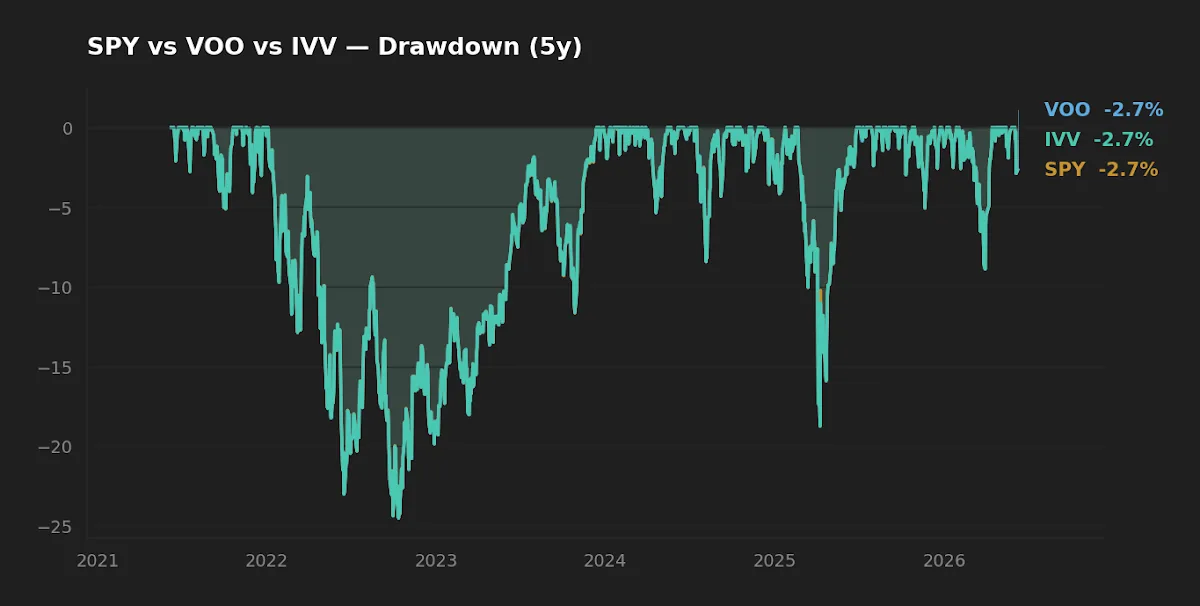
The drawdown chart drives the point home: the three lines overlap so closely they are hard to separate visually. This is the expected result when three funds replicate one index — the systematic risk is the index's risk, and the wrapper contributes only noise at the margins. Anyone reaching for one of these as the core equity sleeve should treat the realized-risk profiles as equivalent and decide on cost and structure instead. For readers thinking about how a -24.5% decline actually behaves in a portfolio, the recovery arithmetic is worth understanding in its own right; we walked through it in The Arithmetic of a -30% Drawdown.
Where SPY still earns its keep: liquidity and options
The case for SPY is not about buy-and-hold investing at all — it is about trading infrastructure. SPY remains the most heavily traded ETF on the planet, with the tightest bid-ask spreads and by far the deepest options market. For an institution rolling large positions, a tactical trader, or anyone writing options against an S&P exposure, that liquidity is worth paying nine basis points for, because the spread savings on a large or frequently traded position can dwarf the fee difference.
The asymmetry the data hides is that long-term holders effectively subsidize the trading ecosystem. SPY's fee stays elevated because its primary users — active traders and options participants — are not fee-sensitive; they care about depth, not basis points. A buy-and-hold investor who sits in SPY for decades pays the trader's convenience premium without using any of it. That is the central insight of this comparison: the right choice depends entirely on whether you are trading the wrapper or holding it. If your equity core is meant to compound untouched for years, you are paying for a feature you will never use.
This connects to a broader principle in how we think about a long-horizon core. Cost compounds, and basis points are not trivial over decades — the same logic we applied when reading SCHD against VOO on dividend yield and total return and when sketching a hybrid 2026 portfolio that mixes classic index exposure with satellite tilts. The discipline is the same: minimize the recurring drag on the part of the portfolio you intend to leave alone.
| Category | Winner | Why |
|---|---|---|
| Cost | VOO / IVV | 0.03% vs 0.09% — a ~0.06% recurring edge. |
| Realized risk | Tie | Volatility and -24.5% drawdown effectively identical. |
| Realized return | VOO / IVV (marginal) | ~10 bp higher 5Y CAGR, consistent with lower drag. |
| Liquidity / options | SPY | Tightest spreads, deepest derivatives market. |
| Suitability (buy-and-hold core) | VOO / IVV | Lower fee, open-end structure, no cash drag. |
FAQ
Are SPY, VOO, and IVV interchangeable?
For a long-term holder, functionally yes — they track the same index with near-identical realized risk and return. The differences are cost (0.09% vs 0.03%) and structure (UIT vs open-end), which favor VOO and IVV for buy-and-hold use.
Why does SPY have a higher expense ratio?
SPY is a unit investment trust, an older wrapper that cannot reinvest dividends internally and is more constrained operationally. Its fee also stays elevated because its core user base — traders and options participants — values liquidity over basis points.
Does the fee difference actually matter?
On any single year it is small. Over decades it compounds: a recurring ~0.06% drag is a headwind the cheaper funds simply do not carry. For a core position held for years, that is the most defensible reason to prefer VOO or IVV.
Is IVV or VOO better?
They are extremely close — same 0.03% fee, same index, near-identical five-year statistics. The choice usually comes down to which brokerage ecosystem you use and minor differences in distribution timing, not performance.
Should a trader use SPY instead?
For active trading or options strategies, SPY's deeper liquidity and tighter spreads can outweigh its higher fee. The wrapper that is "best" depends on whether you are holding the position or trading it.
What this comparison can and can't tell you
The return and volatility figures cover a single five- and ten-year window that was, on balance, a strong one for US large-cap equities. That sample does not capture every regime — a prolonged bear market, a sustained high-inflation stretch, or a liquidity event could surface differences (particularly in spreads) that calm markets hide. The structural points about the UIT wrapper are durable; the precise return gap is sample-dependent and should not be extrapolated.
Scenarios where each fund fits
- Reader in their 30s, 401(k) or taxable buy-and-hold core, no trading intent → VOO or IVV; the lower fee and open-end structure compound in your favor and you never use SPY's liquidity.
- Active trader or options writer needing depth and tight spreads → SPY; the execution quality can outweigh the fee on frequently traded or large positions.
- Investor already deep in one brokerage's ecosystem → whichever of VOO/IVV settles and reinvests most cleanly in that account; the performance difference between them is negligible.
Editor's read
For a long-term core sleeve, the editor leans toward VOO or IVV without much hesitation: the ~0.06% fee edge and the open-end structure that avoids SPY's quarterly cash drag are small advantages, but they are recurring and they sit on the part of a portfolio meant to be left alone for decades. SPY remains the better instrument for trading and options — it simply is not the natural home for capital you intend to hold and forget.
The editor holds a broad US large-cap index position; does not hold SPY at the time of writing.
Methodology: Price, return, volatility, and drawdown data from yfinance, pulled 2026-06-08. Expense ratio, AUM, inception, and structure from each issuer's fact sheet (State Street, Vanguard, iShares). Macro reference from FRED (Fed funds rate, asof 2026-05-01). Window analyzed: trailing 5- and 10-year annualized total return through the pull date.
This article is for educational purposes and does not constitute personalized financial advice. See our full Disclaimer.