
Photo by Vitaly Gariev on Unsplash
The short version
- Gold has a multi-decade record of low-to-negative correlation with equities in stress; Bitcoin's correlation with risk assets has repeatedly risen in liquidity crises — the opposite of what a hedge should do.
- IBIT (inception January 2024) is too young to have its own through-cycle correlation history, so any "Bitcoin hedge" claim borrows the underlying asset's record, not the fund's.
- Bottom line: GLD is the more defensible diversifier for a long-horizon core; IBIT is a high-volatility satellite whose hedge case rests on a thinner, single-regime sample.
The case for holding either Bitcoin or gold rarely turns on expected return. It turns on a quieter claim: that the asset zigs when your equities zag, smoothing the portfolio's path through a stress event. That is a claim about correlation, not performance — and correlation is precisely where the two assets diverge most. This article looks at what the available data does and does not support about IBIT and GLD as portfolio hedges, and why the most important number for IBIT is the one we do not yet have.
Context: what a hedge actually has to do
A diversifier earns its place not by rising on average but by failing to fall when everything else does. Gold's long-standing role rests on a behavioral pattern observed across many decades: in deflationary scares, currency crises, and equity drawdowns, capital has tended to rotate toward it, giving it a low or occasionally negative correlation with stocks during the exact windows that matter. That correlation is not constant — it drifts with the real-rate regime — but it has been measured across multiple cycles.
Bitcoin's hedge thesis is younger and, critically, less tested in stress. The narrative ("digital gold," fixed supply, non-sovereign) is coherent. The realized behavior has been more ambiguous: in the March 2020 liquidity shock and again through the 2022 drawdown, Bitcoin sold off alongside equities, behaving as a high-beta risk asset rather than a refuge. We have the data on price; we are still humble about prediction on whether the decorrelation story holds when it is needed.
The funds, by the numbers
| Metric | IBIT | GLD |
|---|---|---|
| Name | iShares Bitcoin Trust ETF | SPDR Gold Shares |
| Expense ratio | 0.25% | 0.40% |
| AUM | $58.1B | $150.4B |
| Inception | 2024-01-05 | 2004-11-18 |
| Distribution yield | 0.0% | 0.0% |
| 5Y CAGR | n/a (insufficient history) | 17.3% |
| 10Y CAGR | n/a | 13.1% |
| 5Y volatility | n/a | 18.1% |
| 5Y max drawdown | n/a | -21.0% |
Price and return figures are from yfinance, pulled 2026-06-08. Expense ratio, AUM, and inception are from the issuer fact sheets: iShares (IBIT) and SPDR (GLD). Note the small surprise in the cost line: IBIT, at 0.25%, is actually cheaper than GLD's 0.40% — though GLD has lower-cost siblings (GLDM, IAU) that a cost-sensitive investor would compare against before treating 0.40% as the price of gold exposure.
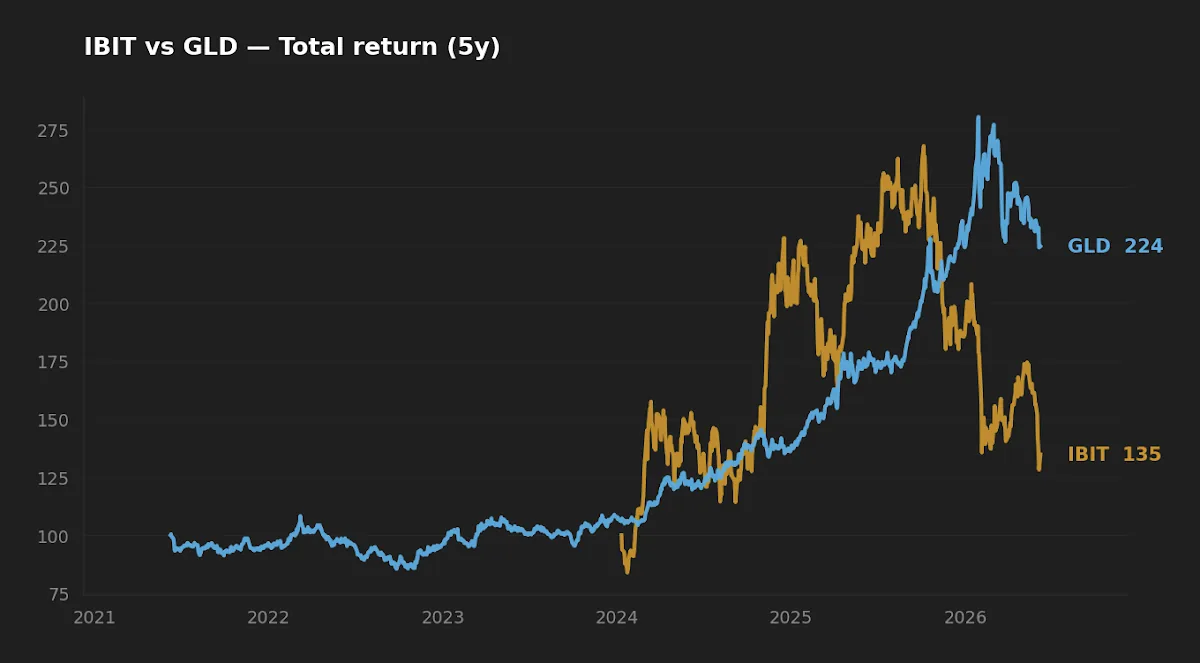
The correlation asymmetry the headline hides
Here is the non-obvious point. The question is usually framed as "Bitcoin or gold?" — as if they are two flavors of the same defensive trade. They are not. Their value as a hedge depends on the sign and stability of their correlation to equities during stress, and on that axis they behave differently.
Gold's correlation to the S&P 500 has historically hovered near zero and dipped negative in acute risk-off episodes. Bitcoin's correlation to equities has been positive on average and, more importantly, has tended to rise during liquidity crunches — when leveraged holders are forced to sell their most liquid, most-up positions to meet margin elsewhere. A diversifier whose correlation increases exactly when you need it to fall is not failing randomly; it is failing systematically, in the one regime that defines its job. That asymmetry, not the difference in average return, is the heart of the comparison.
A diversifier whose correlation to equities rises in a liquidity crunch is not failing randomly — it is failing in the one regime that defines its job.
This connects to a broader point about drawdown mathematics. As covered in the arithmetic of a -30% drawdown, the value of a hedge is concentrated in the deepest part of the loss, where recovery math is most punishing. An asset that decorrelates 90% of the time but re-correlates in the worst 10% delivers its diversification when it is cheap and withdraws it when it is expensive.
Realized risk: what the GLD record shows and IBIT's doesn't
GLD's five-year realized volatility of 18.1% and max drawdown of -21.0% (yfinance, 2026-06-08) make a quiet point: gold is not a low-volatility asset. Its diversification benefit comes from timing — when its drawdowns occur relative to equities — not from being calm in isolation. A -21% peak-to-trough is real and has to be sat through.
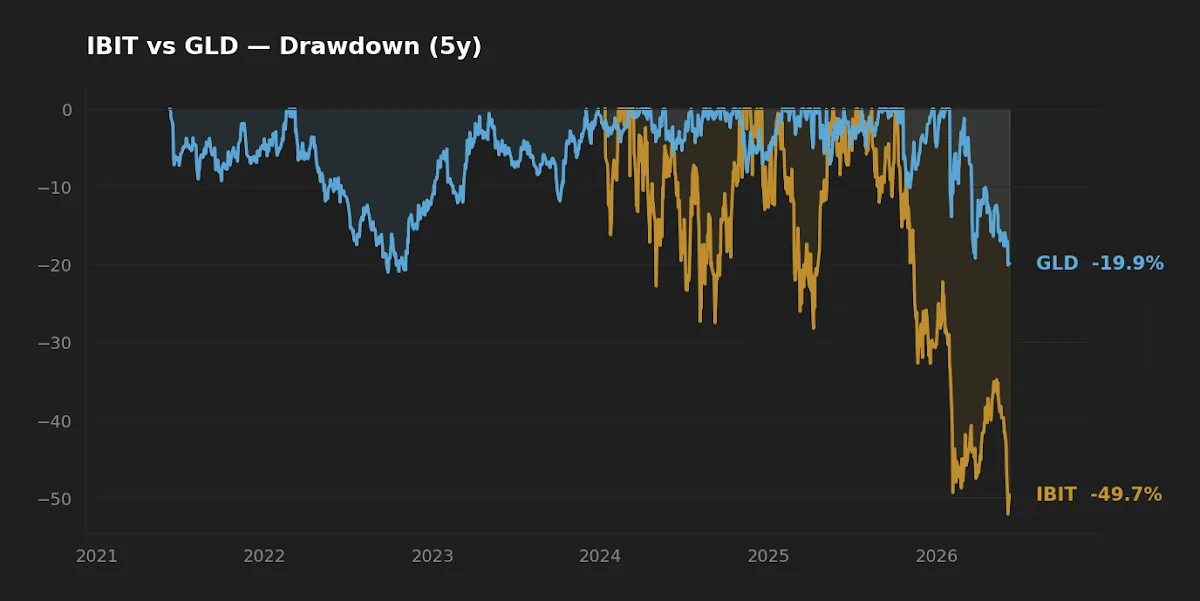
IBIT has no five-year or ten-year figures because it launched in January 2024. The fund itself has lived through one broadly favorable regime. Bitcoin the asset has a longer price history, but it is a short, single-cycle history relative to gold's, and it is dominated by a few extreme drawdowns (roughly -70% to -80% peak-to-trough in prior cycles). Any volatility or correlation estimate for IBIT inherits both look-ahead concerns and single-regime risk — we are extrapolating from a sample that has not yet seen a sustained high-rate, risk-off stress event with the ETF wrapper in place. That is a limit of the analysis, not a footnote to it.
Implementation and structure
Both are physically backed grantor-trust-style vehicles that hold the underlying asset (gold bullion; Bitcoin via a custodian) rather than futures, which avoids roll-cost drag. Neither pays a distribution, so the entire return is price change — relevant for tax timing but irrelevant for income. GLD's $150.4B AUM and two-decade record give it deep liquidity and tight spreads; IBIT's $58.1B is large for a fund its age and trades liquidly, but its custody model carries operational considerations (single-custodian concentration, the mechanics of in-kind versus cash creation) that a buyer should read in the fact sheet rather than assume away.
The macro backdrop frames both. With the federal funds rate at 3.63% (FRED, asof 2026-05-01) and CPI running 3.9% year over year (FRED, asof 2026-04-01), real rates are modestly positive — a regime that has historically been a headwind for non-yielding stores of value, since holding either asset means forgoing a real return available in cash and short Treasuries. That cost of carry applies to gold and Bitcoin alike and is worth weighing against the diversification you are buying. For more on how gold interacts with rates and the dollar, see gold, the dollar, and risk assets in 2026.
Scoreboard: winner by category
| Category | Edge | Why |
|---|---|---|
| Cost | IBIT | 0.25% vs 0.40%, though GLDM/IAU undercut GLD |
| Realized risk (measured) | GLD | Multi-cycle data; IBIT has no through-stress record |
| Hedge reliability | GLD | Low/negative equity correlation in stress; Bitcoin's tends to rise |
| Asymmetric upside | IBIT | Higher convexity, at the cost of -70%-class drawdowns |
| Suitability as core diversifier | GLD | Longer evidence base, lower single-regime risk |
What this comparison can and can't tell you
It can tell you the funds' costs, scale, structure, and — for GLD — realized risk across a measured five- and ten-year window. It cannot tell you IBIT's through-cycle correlation, because that data does not exist yet; the fund has not been tested in a sustained risk-off, high-rate stress. It cannot tell you future correlations for either asset, which are regime-dependent and have drifted historically. And a five- or ten-year sample, however clean, is one path of many — it does not capture the tail events that decide whether a hedge earns its keep.
Scenarios where each fits
A reader in their 30s, 401(k)-only, with no precious-metals or alternative exposure and a multi-decade horizon, is choosing a diversifier — and the longer evidence base favors a small gold sleeve over a position whose hedge case is still being written. A reader who already holds gold, has a high tolerance for -70%-class drawdowns, and explicitly wants asymmetric convexity rather than stability might size a small IBIT satellite, funded from the speculative, not the defensive, part of the portfolio. The distinction that matters is which job you are hiring the asset to do.
Editor's read
If the goal is a diversifier for a long-horizon core, the editor leans toward GLD: its low-to-negative equity correlation in stress is documented across multiple cycles, whereas Bitcoin's correlation has a habit of rising in exactly the liquidity crunches a hedge is meant to cushion. IBIT is the more interesting return asset and a defensible small satellite for an investor who wants convexity and can sit through deep drawdowns — but treating a fund with under two years of history as a proven hedge confuses narrative with evidence.
The editor holds a small gold allocation as a long-term diversifier and does not hold IBIT at the time of writing.
FAQ
Is Bitcoin a better hedge than gold? On the available evidence, no — not as a hedge specifically. Gold has shown low-to-negative equity correlation in stress across decades; Bitcoin's correlation has tended to rise in liquidity crises. Bitcoin may offer more upside, but that is a return argument, not a hedging one.
Why does IBIT have no 5-year return? It launched on 2024-01-05, so it has under two years of history. Any longer-horizon figure would have to use Bitcoin's own price series, which is a different (and shorter, single-cycle) dataset than gold's.
Is IBIT cheaper than GLD? Yes — 0.25% versus 0.40% (issuer fact sheets). But GLD has lower-cost gold siblings such as GLDM and IAU, so 0.40% is not the floor for gold exposure.
Do either of these pay a dividend? No. Both have a 0.0% distribution yield; the entire return is price change. That matters for tax timing but means neither produces income.
Should I hold both? That is a personal allocation decision, not something the data prescribes. The relevant question is whether you are buying diversification (where gold's record is stronger) or asymmetric upside (where Bitcoin's profile is more extreme), and how much drawdown you can hold through. See also the gold vs silver comparison and GLD vs DBMF for adjacent diversifier framings.
Key takeaways
- Gold's hedge case rests on measured low/negative equity correlation in stress across multiple cycles; Bitcoin's correlation has tended to rise in liquidity crunches.
- IBIT (2024 inception) has no through-cycle correlation or drawdown record — its hedge claim borrows the underlying asset's short, single-regime history.
- GLD's 18.1% volatility and -21.0% drawdown show gold is not calm in isolation; its benefit is timing relative to equities.
- IBIT is cheaper (0.25% vs 0.40%) but GLDM/IAU undercut GLD, and cost is secondary to the hedging question.
- Positive real rates (Fed funds 3.63%, CPI 3.9%) impose a cost of carry on both non-yielding assets.
Methodology: price and return data from yfinance (pulled 2026-06-08); expense ratio, AUM, and inception from iShares and SPDR issuer fact sheets; macro figures from FRED (Fed funds asof 2026-05-01, CPI asof 2026-04-01). GLD return window: trailing 5 and 10 years. IBIT long-horizon metrics omitted for insufficient history.
This article is for educational purposes and does not constitute personalized financial advice. See the full Disclaimer.