
Photo by Marcus Reubenstein on Unsplash
The short version
- IBIT and FBTC hold the same asset — spot bitcoin — at the same 0.25% sponsor fee, so the decision is almost entirely structural, not about return.
- The real differentiators hide below the headline: secondary-market liquidity at IBIT's larger scale, bid-ask spreads, and who actually custodies the coins.
- Bottom line: IBIT's scale gives a thin but durable trading-cost edge; FBTC's self-custody is the structural detail most comparisons skip.
When two funds hold the identical underlying asset at the identical headline fee, the usual comparison framework — cost, factor exposure, tracking error — collapses to a single question: what is left to differentiate them? With the iShares Bitcoin Trust (IBIT) and the Fidelity Wise Origin Bitcoin Fund (FBTC), the answer is structure. Both give you spot bitcoin exposure in a brokerage wrapper. The decision lives in the plumbing, and the plumbing is where most retail comparisons stop looking.
Context: what a spot bitcoin ETF actually is
Both funds launched in the January 2024 cohort of US spot bitcoin ETFs — IBIT on 2024-01-05, FBTC on 2024-01-10 (issuer fact sheets). Each holds bitcoin directly rather than futures, so there is no roll cost or contango drag of the kind that historically eroded futures-based crypto products. A share is a fractional claim on a pool of coins held by a custodian. The fund's net asset value tracks the reference bitcoin price, and authorized participants create and redeem shares to keep the market price near NAV.
That sameness is the point. Neither fund is trying to beat bitcoin or apply a factor screen; both are trying to deliver bitcoin minus a fee with minimal tracking error. So the analysis below treats "which tracks bitcoin better" as roughly settled — both do, within a tight band — and spends its time on the costs and structural risks that the marketing pages downplay.
The data, side by side
| Metric | IBIT | FBTC |
|---|---|---|
| Name | iShares Bitcoin Trust ETF | Fidelity Wise Origin Bitcoin Fund |
| Sponsor fee | 0.25% | 0.25% |
| AUM | $58.1B | $13.4B |
| Inception | 2024-01-05 | 2024-01-10 |
| Distribution yield | 0.0% | 0.0% |
| NAV / share | $33.81 | $51.91 |
| 5Y / 10Y CAGR | n/a (since-2024 inception) | n/a (since-2024 inception) |
| Custodian | Coinbase Custody | Fidelity Digital Assets (self-custody) |
Source: yfinance, fetched 2026-06-08; sponsor fees, inception, and custody from issuer fact sheets — iShares (IBIT) and Fidelity (FBTC). Both funds carried introductory sponsor-fee waivers at launch that have since lapsed to the standard 0.25% shown here.
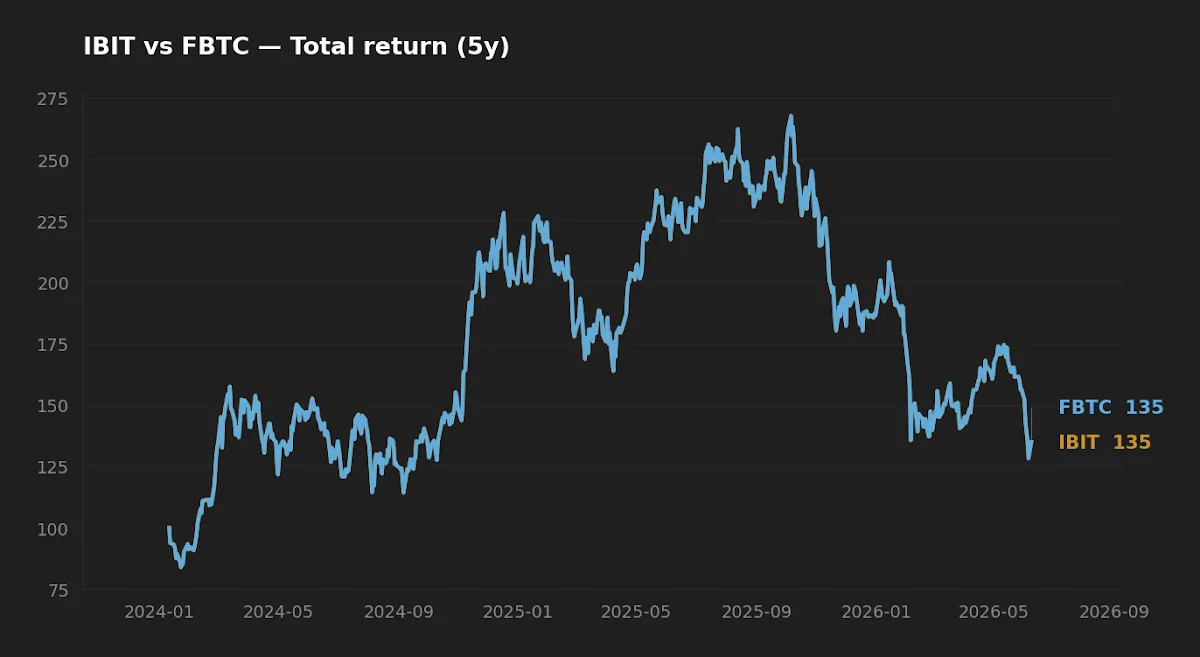
One number deserves an immediate caveat. The chart is framed on a long axis, but neither fund has existed for five years — both date to January 2024, so the realized history is roughly two years. Any "5Y CAGR" field is null for a reason. Read the normalized lines as a coherence check on tracking, not as a long-horizon track record. The two funds move together because they hold the same asset; the visible gap between them is noise from fee accrual and creation/redemption timing, not skill.
Why the NAV-per-share difference means nothing
FBTC trades at a higher NAV per share ($51.91) than IBIT ($33.81). A surprising number of readers infer that the more expensive share is somehow "more" bitcoin, or that the cheaper one has more room to run. Neither is true. Share price is a function of how the sponsor set the initial creation ratio — how many fractional coins each share represents — and nothing else. You can buy the same dollar of bitcoin exposure in either wrapper; you will simply own a different share count. This is the crypto-ETF version of a stock split: cosmetic. The only place it matters is fractional-share availability at brokers that don't support fractions, where a higher unit price marginally coarsens position sizing.
The fee is identical — so cost lives in the spread
With a 0.0% fee gap, the expense ratio — normally the most unforgiving line item over decades — drops out of the decision entirely. What replaces it is the implicit cost of trading: the bid-ask spread you cross on the way in and out, and the premium or discount to NAV at the moment you transact.
This is where IBIT's 4.3× AUM advantage does quiet work. Larger AUM and higher secondary-market volume generally compress quoted spreads and deepen the order book, so a market order absorbs less slippage. For a buy-and-hold investor placing one trade a year, this difference is close to a rounding error against bitcoin's own volatility. For anyone rebalancing across bands, or sizing into a position over several tranches, the spread is paid repeatedly and compounds in the same humble, basis-point way that an expense ratio does. The honest framing: the headline fee is tied, and the tiebreaker is a small structural liquidity edge that only shows up if you trade.
When two funds hold the same coin at the same fee, you are no longer choosing a return — you are choosing a custodian, a spread, and a counterparty.
What you actually own: custody is the real fork
Both prospectuses promise the same economic exposure, but the arrangement behind it differs. IBIT uses Coinbase Custody to hold its bitcoin. FBTC custodies through Fidelity Digital Assets — Fidelity holding the keys itself rather than outsourcing to a third-party crypto specialist. This is the most genuinely structural difference between the two products, and it is the one most fee-focused comparisons omit.
Why it matters is a question of concentration. A large share of the spot-bitcoin-ETF complex relies on the same external custodian, which introduces a shared point of failure across otherwise unrelated funds — a correlation that doesn't appear in any return series. FBTC's self-custody model means its operational risk is borne inside one vertically integrated institution rather than shared across the industry. Neither approach is unambiguously safer; they distribute trust differently. An investor who already holds other Coinbase-custodied products and wants to diversify operational counterparty risk has a non-obvious reason to prefer FBTC that has nothing to do with price.
Realized risk: same asset, same drawdowns
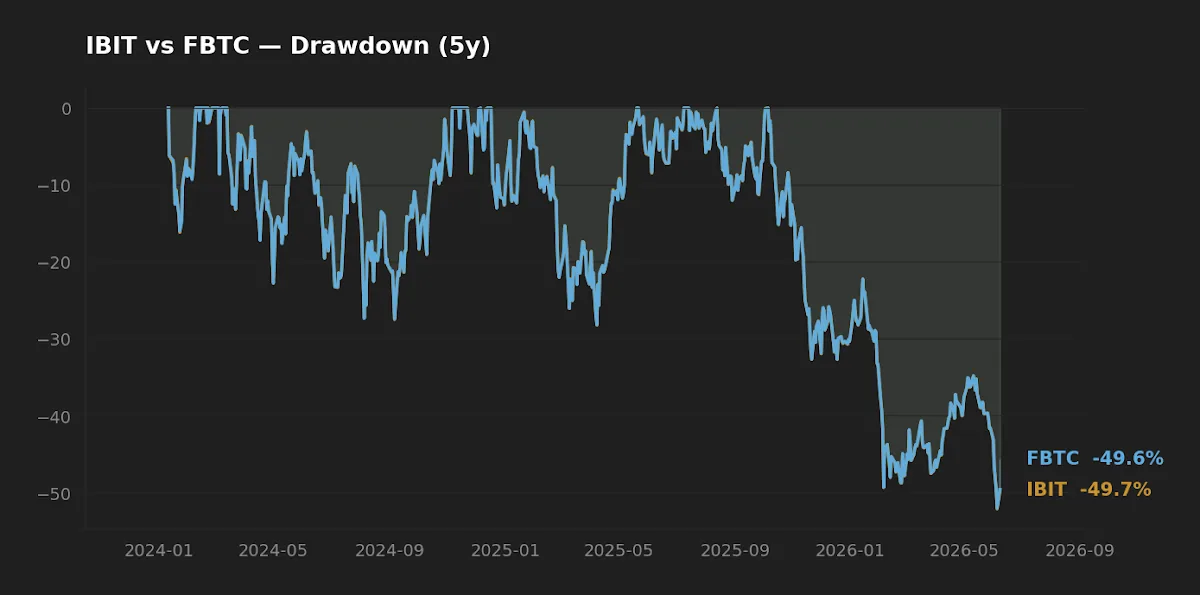
Because both funds hold spot bitcoin, their drawdown profiles are effectively the same curve, separated only by fee accrual and trading noise. There is no diversification benefit to splitting between them — the realized volatility and peak-to-trough declines are bitcoin's, full stop. That is the sobering part of the picture: bitcoin's historical drawdowns have run deeper and lasted longer than anything in a conventional equity sleeve, and an ETF wrapper changes the tax and custody experience without softening the path. The arithmetic of a deep drawdown — a 50% decline requires a 100% recovery to break even — applies to either ticker with full force, and bitcoin has visited that territory more than once. Anyone sizing a position should anchor on drawdown tolerance, not on the choice of wrapper, and should treat this exposure the way the broader risk-asset and store-of-value debate frames it: a volatile satellite, not a core anchor.
For macro context, the Fed funds rate sat at 3.63% as of 2026-05-01 and CPI ran 3.9% year over year as of 2026-04-01 (FRED). A positive real-rate environment historically raises the bar for non-yielding assets; neither fund pays a distribution (0.0% yield), so the entire thesis rests on price appreciation against that backdrop. The data can't tell you whether that thesis holds — only that the cost of carry is non-trivial when cash earns a real return.
Scoreboard: winner by category
| Category | Edge | Why |
|---|---|---|
| Cost (expense ratio) | Tie | Both 0.25% after waivers lapsed |
| Trading cost (spread/liquidity) | IBIT | 4.3× AUM, deeper secondary market |
| Realized risk | Tie | Same underlying, same drawdown path |
| Realized return | Tie | Tracks the same reference price |
| Custody / counterparty diversification | FBTC | Fidelity self-custody vs shared external custodian |
| Suitability (active rebalancer) | IBIT | Liquidity edge compounds with trade frequency |
FAQ
Is IBIT or FBTC cheaper to hold?
Neither, on the sponsor fee — both charge 0.25% after their introductory waivers expired (issuer fact sheets). The only durable cost difference is the bid-ask spread, where IBIT's larger AUM and volume tend to produce tighter quotes.
Does FBTC's higher share price ($51.91 vs $33.81) mean more bitcoin per share?
No. Share price reflects the initial creation ratio the sponsor chose, not a richer or poorer claim. Equal dollars buy equal exposure in either fund.
Do these funds pay a dividend or yield?
No. Both show a 0.0% distribution yield (yfinance, 2026-06-08). Bitcoin produces no cash flow, so the entire return depends on price.
Why is there no 5-year return data?
Both launched in January 2024, so roughly two years of history exists. Any 5Y or 10Y CAGR field is null because the funds haven't been around that long. Treat all long-horizon performance framing with caution.
Should I split a position across both to diversify?
Splitting does not reduce market risk — both track the same asset, so the drawdown path is identical. The only thing a split diversifies is custodial counterparty exposure (Coinbase Custody vs Fidelity Digital Assets), which is a real but narrow consideration.
What this comparison can and can't tell you
It can tell you the funds are structurally near-identical on economics and that the meaningful differences are liquidity and custody. It cannot tell you whether bitcoin belongs in your allocation, what a fair position size is, or how either fund behaves across a full market cycle — the live history is about two years and covers a single, relatively favorable regime. There is no multi-cycle data, no stress test against a sustained bear market within the ETF wrapper, and no precedent for how creation/redemption mechanics perform under extreme redemption pressure. Those are the blind spots, and they are large.
Scenarios where each fund fits
Buy-and-hold investor placing one trade and never touching it: the funds are interchangeable; pick either and ignore the noise. Investor who rebalances across bands or scales in over tranches: IBIT's tighter spreads make it the marginally cheaper venue. Investor already holding other Coinbase-custodied crypto products: FBTC's self-custody adds counterparty diversification at no extra fee. Investor who can't tolerate a 50%+ drawdown: the wrapper choice is irrelevant — the position size is the decision that matters.
Editor's read
If forced to pick one, the editor leans slightly toward IBIT for an investor who expects to trade at all: the 4.3× AUM gap translates into tighter spreads, and trading cost is the only line item that isn't already tied. But the lean is genuinely slight, and an investor seeking to diversify away from a single dominant custodian has a defensible, non-price reason to choose FBTC instead. The larger point dwarfs both: with the same coin at the same fee, the wrapper is a second-order decision. The first-order decision — whether and how much bitcoin exposure to carry through a drawdown you can't time — is the one worth the analysis.
The editor does not hold either fund at the time of writing.
Methodology: Price, NAV, AUM, and yield from yfinance, pulled 2026-06-08. Sponsor fees, inception dates, and custody arrangements from issuer fact sheets (iShares, Fidelity). Macro figures from FRED: Fed funds rate asof 2026-05-01, CPI year-over-year asof 2026-04-01. Window analyzed: since-inception (January 2024) through 2026-06-08. Long-horizon CAGR fields are null because both funds are under two and a half years old.
This article is for educational purposes and does not constitute personalized financial advice. See our full Disclaimer.