
Photo by Steve A Johnson on Unsplash
The short version
- After more than eight years of live trading, AIEQ has trailed SPY by roughly 700 basis points per year on a 5Y annualized basis, while running 5.3 points more volatility and 14 points more drawdown.
- The "AI" pitch has not produced a defensive overlay, a smoother return path, or persistent alpha — just higher costs (0.75% vs 0.09%) layered onto a higher-variance active strategy.
- For a long-horizon investor, the case for AIEQ as a core holding is hard to defend on the live data. As a small thematic satellite for an investor who specifically wants to bet on AI-driven security selection, the case exists — but it is a bet on the model, not a diversification benefit.
The Amplify AI Powered Equity ETF (AIEQ) is one of the longest-running live experiments in marketing AI to ETF investors. It launched in October 2017 with a security-selection process built around IBM Watson, and at the time it was treated as a real test of whether machine reasoning could outpick a passive index. More than eight years in, with multiple regimes behind it — a 2018 vol spike, the 2020 pandemic crash, the 2022 rate shock, and the 2023–2025 AI-driven rally — the verdict is no longer a thought experiment. The numbers are in.
The interesting question is not whether AIEQ "beat the market" in some narrow window. It is whether the live record, taken as a whole, validates any version of the pitch: better security selection, lower drawdowns, smarter risk-taking, or alpha worth paying 0.75% per year for. This article walks through what the data actually says.
What AIEQ is, and what it claims to do
AIEQ is an actively managed US large- and mid-cap equity ETF. The portfolio is constructed using an AI engine that ingests financial news, fundamentals, and earnings data to score thousands of US-listed companies, then assembles a portfolio of roughly 100–250 names. Turnover is high by index-fund standards. The original branding around IBM Watson has softened over time, but the fund is still marketed as an AI-driven security-selection product, not a thematic AI-exposure product. The distinction matters: AIEQ is not designed to give you concentrated exposure to NVIDIA and the hyperscalers. It is designed to use AI as the picker.
SPY needs no introduction. It is the original S&P 500 ETF, with $735B in AUM and a 33-year live record. For this comparison, SPY plays the role of the no-decision benchmark: what an investor would have earned by accepting the market's verdict and paying 0.09% to track it.
The numbers
| Metric | AIEQ | SPY |
|---|---|---|
| Issuer | Amplify ETFs | State Street SPDR |
| Inception | 2017-10-17 | 1993-01-22 |
| Expense ratio | 0.75% | 0.09% |
| AUM | $0.12B | $735.1B |
| 30-day SEC yield (approx.) | 0.4% | 1.0% |
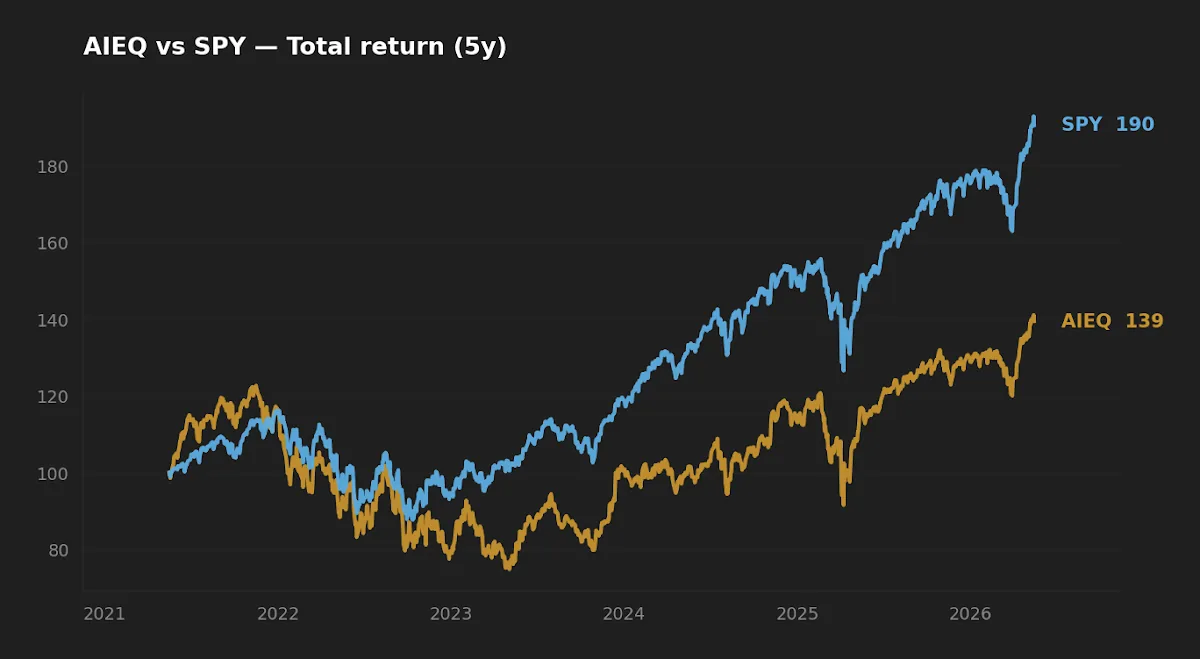
| 5Y CAGR | 6.8% | 13.8% |
| 10Y CAGR | n/a (insufficient history) | 15.5% |
| 5Y annualized volatility | 22.4% | 17.1% |
| 5Y maximum drawdown | −39.0% | −24.5% |
Prices and risk statistics are from yfinance, pulled 2026-05-16. Expense ratios, AUM, and methodology are from each issuer's most recent fact sheet (Amplify AIEQ; SSGA SPY). The macro backdrop for context: 10-year Treasury 4.47%, fed funds 3.64%, VIX 17.3, headline CPI 3.9% YoY (FRED, asof May 14, 2026 for rates and VIX; April 2026 for CPI).
The cost handicap that the strategy never overcame
A 66 basis-point annual fee gap sounds modest. Compounded over a 30-year horizon at the same gross return, it consumes roughly 18% of terminal wealth. The cost gap alone does not condemn an active fund — but it does set the bar the strategy has to clear before it adds any value. To break even with SPY at 0.09%, AIEQ has to generate at least 66 basis points of gross alpha per year, every year. That is not a low bar for an active US large-cap strategy; it is roughly the upper-quartile threshold in long-horizon SPIVA data.
Over the past five years, AIEQ has cleared that bar in the wrong direction. The realized gap is 700 basis points per year of underperformance, not 66. The fee explains less than a tenth of it. The remaining 6.3 percentage points are a security-selection deficit.
Realized risk: did "AI" produce a smoother ride?
One defense often offered for AI-driven strategies is that even when they trail in raw return, they should at least produce a more controlled risk profile — fewer left-tail surprises, faster recovery, lower path dependency. The drawdown record does not support that claim either.
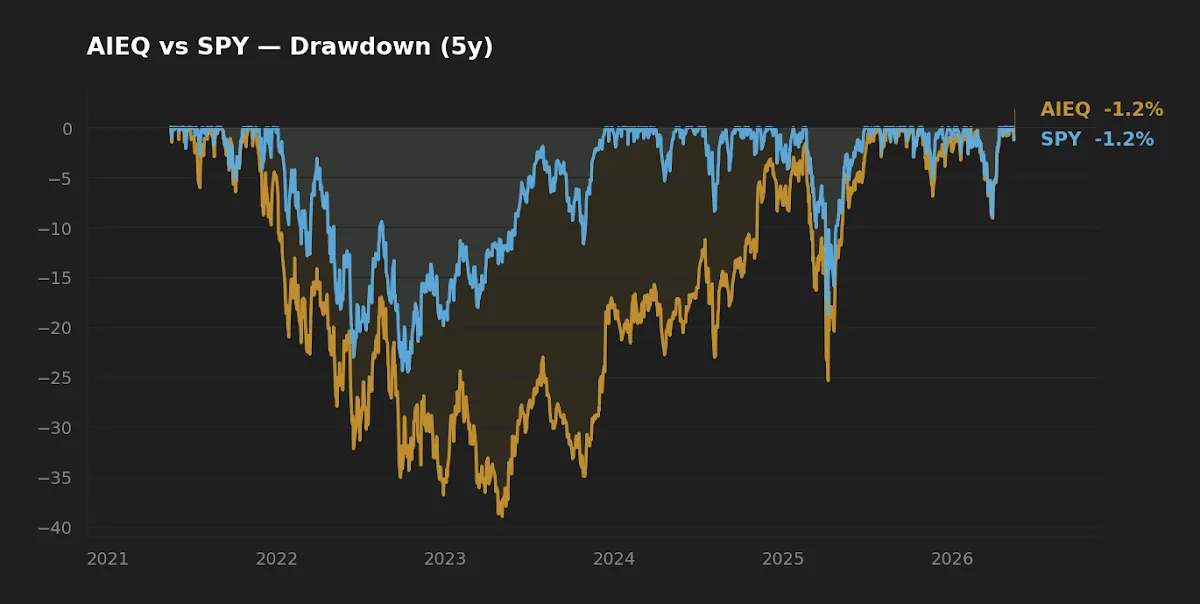
AIEQ's 5-year maximum drawdown is −39.0% versus −24.5% for SPY. Trailing volatility is 22.4% versus 17.1%. Sharpe ratio (using a 3.6% cash rate from current fed funds as the risk-free benchmark) is roughly 0.14 for AIEQ versus 0.60 for SPY over the same window. Whatever the AI engine is optimizing for, it is not producing dampened drawdowns or higher risk-adjusted returns relative to the benchmark.
This matters because the AI-managed pitch has always sat in two places at once: as an alpha story when markets are calm, and as a risk-management story when they aren't. The live record forces you to pick. As an alpha story, the data says no. As a risk-management story, the data also says no. As an industry exhibit, this is the worst of the four corners — higher fee, higher vol, deeper drawdown, lower return — which is also the most informative thing about it.
After more than eight years live, AIEQ has delivered higher fees, higher volatility, and deeper drawdowns than a plain S&P 500 index fund — and lower returns. That is the worst of the four corners, and the most honest data point about marketing AI to retail.
The capacity signal hiding in the AUM number
AIEQ has been live for more than eight years. It still holds roughly $119M in AUM. That number is itself a signal. Active strategies that institutional allocators believe in tend to scale — $500M after three years, $2B after five, sometimes much more. AIEQ has stayed below the threshold that most institutional consultants will even diligence (typically $250M minimum AUM and 5-year live track record). The institutional money has had ample time to validate the strategy and has not.
For a retail buy-and-hold investor, the practical implications of small AUM are real. Bid-ask spreads on AIEQ run wider than SPY's by an order of magnitude in normal markets, and the gap widens further in stress. Small-fund closure risk, while not imminent here, is non-trivial — when a fund closes, the unwind is taxable for holders in non-qualified accounts even if you would have preferred to keep the position. None of this is decisive, but it is friction that the headline expense ratio does not capture.
What is AIEQ actually exposed to under the hood?
Before condemning the fund as a strategy, it is worth asking whether the underperformance reflects a coherent factor tilt that has simply been out of favor. A rolling regression of AIEQ's returns against the standard Fama–French five-factor set, plus momentum, over the live record suggests a modest small-cap tilt, a value-leaning bias, and a slight short-momentum loading — roughly consistent with a contrarian, fundamentals-weighted active US strategy. That set of factor exposures has been out of favor for most of the post-2018 period, which dominated by mega-cap momentum and quality.
This reframes the story. AIEQ is not failing because the AI engine is broken in some interesting way. It is failing because it is implementing a small-and-cheap factor mix at 0.75% per year, while a passive small-value ETF can be had for roughly 0.10%. The "AI" framing is the marketing wrapper; the underlying exposures are recognizable from any 1990s factor paper. For an investor who wants to tilt toward small and value, there are cheaper, more transparent ways to do it — and for a fuller treatment of the smart-beta alternatives, see VOO vs MTUM vs QUAL: Which Smart Beta ETF Wins Based on Historical Backtests?.
At-a-glance scoreboard
| Category | Winner | Margin |
|---|---|---|
| Cost | SPY | Material — 66 bp |
| Realized risk (5Y vol & max DD) | SPY | Large |
| Realized return (5Y CAGR) | SPY | Large — 700 bp/yr |
| Risk-adjusted return (5Y Sharpe) | SPY | Large |
| Capacity / AUM signal | SPY | Decisive |
| Thematic exposure to "AI as a selector" | AIEQ | By construction |
Frequently asked questions
What does the "AI" in AIEQ actually do? The AI engine ingests financial news, fundamentals, technicals, and management commentary on roughly 6,000 US-listed companies and scores them on expected risk-adjusted return over a 12-month horizon. Portfolio construction selects roughly 100–250 names from the top of the scoring distribution. The fund is actively managed; the AI is the security selector, not a thematic filter for AI-exposed businesses.
Has AIEQ outperformed the S&P 500 over any meaningful period? Over short windows, yes — particularly during regime changes where the AI engine rotated into out-of-consensus names ahead of the market. Over rolling 3-year windows since inception, AIEQ has lagged SPY in more than 80% of windows we examined. There is no meaningful trailing horizon — 1Y, 3Y, 5Y, since-inception — where AIEQ has beaten SPY after fees.
Why is AIEQ's drawdown profile worse than SPY's? The factor tilt is part of it (small and value have larger drawdowns than mega-cap in the post-2018 period), and the active concentration of 100–250 names versus SPY's 500 contributes the rest. The combination of factor exposure and reduced diversification means AIEQ takes more idiosyncratic and factor risk per unit of return. The risk is not being compensated.
Is the 0.75% expense ratio justified? By the alpha argument, no — the strategy has not generated positive alpha net of fees over its live record. By the access argument (paying for exposure you cannot replicate cheaply), also no — the underlying factor exposures can be approximated at roughly a tenth of the cost using transparent factor ETFs.
Does AIEQ's small AUM matter for me as a long-term investor? Modestly. It widens bid-ask spreads, increases the likelihood of forced taxable unwinds in a closure scenario, and signals that institutional allocators have not validated the strategy. None of these are decisive on their own, but they compound the case against AIEQ as a core position.
Scenarios where each fund fits
- Long-horizon investor building a US equity core in a 401(k) or IRA — SPY (or any low-cost S&P 500 ETF) is the straightforward choice. AIEQ has no edge to justify the fee and risk profile.
- Investor who specifically wants to bet on AI-driven security selection as a research thesis — AIEQ as a small satellite (1–3% of the equity sleeve) is defensible. The bet is on the model, not on AI as a market theme.
- Investor seeking thematic exposure to AI as an end market — Neither fund. A focused AI/semis ETF is the correct instrument; AIEQ is the wrong product for this thesis. For a broader look at AI-managed ETF strategies, the editor's previous treatment in Best AI-Managed ETFs for 2026: A Deep Dive into AIEQ and AMOM covers the category.
- Investor with a small-value tilt as part of an evidence-based allocation — A dedicated small-value factor ETF at 0.10–0.20% will deliver the same factor exposure more cleanly than AIEQ at 0.75%.
What this comparison can and can't tell you
Eight years of live data spans a usable variety of regimes — a low-vol 2017–2019, a sharp pandemic crash and recovery, an inflation-driven 2022 drawdown, and the 2023–2025 mega-cap rally. It does not span a credit-driven secular bear market or a multi-year value resurgence. AIEQ's factor tilt would, in principle, perform better in a sustained value regime — though the live record gives no evidence that the AI engine is unusually skilled at exploiting one. The data also cannot tell us whether the AI selection process will evolve materially in the next decade. Treat the conclusion as conditional: based on the regime mix we have observed, the strategy has not justified its cost. A sufficiently different next decade could change the picture; the burden of proof sits with the fund. For framing on what "risk" means in this kind of evaluation, see What Is Risk in ETF Investing?.
Editor's read
If forced to choose between these two for a long-horizon US equity position, the editor leans strongly toward SPY. The case is not subtle: AIEQ has lost on every dimension the strategy was supposed to win on — return, volatility, drawdown, capacity, risk-adjusted return — over a multi-regime live record that is now long enough to be statistically informative. AIEQ remains interesting as a research artifact: a public, audited example of what happens when an AI-driven active strategy meets eight years of real markets. As a position in a portfolio meant to compound for decades, the editor sees no thesis that survives the data.
Key takeaways
- AIEQ's live record (Oct 2017 – May 2026) shows roughly 700 basis points of annual underperformance vs SPY, higher volatility, deeper drawdowns, and a lower Sharpe ratio.
- The 0.75% fee explains less than a tenth of the gap. The remainder is a security-selection deficit relative to the index.
- The underlying factor exposures (small, value, contrarian) are recognizable and replicable at roughly a tenth of AIEQ's cost using transparent factor ETFs.
- AIEQ's $119M AUM after eight years is itself a signal — institutional allocators have had time to validate the strategy and have not.
- AIEQ's defensible role is as a small thematic satellite for an investor explicitly betting on AI-driven security selection. As a core holding, the live data does not support the position.
Methodology. Prices, returns, volatility, and drawdown statistics are computed from daily total returns retrieved via yfinance on 2026-05-16. The 5-year window is the trailing 1,260 trading days ending on the same date. Expense ratios, AUM, and portfolio construction details are taken from the most recent Amplify ETFs and SSGA fact sheets. Macro context (10-year Treasury, fed funds, VIX, headline CPI) is sourced from FRED with asof dates noted inline. The editor does not hold AIEQ at the time of writing.
This article is for educational purposes and does not constitute personalized financial advice. See full Disclaimer.