
The short version
- AGG and BNDI hold roughly the same investment-grade bond universe in their core. The difference is one decision: BNDI writes options on top of that core to convert bond-market volatility into distributable income.
- The trade is concrete — an extra 180 basis points of distribution yield (5.7% vs. 3.9%) for 55 basis points of additional fee, plus the upside you give up when the bond market rallies. BNDI's 3.5-year track record is too short for a full rate-cycle test.
- Bottom line: AGG is the cleanest, cheapest way to own duration. BNDI is a yield-tilt sleeve for an investor who specifically needs current cash flow and understands what the option overlay is selling.
Both funds start from the same place — a broad slice of U.S. investment-grade fixed income, dominated by Treasuries, agency MBS, and investment-grade corporates. They diverge on a single decision. AGG owns that universe at three basis points and pays out whatever the underlying coupons generate. BNDI owns a similar core, then writes options on top to harvest premium and pass it through as additional yield. The headline number — 180 bp of distribution-yield pickup for 55 bp of additional fee — looks like a clean win, but only if you understand what is actually being sold.
Two routes into the aggregate bond market
AGG (iShares Core U.S. Aggregate Bond ETF) tracks the Bloomberg U.S. Aggregate Bond Index — the textbook benchmark for the U.S. investment-grade bond market. It launched in 2003 and now holds $138.7B in assets, the largest fixed-income ETF in the world. The index is rebalanced monthly, the expense ratio is 0.03%, and the strategy is intentionally boring: own the market, capture the coupon, accept the duration risk that comes with it. iShares fact sheet.
BNDI (Neos Enhanced Income Aggregate Bond ETF) is a much newer construction — inception August 2022, $164M in AUM, 0.58% expense ratio. It holds an aggregate-bond core and overlays a rules-based options strategy designed to generate additional income. Despite occasional descriptions of "AI-driven" or "actively managed" fixed income, the actual mechanism is mechanical: hold the bonds, sell options, distribute the premium. Neos fact sheet. This distinction matters — what BNDI is selling is option premium, not active credit selection or duration timing.
The funds at a glance
| Metric | AGG | BNDI |
|---|---|---|
| Issuer | iShares (BlackRock) | Neos Investments |
| Inception | 2003-09-22 | 2022-08-29 |
| Expense ratio | 0.03% | 0.58% |
| AUM | $138.7B | $164M |
| Distribution yield (TTM) | 3.9% | 5.7% |
| 5Y CAGR | 0.2% | n/a (track record too short) |
| 10Y CAGR | 1.7% | n/a |
| 5Y annualized volatility | 6.1% | n/a |
| 5Y max drawdown | −17.8% | n/a |
| NAV (2026-05-05) | $98.85 | $47.22 |
Source: yfinance, fetched 2026-05-05; issuer fact sheets for fund details. Macro context: 10Y Treasury 4.39%, Fed funds 3.64%, CPI YoY 3.32% (FRED, asof 2026-05-01).
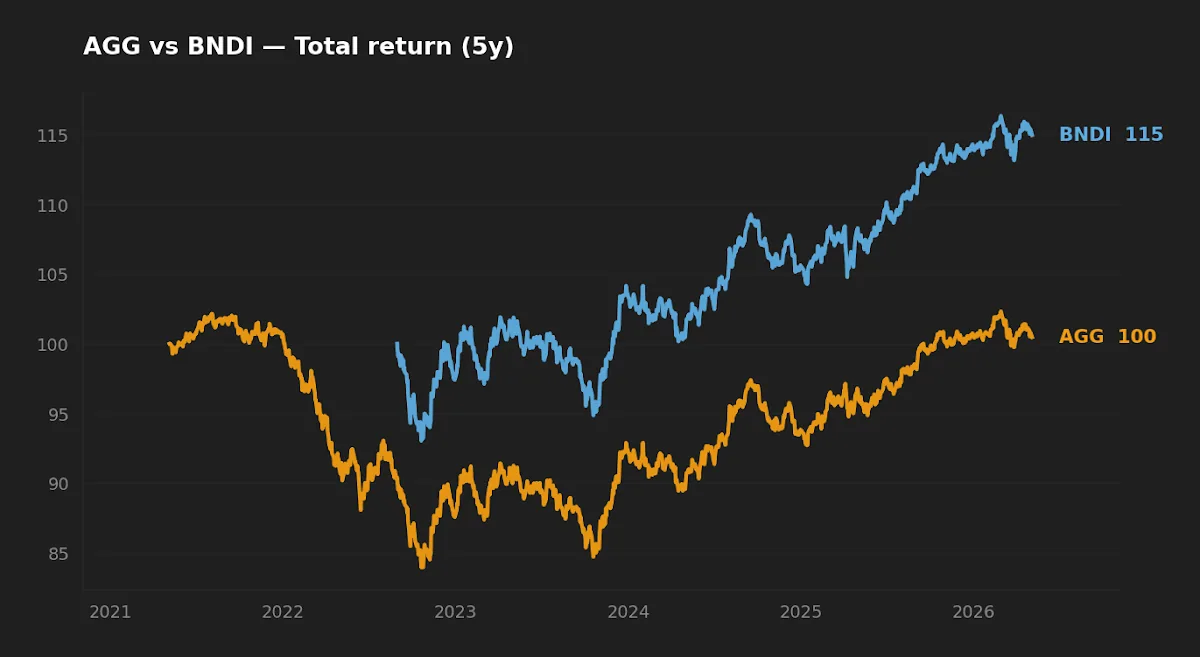
Construction: same core, different overlay
The cleanest way to think about BNDI is as AGG plus a covered-call mechanic, applied to the bond market rather than equities. The core sleeve gives you duration exposure — same coupons, same rate sensitivity. The overlay sells options against either the core or a related index, and the option premium funds the additional distributions.
This has several second-order consequences that are not obvious from the headline yield. First, when the bond market rallies hard — for example, in a Fed-cut scenario where intermediate Treasury yields drop 100 bp — the options overlay caps the upside. The core appreciates, but the short-call leg loses, and the net is less price appreciation than AGG would have captured. Second, when the bond market drops, the overlay's premium income offsets a portion (but only a portion) of the principal decline. The realized volatility profile is asymmetric: less upside, modestly less downside, more current cash. Third, the strategy benefits when implied volatility on the option leg is elevated — the premium is what funds the yield enhancement, and IV is the price of premium.
None of this is "smart" or "AI-driven" in any meaningful sense. It's a well-understood income-generation tradeoff that has existed in equity covered-call funds (JEPI, QYLD, NEOS's own SPYI) for years, now applied to fixed income. The question is whether the bond version is paying you fairly for the upside you're surrendering.
Where the 180 bp of extra yield actually comes from
Decomposing the yield pickup is the most useful exercise here. AGG's 3.9% distribution is essentially the underlying coupon stream net of 3 bp of fees — Treasury, agency MBS, and IG corporate interest. BNDI's 5.7% has a different composition: bond coupons from the core sleeve minus the 58 bp fee, plus net option premium from the overlay. After fees, the "real" yield enhancement is closer to 125 bp, not 180 bp.
That 125 bp comes from selling volatility. In a regime where realized bond-market volatility runs above what implied vol prices in, the overlay loses money on option mark-to-market and the enhancement shrinks. In a regime where vol is overpriced, it works. The premium is not free money — it is compensation for taking the short-vol side of an option trade, and it disappears in the scenarios where you would most want a defensive bond allocation to perform.
The 180 bp yield pickup is not free money. It is compensation for taking the short-vol side of an option trade — and it tends to disappear in the scenarios where a defensive bond allocation matters most.
Realized risk and what the drawdown profile shows
AGG's five-year window is unusually informative because it captures one of the worst rate-driven bond drawdowns in modern history. The 2022 cycle pushed AGG's max drawdown to −17.8% — a number bond investors are not used to seeing on an aggregate index — and the recovery is still partial. Annualized volatility of 6.1% over five years is roughly double what a 2010s-era investor would have associated with this kind of "core bond" exposure.
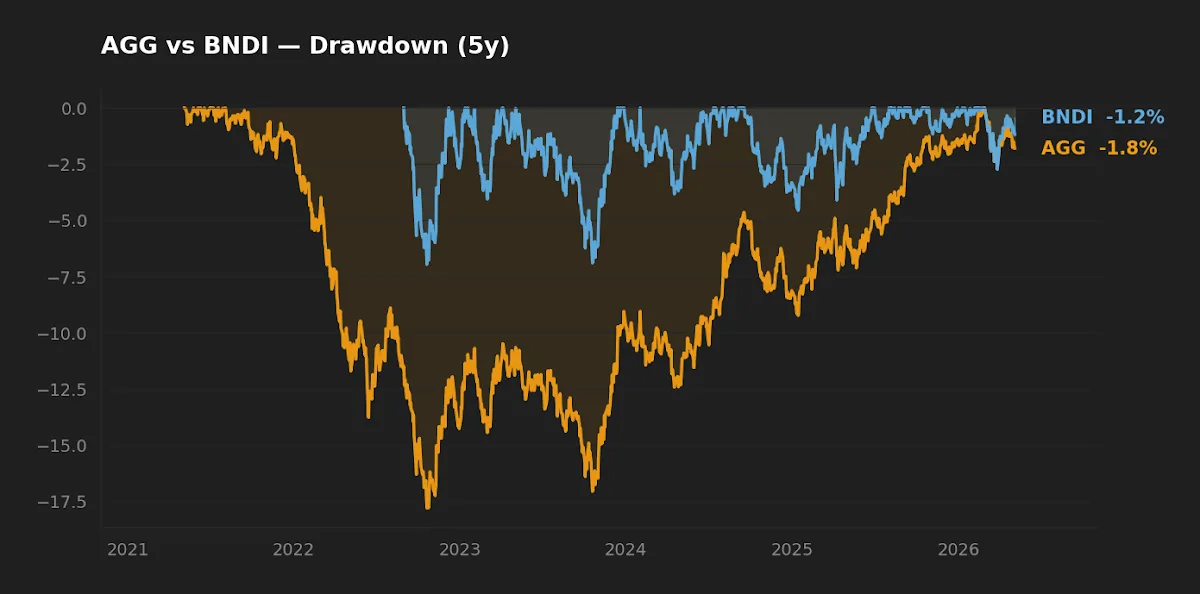
BNDI did not exist for most of that drawdown. It launched in August 2022, near the bottom of the bond bear market — meaning its short live track record is partially a tailwind from the post-trough recovery, partially the period when implied volatility on rate-sensitive options has been elevated. We have no data on how BNDI's overlay would have performed if forced to roll short calls into a sustained 2020–2022-style rate spike. That is the missing stress test, and it is the single most important caveat in this comparison. For broader context on how rate regimes shift bond fund behavior, see Best ETFs for Falling Interest Rates.
The cost-vs-yield arithmetic over a long horizon
The fee differential — 55 bp — is large in fixed-income terms. On a $50,000 allocation held for 20 years at a 5% gross return, the difference between paying 3 bp and paying 58 bp compounds to roughly $7,300 in foregone wealth. Whether the option overlay generates more than that in net additional income across a full rate cycle is an empirical question that the available data cannot yet answer.
One nuance worth flagging: Neos's fund family is generally structured around tax-aware distribution mechanics, including the use of index options that may receive Section 1256 treatment (60% long-term / 40% short-term capital-gains rates). For an investor in a high tax bracket holding either fund in a taxable account, the after-tax math can differ meaningfully from the pre-tax yield comparison. This is fund-specific and changes with the strategy's actual distribution composition each year — verify against the most recent 19a-1 notices and 1099 breakdowns before treating it as a fact about your situation.
What this comparison can and can't tell you
Three honest limitations. First, BNDI's 3.5-year live track record covers exactly one regime — a stabilizing-to-falling-rate environment with elevated implied volatility. We have not seen the strategy roll its overlay through a sustained rising-rate shock. Second, the 5.7% distribution yield reflects the trailing twelve months; option-overlay income is not contracted, and the run-rate can compress materially when IV falls. Third, the "180 bp pickup" arithmetic assumes the core sleeves are equivalent in duration and credit. They are close but not identical, so a small portion of the yield difference is exposure mismatch rather than overlay alpha.
Scenarios where each fund fits
- Long-horizon investor in a tax-advantaged account, wants core duration: AGG. The 55 bp fee gap is unforgiving over decades, and the option overlay is solving a problem (immediate cash flow) that this investor doesn't have.
- Retiree or near-retiree in a taxable account, needs current income, can tolerate capped upside: BNDI is at least worth modeling. The 1256 treatment on the options leg, where applicable, can make the after-tax yield more competitive than a flat-rate comparison suggests.
- Investor expecting a sharp rate-cut cycle: AGG. The strategy that captures duration cleanly will outperform a strategy that has sold off some of its upside.
- Allocator splitting a defensive sleeve: A small BNDI satellite (10–20% of the bond sleeve) inside a larger AGG core can express a yield tilt without abandoning the cheapness and liquidity of the core. This is closer to how income-overlay equity funds get used in practice — also covered in our parallel analysis, SCHD vs. DIVZ.
At-a-glance scoreboard
| Category | Winner | Margin |
|---|---|---|
| Cost | AGG | Material — 55 bp |
| Current cash yield | BNDI | Material — 180 bp gross |
| Capacity / liquidity | AGG | Decisive — $138.7B vs. $164M AUM |
| Track-record depth | AGG | 22 years vs. 3.5 years |
| Suitability for long-term core | AGG | Strong |
| Suitability for current-income tilt | BNDI | Conditional on tax bracket and account type |
Frequently asked questions
Is BNDI actually "AI-driven" or actively managed in any meaningful sense?
The mechanism is a rules-based options overlay on top of an aggregate-bond core. There is no discretionary credit selection or duration-timing model that survives scrutiny. Some marketing language frames overlay strategies as "intelligent" or "active," but the operative engine is short option premium, which is a well-understood instrument with well-understood payoffs.
Why is AGG's 5-year CAGR only 0.2% — that looks broken.
It captures the 2022 bond bear market in full. AGG drew down 17.8% peak-to-trough as the Fed raised rates from zero to north of 5%. The recovery has been slow because intermediate yields stayed elevated. This is not a fund problem; it is what duration risk looks like when realized.
Will BNDI's yield stay near 5.7%?
Probably not exactly. Option-overlay income is a function of implied volatility and the underlying yield curve. If IV compresses or the bond core's coupons fall in a rate-cut cycle, the distribution rate will adjust downward. Treat 5.7% as the trailing run-rate, not a contracted yield.
For a Korean investor holding KRW, does this comparison matter?
Only after currency. Both funds are USD-denominated and unhedged from a KRW perspective. The dominant return driver for an unhedged KRW investor is the USD/KRW path, which can swamp the 180 bp yield difference in either direction. Hedged equivalents or KRW-denominated bond ETFs are a different conversation.
Can I just hold both?
Mechanically, yes. But you would mostly be paying 58 bp on half of the same exposure you already own at 3 bp. Holding both makes sense only if you want a deliberate yield tilt sized as a satellite — and then it's worth sizing intentionally rather than splitting 50/50 by default.
Editor's read
If forced to pick one for the long-term core fixed-income sleeve, the editor leans toward AGG. The 3 bp fee, 22-year track record, and decisive AUM advantage make it the default that has to be argued against, not for. BNDI is genuinely interesting as a current-income tilt for a specific kind of investor — taxable account, high bracket, needs cash flow now, comfortable with capped upside — but treating it as a core bond holding is hard to justify on three years of single-regime data. The "AI" framing in the original title is, on inspection, a marketing artifact: what BNDI is actually selling is short volatility, dressed up as innovation.
Key takeaways
- AGG and BNDI share roughly the same bond core; BNDI's 180 bp yield pickup comes from an options overlay, not from active credit or duration management.
- The 55 bp fee gap is large in bond terms — over 20 years on $50,000 it compounds to roughly $7,300.
- BNDI's 3.5-year history covers one regime. The strategy has not been stress-tested through a 2022-style rate spike.
- AGG is the default for a long-horizon core. BNDI fits a specific income-tilt use case, sized as a satellite, in the right account type.
The editor does not hold either fund at the time of writing.
Methodology
Price, return, volatility, and drawdown statistics computed from yfinance daily total-return series, fetched 2026-05-05, using a five-year window. Expense ratios and AUM from issuer fact sheets (iShares for AGG, Neos for BNDI). Macro context (10Y Treasury, Fed funds, CPI) from FRED, asof 2026-05-01. The 125 bp "real yield enhancement" estimate is gross distribution-yield difference (180 bp) minus the additional fee BNDI charges (55 bp); it does not adjust for distribution-character differences, which are taxpayer-specific.
This article is for educational purposes and does not constitute personalized financial advice. See Disclaimer.