
The short version
- SGOV's five-year realized volatility is 0.2% and its worst drawdown was 0.03% — it behaves like cash with a yield, not like a "bond."
- The 3.9% distribution yield against 12-month CPI of 3.9% leaves a real return near zero. That is the price of optionality, not income.
- Gold and SGOV hedge different risks — gold against currency erosion, SGOV against liquidity timing. The case for holding both rests on that orthogonality, not on either being a better defense.
When a long-horizon investor talks about "defense," the word is doing a lot of work. It can mean low volatility, shallow drawdowns, liquidity available when the rest of the portfolio is hurting, or a hedge against a risk equities are not exposed to at all. SGOV and gold both fit somewhere under that umbrella, but they are doing different jobs.
This article does not argue for a specific defensive allocation. It looks at what the realized numbers actually show after five years that included a zero-rate regime, a 525 bp hiking cycle, and the current higher-for-longer environment — and lines those numbers up against two high-volatility AI and automation ETFs as a reference point for what "non-defensive" looks like in the same window.
Context: what we are actually measuring
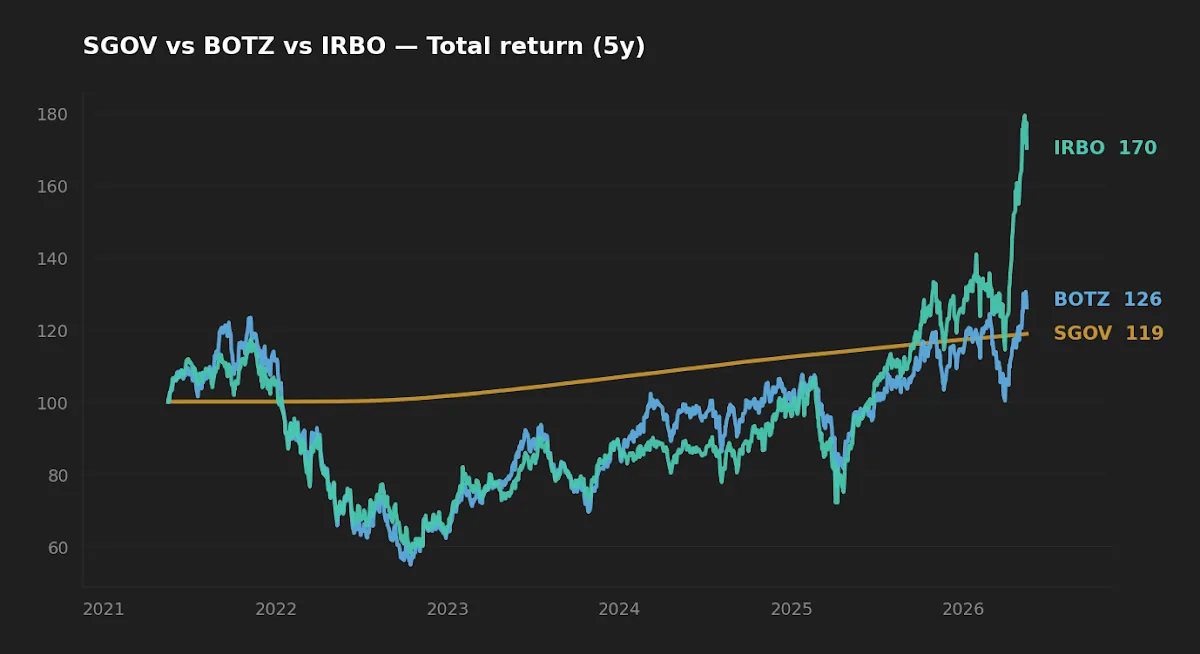
The comparison set is intentionally asymmetric. SGOV (iShares 0-3 Month Treasury Bond ETF) sits at the most defensive end of the bond duration spectrum — its holdings mature inside 90 days, so the price barely moves whatever happens at the long end. BOTZ (Global X Robotics & AI) and IRBO (iShares Future AI & Tech) sit at the opposite end: equity, thematic, mid-cap-skewing, no income to speak of. Setting them against each other is not meant to suggest a head-to-head trade. It is meant to show what a hundred-fold difference in realized volatility looks like over the same five-year window.
Gold does not appear in the data table below because it is not an ETF in this comparison set — the goal is to keep the table tight and verifiable against issuer fact sheets. The conceptual role of gold is discussed in its own section further down.
Fund snapshot
All figures from issuer fact sheets and yfinance, fetched 2026-05-17.
| Field | SGOV | BOTZ | IRBO |
|---|---|---|---|
| Issuer | iShares | Global X | iShares |
| Expense ratio | 0.09% | 0.68% | 0.47% |
| AUM | $85.2B | $3.4B | $0.8B |
| Inception | 2020-05 | 2016-09 | 2018-06 |
| Distribution yield | 3.9% | 0.6% | 0.6% |
| 5Y CAGR | 3.5% | 4.3% | 11.1% |
| 5Y realized vol | 0.2% | 26.8% | 28.3% |
| 5Y max drawdown | -0.03% | -55.5% | -50.5% |
Issuer fact sheets: SGOV (iShares), BOTZ (Global X), IRBO (iShares).
What SGOV actually is
SGOV holds Treasury bills with maturities under 90 days. That is the entire investment thesis. There is no security selection, no credit risk to speak of, and almost no duration risk — the longest-dated bill in the portfolio reprices within three months. The realized volatility of 0.2% over five years and a max drawdown of 0.03% are not artifacts of a quiet sample. They are mechanical consequences of holding paper that turns over that fast.
This is why calling SGOV a "bond fund" is technically correct but functionally misleading. A long-duration Treasury ETF like TLT lost more than 30% peak-to-trough during the 2022 hiking cycle. SGOV did not. What SGOV gives up in exchange is the convexity of duration — if rates fall hard, long bonds rally and SGOV simply rolls into lower-yielding paper at the next maturity. It is cash that earns the prevailing short rate, with the operational convenience of being held in a brokerage account.
The current 3.9% distribution yield is essentially the Fed funds rate (3.64% per FRED, asof 2026-04-01) plus a small premium reflecting where the front of the curve sits relative to the policy rate. As the Fed adjusts, SGOV's yield tracks within weeks. There is no lock-in, no curve bet, no view embedded in the fund.
The real-return problem nobody talks about
Here is the uncomfortable arithmetic. SGOV's 3.9% trailing yield against CPI of 3.9% (FRED, asof 2026-04-01) leaves a real return of roughly zero before tax. After tax — and SGOV distributions are taxed as ordinary income in a US taxable account, not as qualified dividends — the real return is negative.
This is not a flaw in SGOV. It is what cash does in inflationary regimes. But it changes the framing. Holding a cash-equivalent sleeve is not "earning 3.9%." It is buying optionality: the right to deploy capital opportunistically without sequence-of-returns risk forcing equity sales at the wrong time. That option has a real cost, denominated in foregone real return. Whether the option is worth the premium depends entirely on how much volatility lives in the rest of the portfolio and how often the investor expects to actually use it.
SGOV's 3.9% yield against 3.9% inflation isn't income. It's the price the portfolio pays for the right to deploy capital without being forced to sell equities at the wrong moment.

Realized risk: what the drawdown chart shows
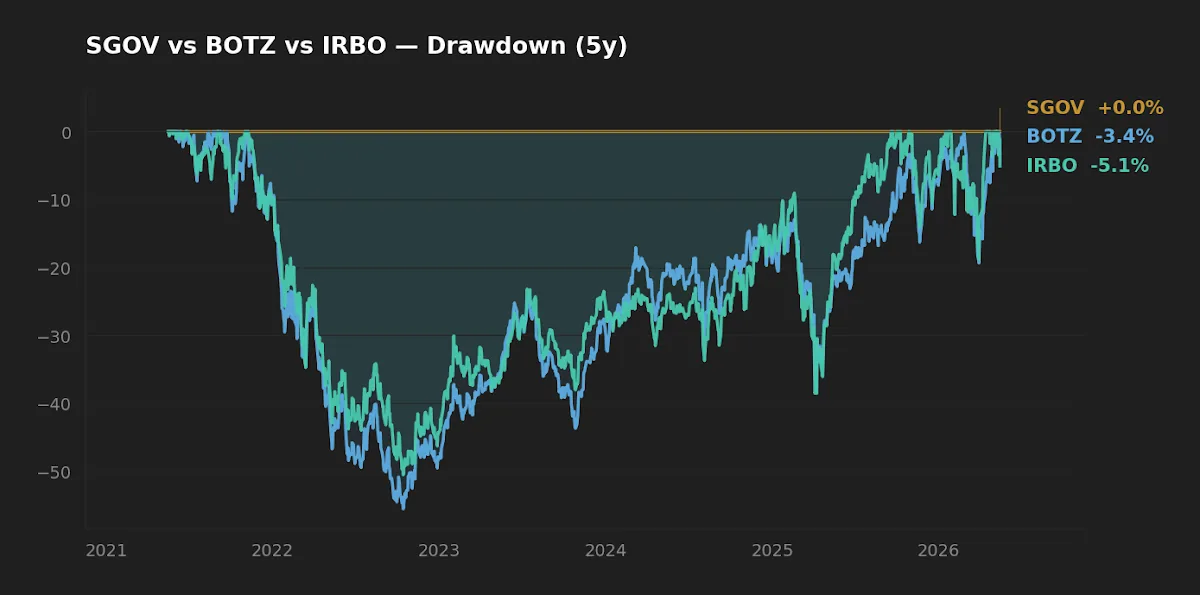
The drawdown chart is the cleanest visualization of why these instruments do different jobs. SGOV's worst trough across five years is barely visible — three basis points down at the deepest, which is closer to a rounding error than a loss. BOTZ and IRBO both spent extended periods 40-55% underwater, with the IRBO drawdown lasting well over a year in calendar time before fully recovering.
The implication for a long-term investor is not "avoid BOTZ and IRBO." It is that the realized risk of a thematic equity sleeve is large enough that any defensive sleeve needs to be sized to actually offset behavioral pressure during those drawdowns. A 5% SGOV position is not a meaningful psychological anchor against a 50% drawdown in a 40% thematic sleeve. A 15-20% defensive position can be — but at that allocation, the real-return drag becomes a portfolio-level decision rather than a footnote.
VIX at 17.3 (FRED, asof 2026-05-14) sits inside its long-run middle range, which is also worth noting. The high-vol drawdowns shown for BOTZ and IRBO did not occur during a particularly stressed equity tape; they occurred during a relatively orderly rate-driven repricing of duration-sensitive growth equity. Defensive sleeves earn their keep across those quieter dislocations as much as during overt crises.
Where gold fits — and where it does not
Gold and SGOV are often discussed together as "defensive assets," and the lazy version of that argument treats them as interchangeable. They are not. SGOV defends against the short-term liquidity problem — having to sell equities to fund a withdrawal or capture a re-entry. Gold defends against a different problem entirely: erosion of the unit of account.
If the concern is that the dollar itself loses purchasing power faster than nominal rates can compensate, SGOV does not help. The yield resets to the prevailing policy rate, but the policy rate is part of the system being debased. Gold, denominated outside any sovereign's balance sheet, is the textbook hedge against that specific risk. The trade-off is that gold has no yield, meaningful price volatility (around 15% annualized in recent windows), and a long history of multi-year flat stretches when no debasement materializes.
The case for holding both is not that one is "better." It is that the two assets hedge largely orthogonal risks, and an investor who only owns SGOV is implicitly betting that currency stability holds. For a deeper look at the gold-dollar relationship, see Gold, the Dollar, and Risk Assets in 2026, and for the head-to-head case, SGOV vs Gold ETFs: Two Defenses That Hedge Different Risks.
Scoreboard
| Category | Winner | Why |
|---|---|---|
| Cost | SGOV | 0.09% expense ratio vs 0.47-0.68% for the thematic peers |
| Realized risk (lowest) | SGOV | 0.2% vol, 0.03% max drawdown |
| Realized return (5Y) | IRBO | 11.1% CAGR — but at 28.3% vol and -50.5% drawdown |
| Defensive role | SGOV | Only fund here that meaningfully reduces portfolio variance |
FAQ
Q: Is SGOV better than a high-yield savings account right now?
A: At the current 3.9% distribution yield, the absolute level is comparable to the best HYSAs. The differences are operational. SGOV sits in a brokerage account (faster to deploy into equities), distributions are taxed as ordinary income (same as HYSA interest), and there is no FDIC insurance — though the underlying is short-dated US Treasury paper, which sits ahead of FDIC in credit terms.
Q: Why not use a longer-duration bond ETF like TLT or AGG for the defensive sleeve?
A: Different instrument, different job. TLT and AGG carry duration risk; TLT drew down more than 30% in the 2022 rate cycle. That can be the right exposure if the view is that rates fall and the investor wants the convexity, but it is not a defensive sleeve in any sense that survives a hiking cycle. SGOV is the no-view, no-duration option.
Q: How much SGOV (or cash equivalent) does the academic literature suggest holding?
A: There is no single number. Daryanani (2008) and Vanguard's 2024 rebalancing research both frame the question in terms of withdrawal needs and rebalancing frequency rather than a fixed percentage. The practical heuristic is: enough to cover anticipated withdrawals for the period over which the equity sleeve might be drawn down (typically one to three years), plus whatever opportunistic capital the investor actually has the discipline to deploy.
Q: Does SGOV have any credit risk?
A: The underlying holdings are direct US Treasury obligations under 90 days to maturity. The credit risk is the credit risk of the US government over a 90-day horizon, which is functionally the lowest-risk fixed income exposure available in dollars.
Q: Why include BOTZ and IRBO in a defensive-asset article?
A: Defensive sleeves do not exist in isolation. Their job is to offset the variance of the growth sleeve. Showing the realized drawdowns of two high-volatility thematic ETFs over the same window makes the case for the defensive allocation concrete — "what am I actually defending against" becomes visible rather than abstract.
What this comparison can and cannot tell you
The five-year window covers a zero-rate regime, a 525 bp hiking cycle, and the current higher-for-longer environment (10Y Treasury at 4.47% per FRED, asof 2026-05-14). It does not include a sustained deflationary shock, a sovereign debt crisis, or a period of negative real rates lasting more than two years. SGOV's behavior in any of those regimes would be qualitatively different. The 0.03% max drawdown is a statement about the regimes we have observed, not a guarantee about regimes we have not.
The thematic ETF comparison also reflects survivorship — BOTZ and IRBO are still trading. Several smaller AI and automation ETFs launched in the 2017-2020 window have closed. AUM scale matters for closure risk; IRBO's $0.8B is small enough that closure is a non-trivial tail risk to consider when sizing, even though the issuer (iShares) is unlikely to wind down a fund without orderly notice.
Scenarios where each fits
Long-horizon investor with stable income, 30-year horizon, all-equity core: A small SGOV sleeve (5-10%) functions as rebalancing capital. Real return is near zero but the optionality is the point.
Investor approaching withdrawals (within 3 years): A larger SGOV sleeve covering one to three years of planned withdrawals reduces sequence-of-returns risk in a way that long bonds cannot, because long bonds can themselves be drawn down at the wrong time.
Investor with significant thematic equity exposure (BOTZ, IRBO, or similar): The defensive sleeve has to be sized against the variance of what it is offsetting. A 5% defensive position against a 40% thematic position is mostly decorative.
Investor primarily worried about currency or debasement risk: SGOV is the wrong tool. A gold allocation, or a diversified-currency or real-asset allocation, addresses that risk more directly.
Editor's read
SGOV is one of the cleanest instruments in the ETF universe — it does exactly one thing, charges nine basis points to do it, and has the AUM scale ($85B) and issuer to make liquidity and closure risk near-zero concerns. The hard question is not whether to hold it but how much, and that question only answers itself once the variance of the growth sleeve and the realistic withdrawal horizon are both honest. Initially the temptation is to think of cash as a single bucket; in practice it is at least two — short-term liquidity and currency hedge — with different instruments and different jobs. Treating them as interchangeable is the most common framing error.
The editor holds short-duration Treasury exposure of the type discussed; does not hold BOTZ or IRBO at the time of writing.
Methodology
Price and return data: yfinance, pulled 2026-05-17. Realized volatility and max drawdown computed over the trailing five-year daily return series; CAGR computed over the same window. Expense ratio, AUM, and inception date sourced from issuer fact sheets linked above. Macro figures (10Y Treasury, Fed funds rate, CPI YoY, VIX): FRED, asof dates noted inline. The portfolio-construction reasoning around cash buffers and rebalancing draws on Daryanani (2008) and Vanguard's 2024 research on rebalancing bands; specific allocation choices remain investor-specific.
For related framework analysis, see Why Capital Preservation Is the Secret to Winning with Leveraged Assets and Why VOO Is Not Enough: The Math Behind Adding AVUV and VXUS.
This article is for educational purposes and does not constitute personalized financial advice. See full Disclaimer.