
The short version
- With SGOV's distribution yield at 3.9% and the 10-year Treasury at 4.47% (FRED, asof 2026-05-14), the opportunity cost of holding non-yielding gold is structurally higher than it was in the 2010-2021 zero-rate regime.
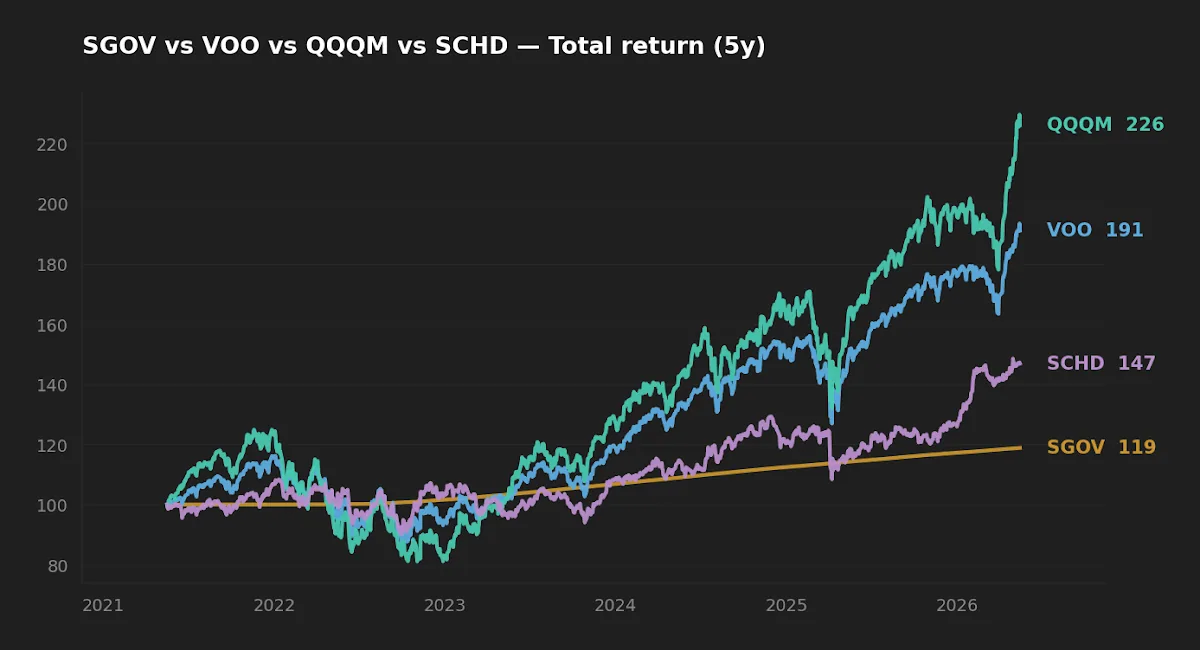
- Over the trailing five years, SGOV delivered a 3.5% CAGR with a maximum drawdown of -0.0%; QQQM delivered 17.6% with a -35.0% drawdown. The defensive sleeve's job is not to compete with that 17.6% — it is to make the -35.0% survivable.
- Gold and SGOV hedge different risks. Treating them as interchangeable defensive assets is the most common sizing error in the retail coverage the editor has reviewed.
The question for 2026 is not whether to hold a defensive sleeve. With short-duration Treasuries paying close to 4% and the 10-year above 4.4%, cash-equivalents are no longer a tax on the portfolio. The question is what the sleeve should contain, and what each component is actually hedging.
This piece works through the trailing five-year numbers for SGOV against three risk-asset benchmarks (VOO, QQQM, SCHD), then turns to gold — for which a clean ticker pull was not available in this data run, so that discussion stays qualitative and references the broader literature.
Why the defensive question changed in 2026
From 2009 through 2021, the U.S. short rate was effectively zero for most months. In that regime, cash was a steady drag. The defensive sleeve had to be justified entirely on optionality: it was there so you could buy the next drawdown, not because it earned anything on its own.
That has shifted. As of mid-May 2026, the FRED prints read: fed funds 3.64%, 10-year Treasury 4.47%, CPI year-on-year 3.95% (asof dates: 2026-04-01 for fed funds and CPI; 2026-05-14 for the 10Y). Real short yields are close to zero — sometimes slightly positive, sometimes slightly negative depending on the month — but the absolute nominal yield on cash is now competitive with what dividend equity ETFs pay. SCHD's distribution yield is 3.3%; SGOV's is 3.9%. The defensive sleeve currently out-yields the dividend sleeve. That inversion is not common, and it changes the rebalancing arithmetic in ways most retail commentary has not caught up with.
Gold, by contrast, pays nothing. In a zero-rate world, that costs you nothing. In a 4% world, it costs roughly 4% a year in opportunity cost — which gold has to make up through price appreciation just to keep pace. This is the structural headwind framed in the academic literature on real yields and gold, and it is the core reason gold has not behaved during the recent geopolitical cycle the way some retail commentary expected. A more detailed look at the mechanism is in an earlier piece on what SGOV and gold actually do.
The data: SGOV versus the risk assets it protects
Five-year metrics below. Price and return computed from yfinance daily adjusted-close data, pulled 2026-05-17. Expense ratio and AUM from issuer fact sheets.
| Ticker | Role | ER | AUM | Yield | 5Y CAGR | 5Y Vol | 5Y Max DD |
|---|---|---|---|---|---|---|---|
| SGOV | Defensive (0-3M T-bills) | 0.09% | $85.2B | 3.9% | 3.5% | 0.2% | -0.0% |
| VOO | US large-cap core | 0.03% | $1,600.2B | 1.1% | 13.9% | 16.8% | -24.5% |
| QQQM | US large-cap growth | 0.15% | $82.9B | 0.5% | 17.6% | 22.3% | -35.0% |
| SCHD | US dividend value | 0.06% | $91.1B | 3.3% | 8.2% | 14.4% | -16.8% |
Fact-sheet sources: iShares SGOV, Vanguard VOO, Invesco QQQM, Schwab SCHD.
Two observations worth pausing on. First, SGOV's 5-year realized volatility of 0.2% is lower than its current distribution yield — which is what a Treasury bill ladder is supposed to look like, but is worth showing in numbers because many "low-risk" labels in retail content are not this clean. Second, SGOV's roughly zero maximum drawdown over five years includes the 2022 rate-shock period that detonated longer-duration bond funds. The short end did exactly what the duration math predicted; AGG and BND did not.
The dividend yield gap between SGOV (3.9%) and SCHD (3.3%) is the non-obvious detail of this snapshot. SCHD is delivering equity-like total return — 8.2% CAGR over five years, 12.7% over ten — but its current distribution yield is below the bill yield. A reader rebalancing on yield alone would rotate from SCHD into SGOV today, which is not what either fund's role in a long-horizon allocation actually calls for. Yield is a current-condition metric; role is a multi-cycle one. Confusing the two is a common source of trouble.

Realized risk: what the drawdown chart shows
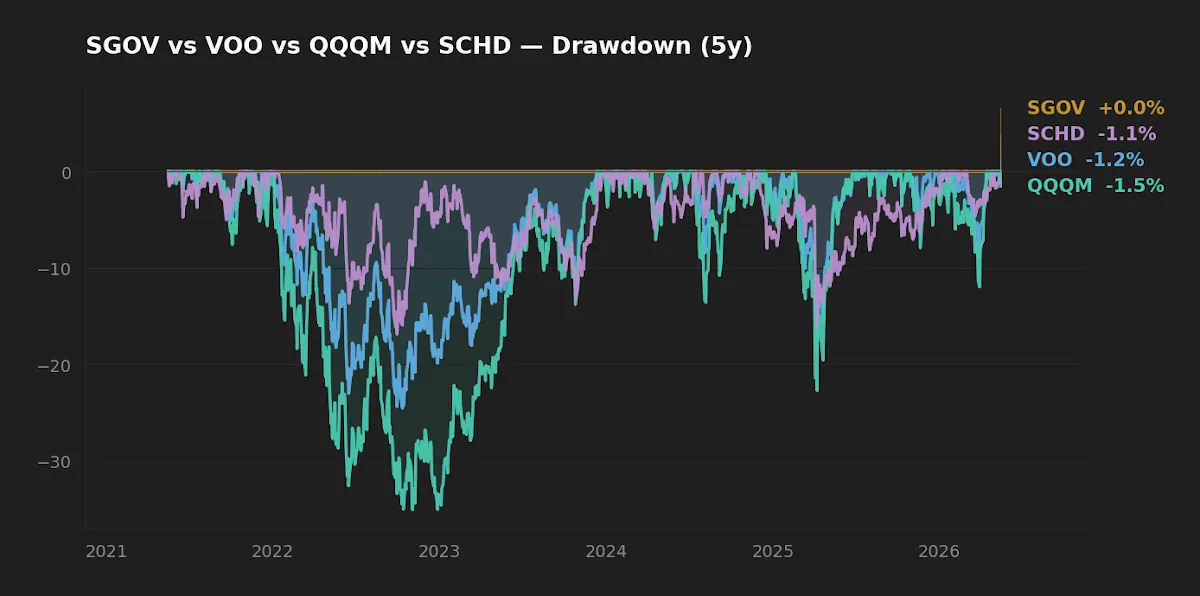
The drawdown chart is the more honest picture of why a defensive sleeve exists. QQQM's -35.0% peak-to-trough drop is not unusual for a concentrated growth index — the 2000-2002 NASDAQ-100 drawdown was deeper and lasted longer. Investors who hold QQQM as a core holding need to have settled, ahead of time, what they will do when that pattern repeats; behaviorally, the worst time to plan is mid-drawdown.
VOO's -24.5% is in the normal range for the S&P 500. SCHD's -16.8% confirms that dividend-value's drawdowns are typically shallower than market-cap-weighted growth — a finding consistent with the broader factor literature on value's defensive characteristics within equity-only universes.
SGOV's roughly zero maximum drawdown is the relevant number for sleeve-sizing math. If a 10% SGOV allocation sits alongside a 90% equity sleeve during a -30% equity drawdown, the blended drawdown is roughly -27% — a modest absolute improvement. The more important effect is operational: the SGOV sleeve is still liquid at its original NAV when the equity sleeve hits its rebalancing band. That is what funds the rebalance.
Yield is a current-condition metric; role is a multi-cycle one. Rebalancing on yield alone — selling SCHD because SGOV currently pays more — is the most common way a long-horizon allocation gets quietly re-engineered into something else.
Gold: what can honestly be said in this data run

The yfinance pull for this article did not include a gold ETF (GLD or IAU), so the quantitative comparison stops at SGOV. What can be said with confidence from the broader literature and current macro data:
Gold hedges a different risk than SGOV. SGOV hedges equity drawdown by holding nominal stability. Gold has historically hedged currency debasement and tail events that materialize as a loss of confidence in fiat — episodes where short-term Treasuries themselves may be the asset under question. In a 2008-style banking stress, both performed defensively. In a 2022-style inflation-driven rate shock, SGOV held NAV and reset to the new yield; gold's behavior was more idiosyncratic.
The "digital gold" question — whether bitcoin has cannibalized some of the marginal flow that would historically have moved into gold during geopolitical episodes — is a real open question in the institutional literature, but the data is regime-thin. Two completed cycles is not enough to declare a structural shift. A more durable framing: gold and bitcoin compete partially for the same allocator dollar, but they are not substitutes inside a defensive sleeve, because bitcoin's realized volatility is roughly an order of magnitude higher than gold's. Treating them interchangeably mis-sizes the sleeve.
For readers thinking through the gold side in more detail, the precious metals ETF guide covers the implementation choices (GLD versus IAU versus physical, expense and storage trade-offs) in more depth than space here permits.
Sizing and rebalancing: making the sleeve do work

A defensive sleeve does no real work unless it triggers behavior. Sitting in SGOV through a -30% equity drawdown and not buying anything yields the same outcome as having held cash from the start — only with the added regret of "I had the powder and I didn't use it." This is where rebalancing discipline does most of its compounding.
The editor uses an in-house portfolio review framework grounded in the rebalancing literature — Daryanani's 2008 work on tolerance bands and Vanguard's 2024 update on the cost-benefit of various rebalancing rules. The operating rule is band-based: when an asset class drifts beyond a pre-set tolerance (commonly ±15% relative for core holdings, ±25% relative for satellite sleeves), the position resets toward target. The defensive sleeve's purpose is to be the source of dry powder when the equity bands breach downward — which by construction tends to coincide with the moments when reading the financial press is most uncomfortable.
For readers building this muscle, an earlier piece on rebalancing a two-layer portfolio without emotion walks through the mechanics. A 5-15% defensive sleeve is the typical reasonable range for long-horizon investors with stable income and 15+ year horizons. The exact number depends on individual circumstances and is not the kind of decision that benefits from a universal rule.
Scoreboard
| Category | Winner | Reason |
|---|---|---|
| Lowest expense ratio | VOO (0.03%) | SGOV at 0.09% is reasonable for the role; SCHD 0.06% leads its category. |
| Lowest realized drawdown | SGOV (-0.0%) | Five years including the 2022 rate shock. |
| Highest realized 5Y CAGR | QQQM (17.6%) | At the cost of a -35.0% drawdown and 22.3% volatility. |
| Best yield-to-risk in defensive role | SGOV | 3.9% distribution with 0.2% realized volatility. |
| Best long-horizon dividend tilt | SCHD | 10-year CAGR of 12.7% with -16.8% max drawdown. |
FAQ
Is SGOV functionally equivalent to cash? Close, not identical. SGOV holds 0-3 month Treasury bills, distributes interest monthly, and its NAV oscillates within a few cents of par. It is subject to the 0.09% expense ratio and a small bid-ask spread, neither of which apply to a true cash holding. For long-horizon investors trading during normal U.S. market hours, the spread cost is negligible.
Does SGOV beat a high-yield savings account? It depends on the savings account and on tax treatment. SGOV distributions are predominantly U.S. Treasury interest, which is typically exempt from state and local income tax in the U.S. — meaningful in high-tax-state accounts. A high-yield savings account's APY is fully taxable at both federal and state level. The right comparison is after-tax, not headline rate.
Should I replace gold with SGOV? They hedge different things. SGOV hedges nominal portfolio volatility; gold hedges currency and tail events that SGOV cannot. A reader who wants both can split the defensive sleeve — for example, two-thirds SGOV and one-third gold — but the right split is a personal allocation decision driven by risk tolerance and horizon, not a universal rule.
What about duration risk in longer-dated bond funds like AGG? AGG's intermediate duration (around six years) means it loses value when rates rise, as observed in 2022. SGOV's effective duration is under three months, so its rate sensitivity is structurally limited. That is exactly why SGOV's 5Y max drawdown is essentially zero while AGG's was double-digit in 2022.
If yields fall, does SGOV become a bad holding? SGOV's distribution yield resets monthly to the prevailing short rate, so its yield falls with the policy rate. NAV stays close to par. The role does not change — it remains the defensive sleeve — but the yield contribution to total return shrinks. In a low-rate regime, the sleeve is justified almost entirely on optionality value, as it was for most of 2009-2021.
What this comparison can and can't tell you
Three honest limits. First, five years is a single regime — a post-COVID expansion bookended by one rate shock and one growth-driven bull. Conclusions about multi-decade behavior must lean on the broader literature, not on this window alone. Second, the dataset does not include a gold ETF for this run, so the gold discussion is qualitative and points back to prior pieces. Third, all the CAGR and drawdown numbers are realized — a single sample path. Realized return is not the same as expected return, and survivorship bias in any backward-looking ETF comparison is real: closed funds do not appear in the data.
Where each piece fits
A reader in their 30s, fully employed, 25+ year horizon, no current bond or cash allocation: 5-10% SGOV is a reasonable starting point — small enough not to drag long-horizon return materially, large enough to fund a rebalance during a major drawdown. A reader nearing or in retirement: the defensive sleeve usually scales up (often 20-40% across cash, SGOV, and longer-duration bonds, depending on income needs and risk tolerance). A reader with concentrated equity exposure from employer stock: SGOV is one of the cleanest places to hold the proceeds of any tax-aware sell-down, given its liquidity and state-tax treatment.
Editor's read
The defensive sleeve in 2026 is doing something it could not do for most of the prior decade: it is paying you to wait. The discipline question is whether you can keep that yield from quietly reshaping the rest of the allocation. The editor's view: SGOV earns its place on optionality first, yield second. Gold sits in a different category — a hedge against the things SGOV cannot hedge — and is sized accordingly, modestly, with no expectation that it tracks equities. Neither asset is the point. The point is that the equity sleeve survives long enough to do its work.
Disclosure: the editor's defensive allocation includes SGOV; gold exposure is held in a separate sleeve. Specific holdings and sizing are not disclosed.
Methodology
Price, total return, dividend yield, NAV, five-year CAGR, realized volatility, and maximum drawdown computed from yfinance daily adjusted-close data, pulled 2026-05-17. Expense ratio, AUM, and inception dates from the linked issuer fact sheets. Macro context (10-year Treasury, fed funds rate, VIX, CPI year-on-year) from FRED, with asof dates labeled inline. Rebalancing framework references: Daryanani (2008), "Opportunistic Rebalancing"; Vanguard (2024), "Best practices for portfolio rebalancing." A gold ETF was not included in this data pull; the gold section is qualitative.
This article is for educational purposes and does not constitute personalized financial advice. See full Disclaimer.